MCQ
A particle moves along $x$-axis as $x=4(t-2)+a(t-2)^2$. Which of the following statements is true?
  • A
    The initial velocity of particle is $4$
  • The acceleration of particle is $2\,a$
  • C
    The particle is at origin at $t=0$
  • D
    None of the above

Answer

Correct option: B.
The acceleration of particle is $2\,a$
b
(b)

$x=4(t-2)+a(t-2)^2$

At $t=0, x=-8+4 a=4 a-8$

$v=\frac{d x}{d t}=4+2 a(t-2)$

At $t=0, \quad v=4-4 a=4(1-a)$

But acceleration, $\frac{d^2 x}{d t^2}=2 a$

Need a full question paper?

Generate a complete, print-ready paper with questions like this in minutes — across 16+ boards, with answer keys.
Start Generating Free

Similar questions

Which of the following quantities remains constant during uniform circular motion?
Two identical flutes produce fundamental notes of frequency $300 Hz$ at ${27^o} C.$ If the temperature of air in one flute is increased to ${31^o}$C, the number of the beats heard per second will be
Consider three quantities $\text{x}=\frac{\text{E}}{\text{B}},\ \text{y}=\sqrt{\frac{1}{\mu_0\in_0}}$ and $\text{z}=\frac{1}{\text{CR}}.$ Here, $l$ is the length of a wire, $C$ is a capacitance and $R$ is a resistance. All other symbols have standard meanings.
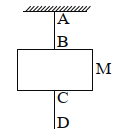
An object of mass $M$ is hung by a thread $A B$ and thread CD is hanging below the object. If end D is pulled down with a jerk then :
Image
According to the experiment of Ingen Hausz the relation between the thermal conductivity of a metal rod is $ K$ and the length of the rod whenever the wax melts is
Water falls from a height of $210\,m.$ Assuming whole of energy due to fall is converted into heat the rise in temperature of water would be   .......... $^oC$  $(J = 4.3 \,Joule/cal)$
A block is placed on a rough horizontal plane. A time dependent horizontal force $F = kt$ acts on the block, where $k$ is a positive constant. The acceleration - time graph of the block is
A stone is released from a hot air balloon which is rising steadily with a velocity of $4ms^{-1}.$ The velocity of the stone at the end of $3s$ after it is released is $......... ms^{-1}$
A chain of length $L$ rests on a rough table. If $\mu $ be the coefficient of friction, the maximum friction of the chain that can hang over the table will be
A body is dropped from a height $H$. The time taken to cover second half of the journey is ............