MCQ
Two identical flutes produce fundamental notes of frequency $300 Hz$ at ${27^o} C.$ If the temperature of air in one flute is increased to ${31^o}$C, the number of the beats heard per second will be
  • A
    $1$
  • $2$
  • C
    $3$
  • D
    $4$

Answer

Correct option: B.
$2$
b
(b) Velocity of sound increases if the temperature increases.

So with $v = n\lambda $, if $v$ increases $n$ will increase at

${27^o}C,\,{v_1} = n\lambda $, at ${31^o}C\,,\,\,{v_2} = (n + x)\lambda $

Now using $v \propto \sqrt T $         $(\because v= \sqrt{\frac{{\gamma \,R\,T}}{{M}}})$

$\frac{{{v_2}}}{{{v_1}}} = \sqrt {\frac{{{T_2}}}{{{T_1}}}} = \frac{{n + x}}{n}$

==> $\frac{{300 + x}}{{300}} = \sqrt {\frac{{(273 + 31)}}{{(273 + 27)}}} = \sqrt {\frac{{304}}{{300}}} = \sqrt {\frac{{300 + 4}}{{300}}} $

==> $1 + \frac{x}{{300}} = {\left( {1 + \frac{4}{{300}}} \right)^{1/2}} = \left( {1 + \frac{1}{2} \times \frac{4}{{300}}} \right)\,$                $[\because {(\,1 + x)^n} = 1 + nx]$

==> $x = 2.$

Need a full question paper?

Generate a complete, print-ready paper with questions like this in minutes — across 16+ boards, with answer keys.
Start Generating Free

Similar questions

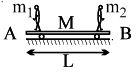
Two persons of mass $m_1$ and $m_2$ are standing at the two ends $A$ and $B $ respectively, of $a$ trolley of mass $M$ as shown. When both the persons jump simultaneously with urel with respect to the trolley, then the velocity of the trolley is
Two particles $A$ and $B$ initially at rest, move towards each other, under mutual force of attraction. At an instance when the speed of $A$ is $v$ and speed of $B$ is $2v,$ the speed of centre of mass $(CM)$ is:
Two identical beakers $A$ and $B$ contain equal volumes of two different liquids at $60\,^oC$ each and left to cool down. Liquid in $A$ has density of $8 \times10^2\, kg / m^3$ and specific heat of $2000\, Jkg^{-1}\,K^{-1}$ while liquid in $B$ has density of $10^3\,kgm^{-3}$ and specific heat of $4000\,JKg^{-1}\,K^{-1}$ . Which of the following best describes their temperature versus time graph schematically? (assume the emissivity of both the beakers to be the same)
The velocity of a particle is zero at $t = 0.$
  1. The acceleration at $t = 0$ must be zero.
  2. The acceleration at $t = 0$ may be zero.
  3. If the acceleration is zero from $t = 0$ to $t = 10s,$ the speed is also zero in this interval.
  4. If the speed is zero from $t = 0$ to $t = 10s$ the acceleration is also zero in this interval.
A soap bubble assumes a spherical surface. Which of the following statement is wrong
From an automatic gun a man fires $ 360$  bullet per minute with a speed of $360 km/hour$. If each weight  $ 20 g, $ the power of the gun is......$W$
A bullet of mass $50 \mathrm{~g}$ is fired with a speed $100 \mathrm{~m} / \mathrm{s}$ on a plywood and emerges with $40 \mathrm{~m} / \mathrm{s}$. The percentage loss of kinetic energy is :
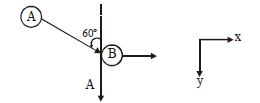
Ball $A$ moving at $12\  m/s$ collides elastically with $B$ as shown. If both balls have the same mass, what is the final velocity of ball $A$ ? ................$m/s$
Given below are two statements: one is labelled as Assertion $A$ and the other is labelled as Reason $R$

Assertion $A$: Steel is used in the construction of buildings and bridges.

Reason $R:$ Steel is more elastic and its elastic limit is high.

In the light of above statements, choose the most appropriate answer from the options given below

A dimensionless quantity: