MCQ
A particle moves in a circle of radius $25\,cm$ at two revolutions per sec. The acceleration of the particle in $m/s^2$ is
  • A
    $\pi ^2$
  • B
    $8\pi ^2$
  • $4\pi ^2$
  • D
    $2\pi ^2$

Answer

Correct option: C.
$4\pi ^2$
c
$\mathrm{r}=25 \times 10^{-2} \mathrm{m}, \mathrm{f}=2 / \mathrm{sec}$

$\therefore \quad \omega=2 \pi f=4 \pi \mathrm{rad} / \mathrm{sec}$

Acceleration $=\omega^{2} \mathrm{r}=(4 \pi)^{2} \times 25 \times 10^{-2}$

$=16 \times 25 \times 10^{-2} \pi^{2} \mathrm{m} / \mathrm{s}^{2}=4 \pi^{2} \mathrm{m} / \mathrm{s}^{2}$

Need a full question paper?

Generate a complete, print-ready paper with questions like this in minutes — across 16+ boards, with answer keys.

Start Generating Free

Similar questions

Two Carnot engines $A$ and $B$ are operated in succession. The first one, $A$ receives heat from a source at ${T_1} = 800K$ and rejects to sink at ${T_2}K.$. The second engine $B$ receives heat rejected by the first engine and rejects to another sink at ${T_3} = 300K.$ If the work outputs of two engines are equal, then the value of ${T_2}$ is .... $K$
In an experiment with a beam balance on unknown mass $m$ is balanced by two known mass $m$ is balanced by two known masses of $16\, kg$ and $4\, kg$ as shown in figure. The value of the unknown mass $m$ is ....... $kg$.
The upper end of a wire of radius $4\ mm$ and length $100\ cm$ is clamped and its other end is twisted through an angle of $30^\circ .$ The angle of shear is:
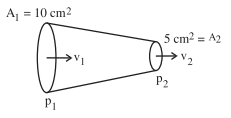
Glycerine of density $1.25 \times 10^3\,kg\,m ^{-3}$ is flowing through the conical section of pipe. The area of cross-section of the pipe at its ends is $10\,cm ^2$ and $5\,cm ^2$ and pressure drop across its length is $3\,Nm ^{-2}$. The rate of flow of glycerine through the pipe is $x \times 10^{-5} m ^3 s ^{-1}$. The value of $x$ is $..............$.
The amount of energy required to form a soap bubble of radius $2\,cm$ from a soap solution is nearly $..........\,\times 10^{-4}\,J$: (surface tension of soap solution $=0.03\,N\,m ^{-1}$ )
A thin circular ring of mass $M$ and radius $r$ is rotating about its axis with an angular speed $\omega.$ Two particles having mass $m$ each are now attached at diametrically opposite points. The angular speed of the ring will become:
A surface of area $S$ is placed perpendicular to the direction of travel of a plane wave. The energy per unit time intercepted by the surface is $E$ when the amplitude of the wave is $A$ . The area of the surface is reduced to $\frac{1}{2} \ S$ and the amplitude of the wave is increased to $2\ A$ . What is the energy per unit time intercepted by this smaller surface?
A block slides down a smooth inclined plane when released from the top, while another falls freely from the same point
Let p and E denote the linear momentum and energy of a photon. If the wavelength is decreased:
The temperature at which the vapour pressure of a liquid becomes equals to the external (atmospheric) pressure is its