MCQ
A particle moves on a straight line with a uniform velocity. Its angular momentum:
  • A
    About any given point remains constant.
  • B
    Is zero about a point on the straight line.
  • C
    Is not zero about a point away from the straight line.
  • All of the above

Answer

Correct option: D.
All of the above
Angular momentum $=\text{m}\Big(\overrightarrow{\text{r}}\times\overrightarrow{\text{v}}\Big)$
If the point is on the straight line, $\overrightarrow{\text{r}}$ and $\overrightarrow{\text{v}}$ will have the same direction and their cross product will be zero. Hence, angular momentum is zero.
If the point is not on the straight line, $\overrightarrow{\text{r}}$ and $\overrightarrow{\text{v}}$ will not have the same direction and their cross product will not be zero. Hence, angular momentum is non$-$zero.
No external torque is applied on the body; therefore, its angular momentum about any given point remains constant.

Need a full question paper?

Generate a complete, print-ready paper with questions like this in minutes — across 16+ boards, with answer keys.

Start Generating Free

Similar questions

If two waves of same frequency and same amplitude respectively, on superimposition produced a resultant disturbance of the same amplitude, the waves differ in phase by
The greatest height to which a man can throw a stone is $h$. The greatest distance to which he can throw it, will be
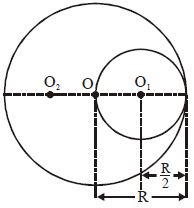
A spherical hollow is made in a lead sphere of radius $R,$ such that its surface touches the outside surface of lead sphere and passes through the centre. What is the shift in the centre of mass of lead sphere due to the following ?
Two satellites of masses $m_1$ and $m_2$ $(m_1 > m_2)$ are revolving round the earth in circular orbits of radii $r_1$ and $r_2(r_1 > r_2)$ respectively. Which of the following statements is true regarding their speeds $v_1$ and $v_2$.
If the earth rotates faster than its present speed, the weight of an object will
The component of vector $\vec A = 2\hat i + 3\hat j$ along the vector $\hat i + \hat j$ is
A ball of mass $0.5\, kg$ moving with a velocity of $2\, m/sec$ strikes a wall normally and bounces back with the same speed. If the time of contact between the ball and the wall is one millisecond, the average force exerted by the wall on the ball is ........ $newton$
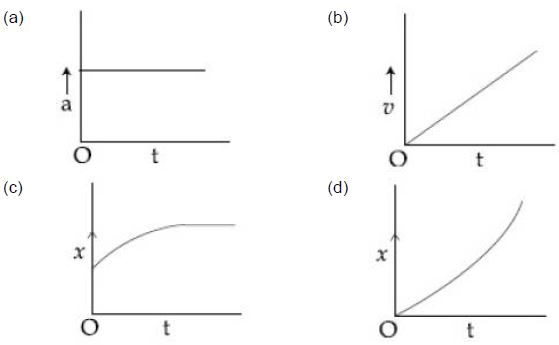
A particle starts from origin $O$ from rest and moves with a uniform acceleration along the positive $x -$ axis. Identify all figures that correctly represent the motion qualitatively. ($a =$ acceleration, $v =$ velocity, $x =$ displacement, $t =$ time)
Two particles which are initially at rest, move towards each other under the action of their internal attraction. If their speeds are $v$ and $2v$ at any instant, then the speed of centre of mass of the system will be
A body under the action of a force $\vec F = 6\hat i - 8\hat j\,N$ acquires an acceleration of $5\, ms^{-2}$. The mass of the body is