MCQ
The component of vector $\vec A = 2\hat i + 3\hat j$ along the vector $\hat i + \hat j$ is
  • $\frac{5}{{\sqrt 2 }}$
  • B
    $10\sqrt 2 $
  • C
    $5\sqrt 2 $
  • D
    $5$

Answer

Correct option: A.
$\frac{5}{{\sqrt 2 }}$
a
Let $\overrightarrow{\mathrm{A}}=2 \hat{\mathrm{i}}+3 \hat{\mathrm{j}}$ and $\overrightarrow{\mathrm{B}}=\hat{\mathrm{i}}+\hat{\mathrm{j}}$

Component of $\vec{\mathrm{A}}$ in direction of $\overrightarrow{\mathrm{B}}=\frac{(\overrightarrow{\mathrm{A}} \cdot \overrightarrow{\mathrm{B}}) \overrightarrow{\mathrm{B}}}{\mathrm{B}^{2}}$

$=\frac{(2 \times 1+3 \times 1)(\hat{i}+\hat{j})}{2}=\frac{5}{2}(\hat{i}+\hat{j})$

Magnitude of component $=\frac{5}{\sqrt{2}}$

Need a full question paper?

Generate a complete, print-ready paper with questions like this in minutes — across 16+ boards, with answer keys.

Start Generating Free

Similar questions

A bomb of mass $1\ kg$ is thrown vertically upwards with a speed of $100\ m/s.$ After $5$ seconds, it explodes into two fragments. One fragment of mass $400\ gm$ is found to go down with a speed of $25\ m/s.$ What will happen to second fragment just after explosion? $(g = 10\ m/s^2).$
$Assertion$ : $n$ small balls each of mass $m$ colliding elastically each second on surface with velocity $u$. The force experienced by the surface is $2\,mnu$.

$Reason$ : On elastic collision, the ball rebounds with the same velocity.

$Assertion :$ The heat supplied to a system is always equal to the increase in its internal energy.
$Reason :$ When a system changes from one thermal equilibrium to another, some heat is absorbed by it.
For a simple pendulum, a graph is plotted between its kinetic energy $(KE)$ and potential energy $(PE)$ against its displacement $d.$ Which one of the following represents these correctly ? (graphs are schematic and not drawn to scale)
The escape velocity of a body on the surface of the earth is $11.2 \,km/s$. If the earth's mass increases to twice its present value and the radius of the earth becomes half, the escape velocity would become ......... $km/s$
Which of the following is not a vector quantity?
There are two planets. The ratio of radius of the two planets is K but ratio of acceleration due to gravity of both planets is g. What will be the ratio of their escape velocity
A particle is projected from ground with speed $80 \,m / s$ at angle $30^{\circ}$ with horizontal from ground. The magnitude of average velocity of particle in time interval $t=2 \,s$ to $t=6 \,s$ is ....... $m / s$ [Take $g=10 \,m / s ^2$ ]
If one wants to remove all the mass of the earth to infinity in order to break it up completely. The amount of energy that needs to be supplied will be $\frac{x}{5}\, \frac{ GM ^{2}}{ R }$ where $x$ is $\quad\,..........$ (Round off to the Nearest Integer)

($M$ is the mass of earth, $R$ is the radius of earth, $G$ is the gravitational constant)
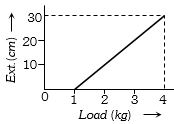
The pointer reading v/s load graph for a spring balance is as given in the figure. The spring constant is ........ $ kg/cm$