Question
A particle moves with a constant velocity parallel to the X-axis. Its angular momentum with respect to the origin:
  1. Is zero.
  2. Remains constant.
  3. Goes on Increasing.
  4. Goes on decreasing.

Answer

  1. Remains constant.
Explanation:
For angular momentum. we have:
$\overrightarrow{\text{L}}=\text{m}\Big(\overrightarrow{\text{r}}\times\overrightarrow{\text{v}}\Big)$
$\overrightarrow{\text{v}}=\text{v}\hat{\text{i}}$ and $\overrightarrow{\text{r}}=\text{x}\hat{\text{i}}+\text{y}\hat{\text{j}}$
So, $\overrightarrow{\text{L}}=-\text{mvy}\hat{\text{k}}$
m, v and y are constant; therefore, angular momentum remains constant.

Need a full question paper?

Generate a complete, print-ready paper with questions like this in minutes — across 16+ boards, with answer keys.

Start Generating Free

Similar questions

The ratio of intensities of two waves are given by 4 : 1. The ratio of the amplitudes of the two waves is(a) 2 : 1(b) 1 : 2(c) 4 : 1(d) 1 : 4
       
Unlike charges _____ each other.
The velocity of light emitted by a source $S$ observed by an observer $O,$ who is at rest with respect to $S$ is $c.$ If the observer moves towards $S$ with velocity $v,$ the velocity of light as observed will be
An inductor, a resistance and a capacitor are joined in series with an $AC$ source. As the frequency of the source is slightly increased from a very low value, the reactance:
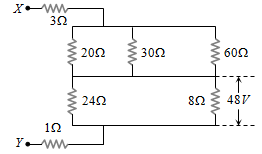
The potential difference across $8$ ohm resistance is $48$ volt as shown in the figure. The value of potential difference across $X$ and $Y$ points will be
Kinetic energy of emitted cathode rays is dependent on(a) Only voltage(b) Only work function(c) Both (a) and (b)(d) It does not depend upon any physical quantity


A point source of light is used in a photoelectric effect. If the source is removed farther from the emitting metal, the stopping potential:
Refractive index of material is equal to tangent of polarising angle. It is called (a) Brewster’s law(b) Lambert’s law(c) Malus’s law(d) Bragg’s law
       
How should people wearing spectacles work with a microscope? 
Sinusoidal carrier voltage of frequency $1.5\ \text{MHz}$ and amplitude $50\ V$ is amplitude modulated by sinusoidal voltage of frequency $10\ \text{kHz}$ producing $50\%$ modulation. The lower and upper side$-$band frequencies in $\text{kHz}$ are