Question types

Rotational Mechanics question types

149 questions across 6 question groups — pick any mix to generate a Physics paper with step-by-step answer keys.

149
Questions
6
Question groups
5
Question types
Sample Questions

Rotational Mechanics questions

One sample from each question group in this chapter. Select any group above to see the full set with answer keys.

A particle moves on a straight line with a uniform velocity. Its angular momentum:
  1. Is always zero.
  2. Is zero about a point on the straight line.
  3. Is not zero about a point away from the straight line.
  4. About any given point remains constant.
View full solution
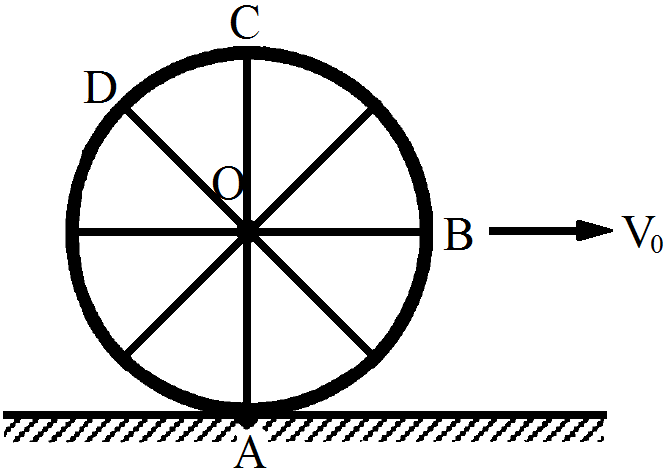
Consider a wheel of a bicycle rolling on a level road at a linear speed $v_0:$
  1. The speed of the particle $A$ is zero.
  2. The speed of $B, C$ and $D$ are all equal to $v_0.$
  3. The speed of $C$ is $2v_0.$
  4. The speed of $B$ is greater than the speed of $O.$
View full solution
Consider the following two equations:
  1. $\text{L}=\text{I}\omega$
  2. $\frac{\text{dL}}{\text{dt}}=\Gamma$
In noninertial frames:
  1. Both A and Bare true.
  2. A is true but B is false.
  3. B is true but A is false.
  4. Both A and Bare false.
View full solution
A hollow sphere and a solid sphere having same mass and same radii are rolled down a rough inclined plane:
  • A
    The hollow sphere reaches the bottom first.
  • The solid sphere reaches the bottom with greater speed.
  • C
    The solid sphere reaches the bottom with greater kinetic energy.
  • D
    The two spheres will reach the bottom with same linear momentum.

Answer: B.

View full solution
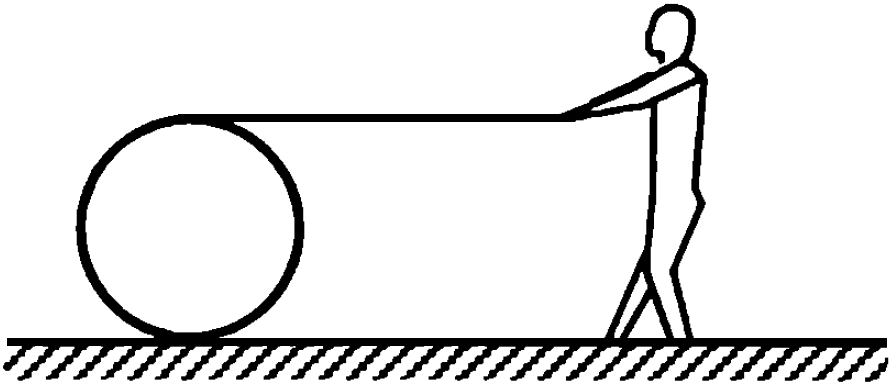
A string of negligible thickness is wrapped several times around a cylinder kept on a rough horizontal surface. A man standing at a distance $1$ from the cylinder holds one end of the string and pulls the cylinder towards him. There is no slipping anywhere. The length of the string passed through the hand of the man while the cylinder reaches his hands is:
  • A
    $l$
  • $2l$
  • C
    $3l$
  • D
    $4l$

Answer: B.

View full solution
When a body is weighed on an ordinary balance we demand that the arm should be horizontal if the weights on the two pans are equal. Suppose equal weights are put on the two pans, the arm is kept at an angle with the horizontal and released. Is the torque of the two weights about the middle point (point of support) zero? Is the total torque zero? If so, why does the arm rotate and finally become horizontal?
View full solution
A rectangular brick is kept on a table with a part of its length projecting out. It remains at rest if the length projected is slightly less than half the total length but it falls down if the length projected is slightly more than half the total length. Give reason.
View full solution
A simple pendulum is a point mass suspended by a light thread from a fixed point. The particle is displaced towards one side and then released. It makes small oscillations. Is the motion of such a simple pendulum a pure rotation? If yes, where is the axis of rotation?
View full solution
Suppose the platform of the previous problem is brought to rest with the ball in the hand of the kid standing on the rim. The kid throws the ball horizontally to his friend in a direction tangential to the rim with a speed v as seen by his friend. Find the angular velocity with which the platform will start rotating.
View full solution
A heavy particle of mass m falls freely near the earth's surface. What is the torque acting on this particle about a point 50cm east to the line of motion? Does this torque produce any angular acceleration in the particle?
View full solution
Find the moment of inertia of a pair of spheres, each having a mass m and radius r, kept in contact about the tangent passing through the point of contact.
View full solution
Because of the friction between the water in oceans with the earth's surface, the rotational kinetic energy of the earth is continuously decreasing. If the earth's angular speed decreases by $0.0016\ rad/ day$ in $100$ years, find the average torque of the friction on the earth. Radius of the earth is $6400\ km$ and its mass is $6.0 \times 10^{24}kg.$
View full solution
Q 163 Marks Question3 Marks
A cylinder rotating at an angular speed of $50\ce{ rev/s}$ is brought in contact with an identical stationary cylinder. Because of the kinetic friction, torques act on the two cylinders, accelerating the stationary one and decelerating the moving one. If the common magnitude of the acceleration and deceleration be one revolution per second square, how long will it take before the two cylinders have equal angular speed?
View full solution
Q 173 Marks Question3 Marks
A disc of radius 10cm is rotating about its axis at an angular speed of 20rad/s. Find the linear speed of:
  1. A point on the rim.
  2. The middle point of a radius.
View full solution
Q 183 Marks Question3 Marks
A rod of mass m and length L, lying horizontally, is free to rotate about a vertical axis through its centre. A horizontal force of constant magnitude F acts on the rod at a distance of $\frac{\text{L}}{4}$ from the centre. The force is always perpendicular to the rod. Find the angle rotated by the rod during the time (t) after the motion starts.
View full solution
Q 193 Marks Question3 Marks
If several forces act on a particle, the total torque on the particle may be obtained by first finding the resultant force and then taking torque of this resultant. Prove this. Is this result valid for the forces acting on different particles of a body in such a way that their lines of action intersect at a common point?
View full solution
Q 203 Marks Question3 Marks
A uniform rod of mass 300g and length 50cm rotates at a uniform angular speed of 2rad/s about an axis perpendicular to the rod through an end. Calculate:
  1. The angular momentum of the rod about the axis of rotation.
  2. The speed of the centre of the rod.
  3. Its kinetic energy.
View full solution
A kid of mass $M$ stands at the edge of a platform of radius $R$ which can be freely rotated about its axis. The moment of inertia of the platform is $I.$ The system is at rest when a friend throws a ball of mass m and the kid catches it. If the velocity of the ball is $v$ horizontally along the tangent to the edge of the platform when it was caught by the kid, find the angular speed of the platform after the event.
View full solution
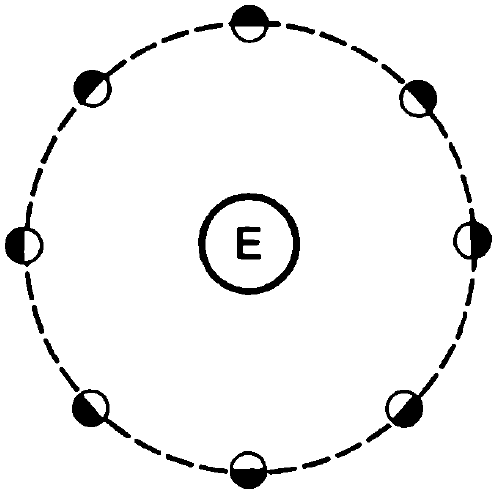
The moon rotates about the earth in such a way that only one hemisphere of the moon faces the earth. Can we ever see the ''other face'' of the moon from the earth? Can a person on the moon ever see all the faces of the earth?
View full solution
A ladder is resting with one end on a vertical wall and the other end on a horizontal floor. Is it more likely to slip when a man stands near the bottom or near the top?
View full solution
A uniform metre stick of mass $200g$ is suspended from the ceiling through two vertical strings of equal lengths fixed at the ends. A small object of mass $20g$ is placed on the stick at a distance of $70\ cm$ from the left end. Find the tensions in the two strings.
View full solution
Suppose the particle of the previous problem has a mass $m$ and a speed $v$ before the collision and it sticks to the rod after the collision. The rod has a mass $ M$:
  1. Find the velocity of the centre of mass $C$ of the system constituting ''The rod plus the particle''.
  2. Find the velocity of the particle with respect to $C$ before the collision.
  3. Find the velocity of the rod with respect to $C$ before the collision.
  4. Find the angular momentum of the particle and of the rod about the centre of mass $C$ before the collision.
  5. Find the moment of inertia of the system about the vertical axis through the centre of mass $C$ after the collision.
  6. Find the velocity of the centre of mass $C$ and the angular velocity of the system about the centre of mass after the collision.
View full solution
Suppose the smaller pulley of the previous problem has its radius $5.0\ cm$ and moment of inertia $0.10\ kg-m^2$. Find the tension in the part of the string joining the pulleys.
View full solution
The door of an almirah is $6\ ft$ high, $1.5\ ft$ wide and weighs $8\ kg.$ The door is supported by two hinges situated at a distance of $1\ ft$ from the ends. If the magnitudes of the forces exerted by the hinges on the door are equal, find this magnitude.
View full solution
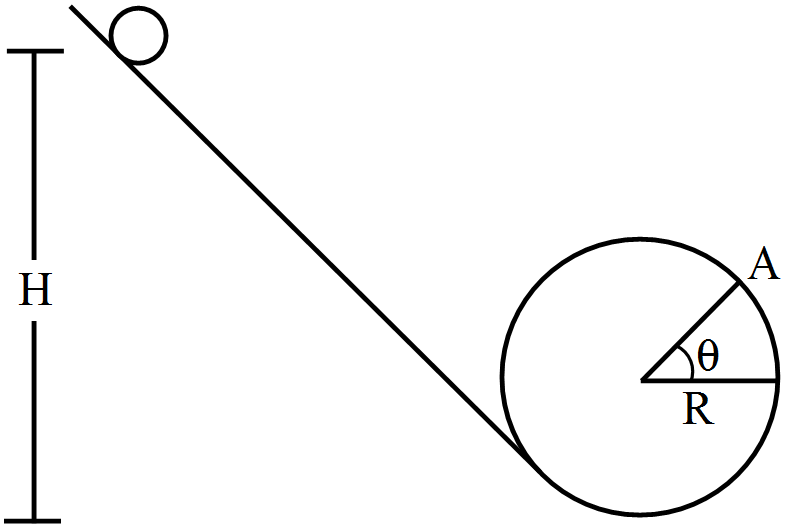
Figure shows a small spherical ball of mass m rolling down the loop track. The ball is released on the linear portion at a vertical height H from the lowest point. The circular part shown has a radius R.
  1. Find the kinetic energy of the ball when it is at a point A where the radius makes an angle $\theta$ with the horizontal.
  2. Find the radial and the tangential accelerations of the centre when the ball is at A.
  3. Find the normal force and the frictional force acting on the ball if H = 60cm, R = 10cm, $\theta=0 $ and m = 70g.
View full solution

Generate a Rotational Mechanics paper free

Pick question groups from the list above, set marks and difficulty, and export a branded PDF with step-by-step answer keys. First 3 chapters free — no signup.

Download App