MCQ
A particle moves with a velocity $6\hat i - 4\hat j + 3\hat k\,m/s$ under the influence of a constant force $\overrightarrow F = 20\hat i + 15\hat j - 5\hat k\,N.\,$ The instantaneous power applied to the particle is......... $J/s$
  • A
    $35$
  • $45 $
  • C
    $25$
  • D
    $195$

Answer

Correct option: B.
$45 $
b
(b) $P = \vec F.\vec v = 20 \times 6 + 15 \times ( - 4) + ( - 5) \times 3$

$ = 120 - 60 - 15 = 120 - 75 = 45\,J/s$

Need a full question paper?

Generate a complete, print-ready paper with questions like this in minutes — across 16+ boards, with answer keys.

Start Generating Free

Similar questions

If the momentum of a body is increased $n$ times, its kinetic energy increases
A juggler maintains four ball in vertically upward motion. He attempts next ball after $1/4\, sec$. For the shows to go on, what should be the height for which he throws the ball ?.........$m$ $(g=10\,m/s^2)$
A displacement vector of magnitude $4$ makes an angle $30^{\circ}$ with the $x$-axis. Its rectangular components in $x-y$ plane are .........
A ring of radius $0.5\, m$ and mass $10 \,kg$ is rotating about its diameter with an angular velocity of $20 \,rad/s.$  Its kinetic energy is .......... $J$
For inelastic collision between two spherical rigid bodies
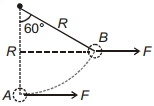
A block of mass $m$ is pulled along a circular arc by means of a constant horizontal force $F$ as shown. Work done by this force in pulling the block from $A$ to $B$ is ............ 
A rod of length $2m$ rests on smooth horizontal floor. If the rod is heated from $0^o C$ to $20^o C$. Find the longitudinal strain developed? $(\alpha = 5 × 10^{-5}/^o C)$
A particle of mass $m$ is moving in a circular path of constant radius $r$ such that its centripetal acceleration ${a_c}$ is varying with time t as, ${a_c} = {k^2}r{t^2}$, The power delivered to the particle by the forces acting on it is
$STATEMENT-1$ It is easier to pull a heavy object than to push it on a level ground. and

$STATEMENT-2$ The magnitude of frictional force depends on the nature of the two surfaces in contact.

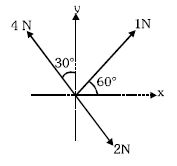
Three forces acting on a body are shown in the figure. To have the resultant force only along the $y-$ direction, the magnitude of the minimum additional force needed is.........$N$