MCQ
A particle moves with constant speed $v$ along a regular hexagon $ABCDEF$ in the same order. Then the magnitude of the average velocity for its motion from $A$ to
  • A
    $F$ is $v/5$
  • B
    $B$ is $v$
  • C
    $\frac{{\sqrt 3 v}}{2}$
  • All of the above

Answer

Correct option: D.
All of the above
d
$\left|\vec{v}_{a v}\right|=\left|\frac{\text {displacement}}{\text {timetaken}}\right|$

$\left|\vec{v}_{a v}\right|=\frac{X}{5 X / V}=\frac{v}{5}$

$\left|\vec{v}_{a v}\right|=\frac{x}{3 x / v}=\frac{2 v}{3}$

$\left|\vec{v}_{a v}\right|=\frac{2 x \cos 30^{\circ}}{2 x / v}=\frac{\sqrt{3} v}{2}$

Need a full question paper?

Generate a complete, print-ready paper with questions like this in minutes — across 16+ boards, with answer keys.
Start Generating Free

Similar questions

Two vessels of the same volume contain the same gas at same temperature. If the pressure in the vessels be in the ratio of $1 : 2$, then
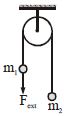
Two bodies of mass $m_1$ and $m_2$ $(m_2 > m_1)$ are connected by a light inextensible string which passes through a smooth fixed pulley. The instantaneous power delivered by an external agent to pull $m_1$ with constant velocity $v$ is
The wavefronts of light coming from a distant source of unknown shape are nearly:
A body of mass $500\,g$ moves along $x$-axis such that it's velocity varies with displacement $x$ according to the relation $v =10 \sqrt{ x } m / s$ the force acting on the body is $...........\,N$
A block of ice at $-20\,^oC$ having a mass of $2\, kg$ is added to a $3\, kg$ water at $15\,^oC$. Neglecting heat losses and the heat capacity of the container
The pressure wave, $P = 0.01\,sin\,[1000t -3x]\,Nm^{-2},$ corresponds to the sound produced by a vibrating blade on a day when atmospheric temperature is $0\,^oC.$ On some other day when temperature is $T,$ the speed of sound produced by the same blade and at the same frequency is found to be $336 \,ms^{-1}$. Approximate value of $T$ is .... $^oC$
A spherical body of mass $2\,kg$ starting from rest acquires a kinetic energy of $10000\,J$ at the end of $5^{\text {th }}$ second. The force acted on the body is $.....N$
The velocity of a small ball of mass $0.3\,g$ and density $8\,g / cc$ when dropped in a container filled with glycerine becomes constant after some time. If the density of glycerine is $1.3\,g / cc$, then the value of viscous force acting on the ball will be $x \times 10^{-4}\,N$, the value of $x$ is [use $g=10\,m / s ^{2}$ ] 
An inflated rubber balloon contains one mole of an ideal gas, has a pressure P. volume V and temperature T. If the temperature rises to 1.1 T, and the volume is increased to 1.05V, the final pressure will be:
For an ideal gas of diatomic molecules