MCQ
A particle moves with constant speed $v$ along a regular hexagon $ABCDEF$ in the same order. Then the magnitude of the average velocity for its motion from $A$ to
  • A
    $F$ is $v/5$
  • B
    $B$ is $v$
  • C
    $\frac{{\sqrt 3 v}}{2}$
  • All of the above

Answer

Correct option: D.
All of the above
d
$\left|\vec{v}_{a v}\right|=\left|\frac{\text {displacement}}{\text {timetaken}}\right|$

$\left|\vec{v}_{a v}\right|=\frac{X}{5 X / V}=\frac{v}{5}$

$\left|\vec{v}_{a v}\right|=\frac{x}{3 x / v}=\frac{2 v}{3}$

$\left|\vec{v}_{a v}\right|=\frac{2 x \cos 30^{\circ}}{2 x / v}=\frac{\sqrt{3} v}{2}$

Need a full question paper?

Generate a complete, print-ready paper with questions like this in minutes — across 16+ boards, with answer keys.
Start Generating Free

Similar questions

A standing wave in a pipe with a length $L=1.2 \,m$ is described by $y(x, t)=y_0 \sin [(2 \pi / L) x] \sin [(2 \pi / L) x+\pi / 4]$ based on above information, which one of the following statement is incorrect? (Speed of sound in air is $300 \,ms ^{-1}$ )
A ball is dropped from top of a tower of $100\,m$ height. Simultaneously another ball was thrown upward from bottom of the tower with a speed of $50\, m/s$ ($g = 10\,m/{s^2})$. They will cross each other after..........$s$
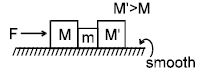
A constant force $F$ is applied in horizontal direction as shown in figure. Contact force between $M$ and $m$ is $N$ and between $m$ and $M'$ is $N'$ then
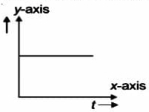
In the graph shown in figure, which quantity associated with projectile motion is plotted along $y$-axis?
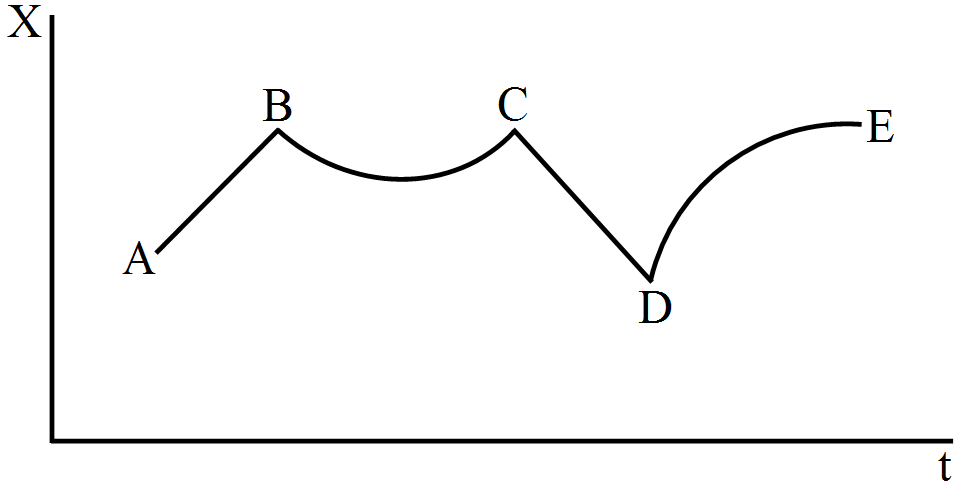
Figure shows the displacement of a particle going along the $X-$axis as a function of time. The force acting on the particle is zero in the region:
  1. $AB$
  2. $BC$
  3. $CD$
  4. $DE$
A particle moves from the point $\left( {2.0\hat i + 4.0\hat j} \right)\,m$, at $t = 0$ with an initial velocity $\left( {5.0\hat i + 4.0\hat j} \right)\,m{s^{ - 1  }}$. It is acted upon by a constant force which produces a constant acceleration $\left( {4.0\hat i + 4.0\hat j} \right)\,m{s^{ - 2}}$. What is the distance of the particle from the origin at time $2\,s$
If temperature increases, the surface tension of a liquid
The radius of a circle is stated as $2.12\ cm$. Its area should be written as:
A satellite of mass $m$ is in circular orbit of radius $3 R_E$ about earth (mass of earth $M_{E}$, radius of earth $R_{E}$). How much additional energy is required to transfer the satellite to an orbit of radius $9 R_{E}$?
If the distance between two masses is doubled, the gravitational attraction between them