MCQ
A particle moving with uniform speed in a circular path maintains:
  • A
    Constant acceleration
  • B
    Constant velocity but varying acceleration
  • Varying velocity and varying acceleration
  • D
    Constant velocity

Answer

Correct option: C.
Varying velocity and varying acceleration
c
A particle moving with uniform speed in a circular path maintains varying velocity and varying acceleration. It is because direction of both velocity as well as acceleration will change continuously.

Need a full question paper?

Generate a complete, print-ready paper with questions like this in minutes — across 16+ boards, with answer keys.
Start Generating Free

Similar questions

If a vector $\overrightarrow P $ making angles $\alpha, \beta\  and\ \gamma$ respectively with the $X, Y$ and $Z$ axes respectively. Then ${\sin ^2}\alpha + {\sin ^2}\beta + {\sin ^2}\gamma = $
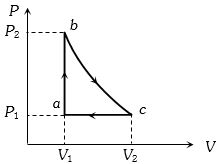
Carbon monoxide is carried around a closed cycle $abc$ in which bc is an isothermal process as shown in the figure. The gas absorbs $7000 J$ of heat as its temperature increases from $300 K$ to $1000 K$ in going from $a$ to $b$. The quantity of heat rejected by the gas during the process $ca$ is ..... $J$
A $140\, g$ ball, in horizontal flight with a speed $v_1$ of $39.0\, m/s$, is struck by a bat. After leaving the bat, the ball travel in the opposite direction with speed $v_2 = 39.0\, m/s$. If the impact time $\Delta t$ for the ball-bat collision is $1.20\, ms$, what average net force acts on the ball ......... $N$
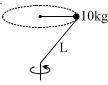
$A \,10\, kg$ ball attached to the end of a rigid massless rod of length $1\, m$ rotates at constant speed in a horizontal circle of radius $0.5\, m$ and period $1.57 \, sec$ as in fig. The force exerted by rod on the ball is ........ $N$.
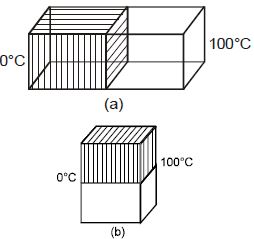
Two identical square rods of metal are welded end to end as shown in figure $(a)$. Assume that $10\, cal$ of heat flows through the rods in $2\, min$. Now the rods are welded as shown in figure, $(b)$. The time it would take for $10$ cal to flow through the rods now, is ........ $\min$
Two particles $A$ and $B$ start moving with velocities $20 \,m / s$ and $30 \sqrt{2} \,m / s$ along $x$-axis and at an angle $45^{\circ}$ with $x$-axis respectively in $x y$-plane from origin. The relative velocity of $B$ w.r.t. $A$ is ........... $m / s$
Variation of the density of water with respect to temperature from 0°C to 10°C is correctly represented by:
The height of water rising in a capillary will be:
Which of the following statements is correct?
Which of the following statements about kinetic theory of gases is wrong