MCQ
A particle, moving with uniform speed $v$, changes its direction by angle $\theta$ in time $t$. Magnitude of its average acceleration during this time is
- Azero
- ✓$\frac{2 v}{t} \sin \frac{\theta}{2}$
- C$\frac{v \sqrt{2}}{t}$
- DNone of these
$a_{ av }=\left|\frac{\Delta v }{\Delta t}\right|=\frac{\left| v _f- v _i\right|}{t}$
$=\frac{\sqrt{v^2+v^2-2 v \cdot v \cdot \cos \theta}}{t}$
$=\frac{2 v}{t} \sin \frac{\theta}{2}$
Generate a complete, print-ready paper with questions like this in minutes — across 16+ boards, with answer keys.
$y_1=5 \sin 2 \pi(75 t-0.25 x)$
$y_2=10 \sin 2 \pi(150 t-0.50 x)$
The intensity ratio $\frac{I_1}{I_2}$ of the two waves is
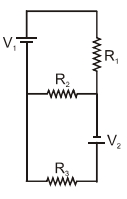
The current in resistance $R _2$ would be zero if
$(A)$ $V_1=V_2$ and $R_1=R_2=R_3$
$(B)$ $V_1=V_2$ and $R_1=2 R_2=R_3$
$(C)$ $V_1=2 V_2$ and $2 R_1=2 R_2=R_3$
$(D)$ $2 V _1= V _2$ and $2 R _1= R _2= R _3$