A particle of charge $Q$ and mass $M$ moves in a circular path of radius $R$ in a uniform magnetic field of magnitude $B$. The same particle now moves with the same speed in a circular path of same radius $R$ in the space between the cylindrical electrodes of the cylindrical capacitor. The radius of the inner electrode is $R/2$ while that of the outer electrode is $ 3R/2.$ Then the potential difference between the capacitor electrodes must be
Diffcult
Download our app for free and get started

Download our appand get started for free
Experience the future of education. Simply download our apps or reach out to us for more information. Let's shape the future of learning together!No signup needed.*
Similar Questions
- 1View SolutionThe energy stored in a condenser is in the form of
- 2An electron enters between two horizontal plates separated by $2\,mm$ and having a potential difference of $1000\,V$. The force on electron isView Solution
- 3View SolutionAssertion : In a cavity within a conductor, the electric field is zero.
Reason : Charges in a conductor reside only at its surface
- 4The capacitance between the points $A$ and $B$ in the given circuit will be.......$\mu \,F$View Solution
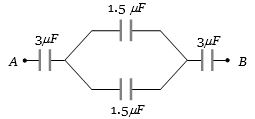
- 5In a parallel plate capacitor of capacitance $C$, a metal sheet is inserted between the plates, parallel to them. If the thickness of the sheet is half of the separation between the plates. The capacitance will beView Solution
- 6Two particles each of mass $m$ and charge $q$ are separated by distance $r_1$ and the system is left free to move at $t = 0$. At time $t$ both the particles are found to be separated by distance $r_2$. The speed of each particle isView Solution
- 7A $500\,\mu F$ capacitor is charged at a steady rate of $100\, \mu C/sec$. The potential difference across the capacitor will be $10\, V$ after an interval of.....$sec$View Solution
- 8The radii of the inner and outer spheres of a condenser are $9\,cm$ and $10\,cm$ respectively. If the dielectric constant of the medium between the two spheres is $6$ and charge on the inner sphere is $18 \times {10^{ - 9}}\;coulomb$, then the potential of inner sphere will be, if the outer sphere is earthed........$volts$View Solution
- 9Two positively charged particles $X$ and $Y$ are initially far away from each other and at rest. $X$ begins to move towards $Y$ with some initial velocity. The total momentum and energy of the system are $p$ and $E$.View Solution
- 10A $5.0\, \mu F$ capacitor is charged to a potential difference $800\, V$ and discharged through a conductor. The energy(in $J$) given to a conductor during the discharge isView Solution