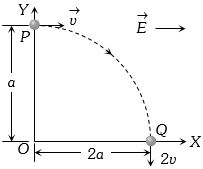
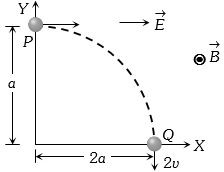
A particle of charge $+q$ and mass $m$ moving under the influence of a uniform electric field $E\hat i$ and a uniform magnetic field $B\hat k$ follows trajectory from $P$ to $Q$ as shown in figure. The velocities at $P$ and $Q$ are $v\hat i$ and $ - 2v\hat j$ respectively. Which of the following statement(s) is/are correct
IIT 1991, Diffcult
Download our app for free and get started
(d) Kinetic energy of the particle at point $P = \frac{1}{2}m{v^2}$
$K.E.$ of the particle at point $Q = \frac{1}{2}m{(2v)^2}$
Increase in $K.E.$ $ = \frac{3}{2}m{v^2}$
It comes from the work done by the electric force $qE$ on the particle as it covers a distance $2a$ along the $x$-axis. Thus $\frac{3}{2}m{v^2} = qE \times 2a \Rightarrow E = \frac{3}{4}\frac{{m{v^2}}}{{qa}}$. The rate of work done by the electric field at $P$ $ = F \times v = qE \times v = 3\frac{{m{v^3}}}{{4a}}$
At $Q,\;\overrightarrow {{F_e}} = q\overrightarrow E $ is along $x$-axis while velocity is along negative $y$-axis. Hence rate of work done by electric field Similarly, according to equation $\overrightarrow {{F_m}} = q(\overrightarrow {v\,} \times \overrightarrow B )$
Force $\overrightarrow {{F_{\rm{m}}}} $ is also perpendicular to velocity vector .
Hence the rate of work done by the magnetic field = $0$
$K.E.$ of the particle at point $Q = \frac{1}{2}m{(2v)^2}$
Increase in $K.E.$ $ = \frac{3}{2}m{v^2}$
It comes from the work done by the electric force $qE$ on the particle as it covers a distance $2a$ along the $x$-axis. Thus $\frac{3}{2}m{v^2} = qE \times 2a \Rightarrow E = \frac{3}{4}\frac{{m{v^2}}}{{qa}}$. The rate of work done by the electric field at $P$ $ = F \times v = qE \times v = 3\frac{{m{v^3}}}{{4a}}$
At $Q,\;\overrightarrow {{F_e}} = q\overrightarrow E $ is along $x$-axis while velocity is along negative $y$-axis. Hence rate of work done by electric field Similarly, according to equation $\overrightarrow {{F_m}} = q(\overrightarrow {v\,} \times \overrightarrow B )$
Force $\overrightarrow {{F_{\rm{m}}}} $ is also perpendicular to velocity vector .
Hence the rate of work done by the magnetic field = $0$

Download our appand get started for free
Experience the future of education. Simply download our apps or reach out to us for more information. Let's shape the future of learning together!No signup needed.*
Similar Questions
- 1A electron experiences a force $\left( {4.0\,\hat i + 3.0\,\hat j} \right)\times 10^{-13} N$ in a uniform magnetic field when its velocity is $2.5\,\hat k \times \,{10^7} ms^{-1}$. When the velocity is redirected and becomes $\left( {1.5\,\hat i - 2.0\,\hat j} \right) \times {10^7}$, the magnetic force of the electron is zero. The magnetic field $\vec B$ is :View Solution
- 2A rectangular coil (Dimension $5\,cm\times 2\,cm$ ) with $100\,turns,$ carrying a current of $3\,A$ in the clock-wise direction, is kept centered at the origin and in the $X-Z$ plane. A magnetic field of $1\,T$ is applied along $X-$ axis. If the coil is tilted through $45^o$ about $Z-$ axis, then the torque on the coil is.....$Nm$View Solution
- 3When a charged particle moving with velocity $\vec V$ is subjected to a magnetic field of induction $\vec B$ , the force on it is non-zero. This implies theView Solution
- 4View SolutionIn order to increase the sensitivity of a moving coil galvanometer, one should decrease
- 5When a proton is released from rest in a room, it starts with an initial acceleration $a_0$ towards west. When it is projected towards north with a speed $v_0$ it moves with an initial acceleration $3a_0$ toward west. The electric and magnetic fields in the room areView Solution
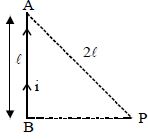
- 6The magnetic field at point, point $P$ will be :-View Solution
- 7This question has Statement $1$ and Statement $2$ . Of the four choices given after the Statements, choose the one that best describes the two Statements.View Solution
Statement $1$: A charged particle is moving at right angle to a static magnetic field . During the motion the kinetic energy of the charge remains unchanged.
Statement $2$: Static magnetic field exert force on a moving charge in the direction perpendicular to the magnetic field.
- 8The ($\tau -\theta$) graph for a coil isView Solution
- 9A proton and an alpha particle both enter a region of uniform magnetic field $B,$ moving at right angles to the field $B.$ If the radius of circular orbits for both the particles is equal and the kinetic energy acquired by proton is $1\,\, MeV,$ the energy acquired by the alpha particle will be......$MeV$View Solution
- 10Which one of the following modifications may ncrease the sensitivity of moving coil galvanometer?View Solution
$1^{st}$ Way : By using spring of smaller torsion constant.
$2^{nd}$ Way : By using a smaller coil
$3^{rd}$ Way : By using a stronger magnet
$4^{th}$ Way : By using a coil having fewer number of turns.