When a charged particle moving with velocity $\vec V$ is subjected to a magnetic field of induction $\vec B$ , the force on it is non-zero. This implies the
Medium


Download our appand get started for free
Experience the future of education. Simply download our apps or reach out to us for more information. Let's shape the future of learning together!No signup needed.*
Similar Questions
- 1In hydrogen atom, an electron is revolving in the orbit of radius $0.53\,{\mathop A\limits^o }$ with $6.6 \times {10^{15}}$ $rotations/second$. Magnetic field produced at the centre of the orbit is.......$wb/{m^2}$View Solution
- 2Two long straight parallel wires, carrying (adjustable) current $I_1$ and $I_2$, are kept at a distance $d$ apart. If the force $'F'$ between the two wires is taken as 'positive' when the wires repel each other and 'negative' when the wires attract each other, the graph showing the dependence of $'F'$, on the product $I_1 I_2$, would beView Solution
- 3A proton (or charged particle) moving with velocity $v$ is acted upon by electric field $E$ and magnetic field $B$. The proton will move undeflected ifView Solution
- 4Which one of the following modifications may ncrease the sensitivity of moving coil galvanometer?View Solution
$1^{st}$ Way : By using spring of smaller torsion constant.
$2^{nd}$ Way : By using a smaller coil
$3^{rd}$ Way : By using a stronger magnet
$4^{th}$ Way : By using a coil having fewer number of turns. - 5If wire of length $L$ form a loop of radius $R$ and have $n$ turn. Find magnetic field at centre of loop if current flowing in loop is $I$View Solution
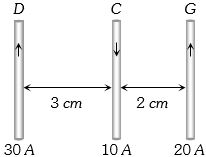
- 6Three long, straight parallel wires carrying current, are arranged as shown in figure. The force experienced by a $25\, cm$ length of wire $C$ isView Solution
- 7A voltmeter of resistance $20000\,\Omega$ reads $5$ volt. To make it read $20$ volt, the extra resistance required isView Solution
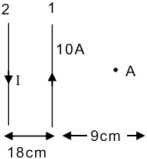
- 8In figure two parallel infinitely long current carrying wires are shown. If resultant magnetic field at point $A$ is zero. Then determine current $I.$ (in $A$)View Solution
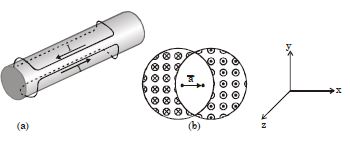
- 9To produce a uniform magnetic field directed parallel to a diameter of a cylindrical region, one can use the saddle coils illustrated in figure. The loops are wrapped over a somewhat flattened tube. Assume the straight sections of wire are very long. The end view of the tube shows how the windings are applied. The overall current distribution is the superposition of two overlapping,circular cylinders of uniformly distributed current, one toward you and one away from you. The current density $J$ is the same for each cylinder. The position of the axis of one cylinder is described by a position vector a relative to the other cylinder. The magnetic field inside the hollow tube is.View Solution
- 10The magnetic field $B$ with in the solenoid having $n$ $turns$ per $metre$ length and carrying a current of $i$ $ampere$ is given byView Solution