A particle of charge $q$ and mass $m$ moving with a velocity $v$ along the $x$-axis enters the region $x > 0$ with uniform magnetic field $B$ along the $\hat k$ direction. The particle will penetrate in this region in the $x$-direction upto a distance $d$ equal to
Easy
Download our app for free and get started
(b) It is easy to understand the given problem, along with the following figure.
$d$ = radius of path
$ = \frac{{mv}}{{qB}}$
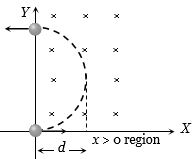
$d$ = radius of path
$ = \frac{{mv}}{{qB}}$

Download our appand get started for free
Experience the future of education. Simply download our apps or reach out to us for more information. Let's shape the future of learning together!No signup needed.*
Similar Questions
- 1A particle of specific charge (charge/mass) $\alpha$ starts moving from the origin under the action of an electric field $\vec E = {E_0}\hat i$ and magnetic field $\vec B = {B_0}\hat k$. Its velocity at $(x_0 , y_0 , 0)$ is ($(4\hat i + 3\hat j)$ . The value of $x_0$ is:View Solution
- 2A galvanometer coil has $500$ turns and each turn has an average area of $3 \times 10^{-4}\, m ^{2}$. If a torque of $1.5\,Nm$ is required to keep this coil parallel to magnetic field when a current of $0.5\, A$ is flowing through it, the strength of the field (in $T )$ isView Solution
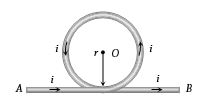
- 3A part of a long wire carrying a current $i$ is bent into a circle of radius $r$ as shown in figure. The net magnetic field at the centre $O$ of the circular loop isView Solution
- 4View SolutionThe magnetic induction at any point due to a long straight wire carrying a current is
- 5View SolutionIn order to increase the sensitivity of a moving coil galvanometer, one should decrease
- 6The region between $y = 0$ and $y = d$ contains a magnetic field $\vec B = B\hat z$ A particle of mass $m$ and charge $q$ enters the region with a velocity $\vec v = v\hat i$. If $d = \frac{{mv}}{{2qB}}$ , the acceleration of the charged particle at the point of its emergence at the other side isView Solution
- 7In a moving coil galvanometer, the deflection of the coil $\theta $ is related to the electrical current $i$ by the relationView Solution
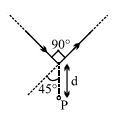
- 8Find the magnetic field at $P$ due to the arrangement shownView Solution
- 9A long straight wire with a circular crosssection having radius $R$, is carrying a steady current $I$. The current I is uniformly distributed across this cross-section. Then the variation of magnetic field due to current I with distance $r\;( r < R )$ from its centre will beView Solution
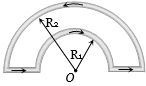
- 10The magnetic induction at the centre $O$ in the figure shown isView Solution