A particle of charge $q$ and mass $m$ starts moving from the origin under the action of an electric field $\vec E = {E_0}\hat i$ and $\vec B = {B_0}\hat i$ with velocity ${\rm{\vec v}} = {{\rm{v}}_0}\hat j$. The speed of the particle will become $2v_0$ after a time
Advanced


Download our appand get started for free
Experience the future of education. Simply download our apps or reach out to us for more information. Let's shape the future of learning together!No signup needed.*
Similar Questions
- 1A long conducting wire having a current $I$ flowing through it, is bent into a circular coil of $N$ turns.Then it is bent into a circular coil of $n$ tums. The magnetic field is calculated at the centre of coils in both the cases. The ratio of the magnetic field in first case to that of second case is:View Solution
- 2View SolutionIn order to increase the sensitivity of a moving coil galvanometer, one should decrease
- 3If wire of length $L$ form a loop of radius $R$ and have $n$ turn. Find magnetic field at centre of loop if current flowing in loop is $I$View Solution
- 4A particle of specific charge $(q/m)$ is projected from the origin of coordinates with initial velocity $[ui - vj]$. Uniform electric magnetic fields exist in the region along the $+y$ direction, of magnitude $E$ and $B.$ The particle will definitely return to the origin once ifView Solution
- 5A charged particle (electron or proton) is introduced at the origin $(x=0, y=0, z=0)$ with a given initial velocity $\overrightarrow{\mathrm{v}}$. A uniform electric field $\overrightarrow{\mathrm{E}}$ and magnetic field $\vec{B}$ are given in columns $1,2$ and $3$ , respectively. The quantities $E_0, B_0$ are positive in magnitude.View Solution
column $I$
column $II$ column $III$ $(I)$ Electron with $\overrightarrow{\mathrm{v}}=2 \frac{\mathrm{E}_0}{\mathrm{~B}_0} \hat{\mathrm{x}}$ $(i)$ $\overrightarrow{\mathrm{E}}=\mathrm{E}_0^2 \hat{\mathrm{Z}}$ $(P)$ $\overrightarrow{\mathrm{B}}=-\mathrm{B}_0 \hat{\mathrm{x}}$ $(II)$ Electron with $\overrightarrow{\mathrm{v}}=\frac{\mathrm{E}_0}{\mathrm{~B}_0} \hat{\mathrm{y}}$ $(ii)$ $\overrightarrow{\mathrm{E}}=-\mathrm{E}_0 \hat{\mathrm{y}}$ $(Q)$ $\overrightarrow{\mathrm{B}}=\mathrm{B}_0 \hat{\mathrm{x}}$ $(III)$ Proton with $\overrightarrow{\mathrm{v}}=0$ $(iii)$ $\overrightarrow{\mathrm{E}}=-\mathrm{E}_0 \hat{\mathrm{x}}$ $(R)$ $\overrightarrow{\mathrm{B}}=\mathrm{B}_0 \hat{\mathrm{y}}$ $(IV)$ Proton with $\overrightarrow{\mathrm{v}}=2 \frac{\mathrm{E}_0}{\mathrm{~B}_0} \hat{\mathrm{x}}$ $(iv)$ $\overrightarrow{\mathrm{E}}=\mathrm{E}_0 \hat{\mathrm{x}}$ $(S)$ $\overrightarrow{\mathrm{B}}=\mathrm{B}_0 \hat{\mathrm{z}}$ ($1$) In which case will the particle move in a straight line with constant velocity?
$[A] (II) (iii) (S)$ $[B] (IV) (i) (S)$ $[C] (III) (ii) (R)$ $[D] (III) (iii) (P)$
($2$) In which case will the particle describe a helical path with axis along the positive $z$ direction?
$[A] (II) (ii) (R)$ $[B] (IV) (ii) (R)$ $[C] (IV) (i) (S)$ $[D] (III) (iii)(P)$
($3$) In which case would be particle move in a straight line along the negative direction of y-axis (i.e., more along $-\hat{y}$ )?
$[A] (IV) (ii) (S)$ $[B] (III) (ii) (P)$ $[C]$ (II) (iii) $(Q)$ $[D] (III) (ii) (R)$
- 6A proton is projected with velocity $\overrightarrow{ V }=2 \hat{ i }$ in a region where magnetic field $\overrightarrow{ B }=(\hat{i}+3 \hat{j}+4 \hat{k})\; \mu T$ and electric field $\overrightarrow{ E }=10 \hat{ i } \;\mu V / m .$ Then find out the net acceleration of proton (in $m / s ^{2}$)View Solution
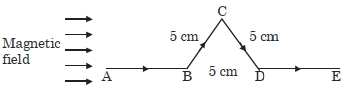
- 7A triangular shaped wire carrying $10 A$ current is placed in a uniform magnetic field of $0.5\,T$, as shown in figure. The magnetic force on segment $CD$ is $....N$ $($ Given $BC = CD = BD =5\,cm )$.View Solution
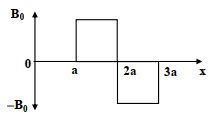
- 8A magnetic field $\overrightarrow{\mathrm{B}}=\mathrm{B}_0 \hat{\mathrm{j}}$ exists in the region $\mathrm{a} < \mathrm{x} < 2 \mathrm{a}$ and $\vec{B}=-B_0 \hat{j}$, in the region $2 \mathrm{a} < \mathrm{x} < 3 \mathrm{a}$, where $\mathrm{B}_0$ is a positive constant. $\mathrm{A}$ positive point charge moving with a velocity $\overrightarrow{\mathrm{v}}=\mathrm{v}_0 \hat{\dot{i}}$, where $v_0$ is a positive constant, enters the magnetic field at $x=a$. The trajectory of the charge in this region can be like,View Solution
- 9A proton of velocity $\left( {3\hat i + 2\hat j} \right)\,ms^{-1}$ enters a magnetic field of $(2\hat j + 3\hat k)\, tesla$. The acceleration produced in the proton is (charge to mass ratio of proton $= 0.96 \times10^8\,Ckg^{-1}$)View Solution
- 10The electric current in a circular coil of $2$ turns produces a magnetic induction $B _{1}$ at its centre. The coil is unwound and is rewound into a circular coil of $5$ turns and the same current produces a magnetic induction $B _{2}$ at its centre.The ratio of $\frac{ B _{2}}{ B _{1}}$ is.View Solution