MCQ
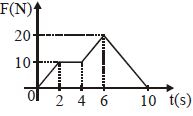
A particle of mass $2\, kg$ is initially at rest. A force acts on it whose magnitude changes with time. The force time graph is shown below. The velocity of the particle after $10\, s$ is ......... $ms^{-1}$
- A$20$
- B$10$
- C$75$
- ✓$50$
or $\frac{1}{2} \times 2 \times(10)+2 \times 10+\frac{1}{2}(10+20) \times 2+\frac{1}{2} \times 4 \times 20$
$=\mathrm{m}(\mathrm{v}-\mathrm{u})$
$\begin{array}{ll}{\text { or } 10+20+30+40=} & {2(\mathrm{v}-0)} \\ {\text { or }} & {100=2 \mathrm{v}}\end{array}$
or $\mathrm{v}=50 \mathrm{ms}^{-1}$
Generate a complete, print-ready paper with questions like this in minutes — across 16+ boards, with answer keys.
Choose the correct answer from the options given below: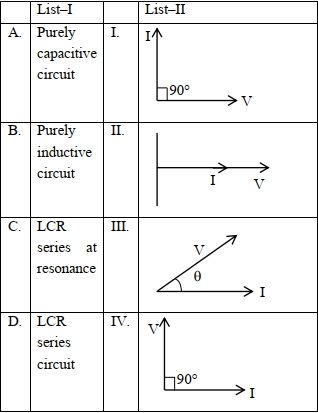
Reason $(R):$ Electrostatic force of repulsion between two protons reduces net nuclear forces between them.