MCQ
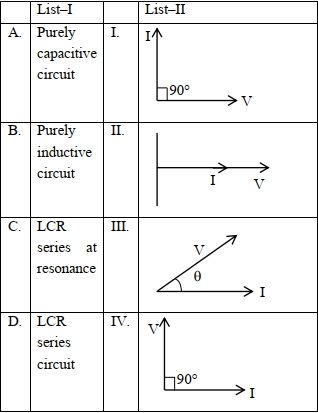
Match List I with List $II$

Choose the correct answer from the options given below:
  • A
    $A-I, B-IV, C-III, D-II$
  • B
    $A-IV, B-I, C-III, D-II$
  • C
    $A-IV, B-I, C-II, D-III$
  • $A-I, B-IV, C-II, D-III$

Answer

Correct option: D.
$A-I, B-IV, C-II, D-III$
d
$A - V$ lags by $90^{\circ}$ from I hence option $(I)$ is correct.

$B - V$ lead by $90^{\circ}$ from $I$ hence option $(IV)$ is correct

$\mathrm{C}-\mathrm{In} \mathrm{LCR}$ resonance $\mathrm{X}_{\mathrm{L}}=\mathrm{X}_{\mathrm{C}}$. Hence circuit is purely resistive so option $(II)$ is correct $D$ - In LCR series $V$ is at some angle from $I$ hence $(III)$ is correct

Hence option $(4)$ is correct.

Need a full question paper?

Generate a complete, print-ready paper with questions like this in minutes — across 16+ boards, with answer keys.

Start Generating Free

Similar questions

Velocity-displacement graph of a particle moving in a straight line is as shown in figure
Name of the India's first nuclear reactor is
The capacity of a vessel is $3$ litres. It contains $6 \,gm$ oxygen, $8\, gm$ nitrogen and $5\, gm$ $C{O_2}$ mixture at $27°C.$ If $R = 8.31\, J/mole$ $ \times $ $kelvin,$ then the pressure in the vessel in $N/{m^2}$ will be (approx.)
According to Joule's law, if the potential difference across a conductor having a material of specific resistance remains constant, then the heat produced in the conductor is directly proportional to
In Young's double slit experiment, the phase difference between the light waves reaching third bright fringe from the central fringe will be ($\lambda$ $=6000 Å$ )
Choose the correct statement
When a metallic surface is illuminated by a light of wavelength $\lambda,$ the stopping potential for the photoelectric current is $3\, V$. When the same surface is illuminated by light of wavelength $2\, \lambda$ the stopping potential is $1\, V$. The threshold wavelength for this surface is
The electric field due to a charge at a distance of $3\, m$ from it is $500\, N/coulomb$. The magnitude of the charge is.......$\mu C$ $\left[ {\frac{1}{{4\pi {\varepsilon _0}}} = 9 \times {{10}^9}\,\frac{{N - {m^2}}}{{coulom{b^2}}}} \right]$
 If $N$ is the number of turns in a coil, the value of self inductance varies as
The current in a conductor varies with time t as $I = 2t + 3{t^2}$ where $I$ is in ampere and $t$ in seconds. Electric charge flowing through a section of the conductor during $t = 2\,\sec$ to $t = 3\,\sec$ is ............. $C$