A particle of mass $250\,g$ executes a simple harmonic motion under a periodic force $F =(-25\,x) N$. The particle attains a maximum speed of $4\,m / s$ during its oscillation. The amplitude of the motion is $...........cm$.
JEE MAIN 2023, Medium
Download our app for free and get started
$\frac{1}{4} a =-25 x \quad ; \quad a =-100 x$
$\omega^2=100 \quad \omega=10$
$\omega A =4$ $\quad A=\frac{4}{10}=0.4\,m$
$A =40\,cm$

Download our appand get started for free
Experience the future of education. Simply download our apps or reach out to us for more information. Let's shape the future of learning together!No signup needed.*
Similar Questions
- 1The displacement of a damped harmonic oscillator is given by $x\left( t \right) = {e^{ - 0.1\,t}}\,\cos \left( {10\pi t + \varphi } \right)$ The time taken for its amplitude of vibration to drop to half of its initial value is close to .... $s$View Solution
- 2View SolutionIf a body is released into a tunnel dug across the diameter of earth, it executes simple harmonic motion with time period
- 3Kinetic energy of a particle executing simple harmonic motion in straight line is $pv^2$ and potential energy is $qx^2$, where $v$ is speed at distance $x$ from the mean position. It time period is given by the expressionView Solution
- 4$Assertion :$ In simple harmonic motion, the velocity is maximum when the acceleration is minimum.View Solution
$Reason :$ Displacement and velocity of $S.H.M.$ differ in phase by $\frac{\pi }{2}$ - 5The variation of the acceleration $a$ of the particle executing $S.H.M.$ with displacement $x$ is as shown in the figureView Solution
- 6The time period of oscillations of a simple pendulum is $1$ minute. If its length is increased by $44 \%$. then its new time period of oscillation will be ......... $s$View Solution
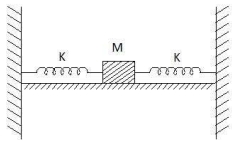
- 7In the figure given below. a block of mass $M =490\,g$ placed on a frictionless table is connected with two springs having same spring constant $\left( K =2 N m ^{-1}\right)$. If the block is horizontally displaced through ' $X$ 'm then the number of complete oscillations it will make in $14 \pi$ seconds will be $.........$View Solution
- 8Which of the following quantities are always negative in a $SHM$View Solution
- 9When the potential energy of a particle executing simple harmonic motion is one-fourth of its maximum value during the oscillation, the displacement of the particle from the equilibrium position in terms of its amplitude $a$ isView Solution
- 10A particle of mass $m$ performs $SHM$ along a straight line with frequency $f$ and amplitude $A.$View Solution