Kinetic energy of a particle executing simple harmonic motion in straight line is $pv^2$ and potential energy is $qx^2$, where $v$ is speed at distance $x$ from the mean position. It time period is given by the expression
Medium
Download our app for free and get started
$\mathrm{KE}=\mathrm{TE} \propto \mathrm{pA}^{2} \omega^{2}$
$\mathrm{PE}=\mathrm{TE} \propto \mathrm{q} \mathrm{A}^{2}$
$\mathrm{PA}^{2} / \omega^{2}=\mathrm{q} \mathrm{A}^{2}$
$\mathrm{T}=2 \pi \sqrt{\frac{p}{q}}$

Download our appand get started for free
Experience the future of education. Simply download our apps or reach out to us for more information. Let's shape the future of learning together!No signup needed.*
Similar Questions
- 1A pendulum has time period $T$ in air. When it is made to oscillate in water, it acquired a time period $T' = \sqrt 2 T$. The density of the pendulum bob is equal to (density of water $= 1$)View Solution
- 2A block is placed on a horizontal plank. The plank is performing $SHM$ along a vertical line with amplitude of $40\,cm.$ The block just loses contact with the plank when the plank is momentarily at rest. Then :View Solution
- 3If a spring of stiffness $k$ is cut into two parts $A$ and $B$ of length $l_{A}: l_{B}=2: 3$, then the stiffness of spring $A$ is given byView Solution
- 4If two similar springs each of spring constant $K _{1}$ are joined in series, the new spring constant and time period would be changed by a factorView Solution
- 5A particle of mass $m$ performs $SHM$ along a straight line with frequency $f$ and amplitude $A.$View Solution
- 6A particle of mass $m$ is performing linear simple harmonic motion. Its equilibrium is at $x = 0,$ force constant is $K$ and amplitude of $SHM$ is $A$. The maximum power supplied by the restoring force to the particle during $SHM$ will beView Solution
- 7A spring whose unstretched length is $\ell $ has a force constant $k$. The spring is cut into two pieces of unstretched lengths $\ell_1$ and $\ell_2$ where, $\ell_1 = n\ell_2$ and $n$ is an integer. The ratio $k_1/k_2$ of the corresponding force constants, $k_1$ and $k_2$ will beView Solution
- 8Two waves executing simple harmonic motion travelling in the same direction with same amplitude and frequency are superimposed. The resultant amplitude is equal to the $\sqrt{3}$ times of amplitude of individual motions. The phase difference between the two motions is $.....(degree)$View Solution
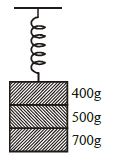
- 9Three mass and string system is in equilibrium. When $700\,gm$ mass is removed, then the system oscillates with a period of $3\,seconds$ . When the $500\,gm$ mass is also removed, then what will be new time period for system ..... $\sec$View Solution
- 10View SolutionIn case of a simple pendulum, time period versus length is depicted by