A particle of mass $m$ in a unidirectional potential field have potential energy $U(x)=\alpha+2 \beta x^2$, where $\alpha$ and $\beta$ are positive constants. Find its time period of oscillation.
Medium


Download our appand get started for free
Experience the future of education. Simply download our apps or reach out to us for more information. Let's shape the future of learning together!No signup needed.*
Similar Questions
- 1An ideal gas enclosed in a vertical cylindrical container supports a freely moving piston of mass $M$. The piston and the cylinder have equal cross sectional area $A$. When the piston is in equilibrium, the volume of the gas is $V_0$ and its pressure is $P_ 0$. The piston is slightly displaced from the equilibrium position and released. Assuming that the system is completely isolated from its surrounding, the piston executes a simple harmonic motion with frequencyView Solution
- 2View SolutionA simple pendulum is taken from the equator to the pole. Its period
- 3Two masses $M_{A}$ and $M_{B}$ are hung from two strings of length $l_{A}$ and $l_{B}$ respectively. They are executing SHM with frequency relation $f_{A}=2 f_{B}$, then relationView Solution
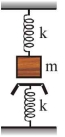
- 4A mass $m$ is suspended from a spring of force constant $k$ and just touches another identical spring fixed to the floor as shown in the figure. The time period of small oscillations isView Solution
- 5A $LCR$ circuit behaves like a damped harmonic oscillator. Comparing it with a physical springmass damped oscillator having damping constant $\mathrm{b}$, the correct equivalence would be:View Solution
- 6The maximum acceleration of a particle in $SHM$ is made two times keeping the maximum speed to be constant. It is possible whenView Solution
- 7Vertical displacement of a plank with a body of mass $'m'$ on it is varying according to law $y = \sin \omega t + \cos \omega t.$ The minimum value of $\omega $ for which the mass just breaks off the plank and the moment it occurs first after $t = 0$ are given by : ( $y$ is positive vertically upwards)View Solution
- 8The composition of two simple harmonic motions of equal periods at right angle to each other and with a phase difference of $\pi $ results in the displacement of the particle alongView Solution
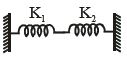
- 9View SolutionThe effective spring constant of two spring system as shown in figure will be
- 10In a sinusoidal wave, the time required for a particular point to move from maximum displacement to zero displacement is $0.170\,$second. The frequency of the wave is .... $Hz$View Solution