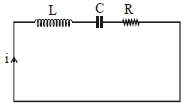
A $LCR$ circuit behaves like a damped harmonic oscillator. Comparing it with a physical springmass damped oscillator having damping constant $\mathrm{b}$, the correct equivalence would be:
JEE MAIN 2020, Diffcult


Download our appand get started for free
Experience the future of education. Simply download our apps or reach out to us for more information. Let's shape the future of learning together!No signup needed.*
Similar Questions
- 1The acceleration of a particle performing S.H.M. is at a distance of $3\; cm$ from the mean position is $ 12\,cm/sec^2 $. Its time period is ..... $\sec$View Solution
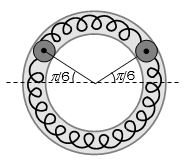
- 2Two identical balls A and B each of mass 0.1 kg are attached to two identical massless springs. The spring mass system is constrained to move inside a rigid smooth pipe bent in the form of a circle as shown in the figure. The pipe is fixed in a horizontal plane. The centres of the balls can move in a circle of radius 0.06 m. Each spring has a natural length of 0.06$\pi$ m and force constant 0.1N/m. Initially both the balls are displaced by an angle $\theta = \pi /6$ radian with respect to the diameter $PQ$ of the circle and released from rest. The frequency of oscillation of the ball B isView Solution
- 3Two particles are performing simple harmonic motion in a straight line about the same equilibrium point. The amplitude and time period for both particles are same and equal to $A$ and $T,$ respectively. At time $t=0$ one particle has displacement $A$ while the other one has displacement $\frac {-A}{2}$ and they are moving towards each other. If they cross each other at time $t,$ then $t$ isView Solution
- 4View SolutionIf a body is released into a tunnel dug across the diameter of earth, it executes simple harmonic motion with time period
- 5View SolutionA pendulum is swinging in an elevator. Its period will be greatest when the elevator is
- 6Two simple harmonic waves having equal amplitudes of $8\,cm$ and equal frequency of $10\,Hz$ are moving along the same direction. The resultant amplitude is also $8\,cm$. The phase difference between the individual waves is $..................$ degree.View Solution
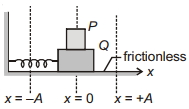
- 7In the figure shown, there is friction between the blocks $P$ and $Q$ but the contact between the block $Q$ and lower surface is frictionless. Initially the block $Q$ with block $P$ over it lies at $x=0$, with spring at its natural length. The block $Q$ is pulled to right and then released. As the spring - blocks system undergoes $S.H.M.$ with amplitude $A$, the block $P$ tends to slip over $Q . P$ is more likely to slip atView Solution
- 8A particle performs simple harmonic oscillation of period $T$ and the equation of motion is given by;View Solution
$x = a\,\sin \,\left( {\omega t + \pi /6} \right)$
After the elapse of what fraction of the time period the velocity of the particle will be equal to half of its maximum velocity?
- 9An oscillator of mass $M$ is at rest in its equilibrium position in a potential $V\, = \,\frac{1}{2}\,k{(x - X)^2}.$ A particle of mass $m$ comes from right with speed $u$ and collides completely inelastically with $M$ and sticks to it . This process repeats every time the oscillator crosses its equilibrium position .The amplitude of oscillations after $13$ collisions is: $(M = 10,\, m = 5,\, u = 1,\, k = 1 ).$View Solution
- 10A particle starts simple harmonic motion from the mean position. Its amplitude is $a$ and total energy $E$. At one instant its kinetic energy is $3E/4.$ Its displacement at that instant isView Solution