A particle of mass m is attached to a spring (of spring constant k) and has a natural angular frequency ${\omega _0}$ - An external force $F (t)$ proportional to $\cos \omega \,t((\omega \ne {\omega _0})$ is applied to the oscillator. The time displacement of the oscillator will be proportional to
AIEEE 2004, Medium


Download our appand get started for free
Experience the future of education. Simply download our apps or reach out to us for more information. Let's shape the future of learning together!No signup needed.*
Similar Questions
- 1You are holding a shallow circular container of radius $R$, filled with water to a height $h ( h < < R )$. When yon walk with speed $v$, it is seen that water starts spilling over. This happens due to the resonance of the periodic impulse given to the container (due to walking) with the oscillation of the water in the container. If the time period of water oscillating in the container is inversely proportional to $\sqrt{ h }$, then $v$ is proportional toView Solution
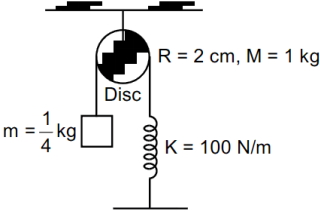
- 2View SolutionFor the system given below, find the angular frequency of oscillation ?
- 3View SolutionA second's pendulum is mounted in a rocket. Its period of oscillation decreases when the rocket
- 4A body is executing simple harmonic motion of amplitude $a$ and period $T$ about the equilibrium position $x=0$. Large numbers of snapshots are taken at random of this body in motion. The probability of the body being found in a very small interval $x$ to $x+|d x|$ is highest atView Solution
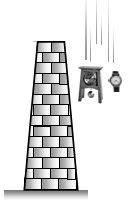
- 5A man having a wrist watch and a pendulum clock rises on a $TV$ tower. The wrist watch and pendulum clock per chance fall from the top of the tower. ThenView Solution
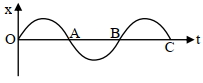
- 6The variation of displacement with time of a particle executing free simple harmonic motion is shown in the figure. The potential energy ${U}({x})$ versus time $({t})$ plot of the particle is correctly shown in figure:View Solution
- 7A block of mass $m$ is suspended separately by two different springs have time period $t_1$ and $t_2$ . If same mass is connected to parallel combination of both springs, then its time period will beView Solution
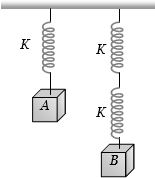
- 8The springs shown are identical. When $A = 4kg$, the elongation of spring is $1\, cm$. If $B = 6\,kg$, the elongation produced by it is ..... $ cm$View Solution
- 9$y = 2\, (cm)\, sin\,\left[ {\frac{{\pi t}}{2} + \phi } \right]$ what is the maximum acceleration of the particle doing the $S.H.M.$View Solution
- 10View SolutionIn forced oscillations, a particle oscillates simple harmonically with frequency equal to