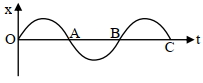
The variation of displacement with time of a particle executing free simple harmonic motion is shown in the figure. The potential energy ${U}({x})$ versus time $({t})$ plot of the particle is correctly shown in figure:
JEE MAIN 2021, Medium
Download our app for free and get started
Potential energy is maximum at maximum distance from mean.

Download our appand get started for free
Experience the future of education. Simply download our apps or reach out to us for more information. Let's shape the future of learning together!No signup needed.*
Similar Questions
- 1A particle executes a simple harmonic motion of time period $T$. Find the time taken by the particle to go directly from its mean position to half the amplitudeView Solution
- 2View SolutionA graph of the square of the velocity against the square of the acceleration of a given simple harmonic motion is
- 3The variation of the acceleration $a$ of the particle executing $S.H.M.$ with displacement $x$ is as shown in the figureView Solution
- 4A particle of mass m is executing oscillations about the origin on the $X-$axis. Its potential energy is $U(x) = k{[x]^3}$, where $k$ is a positive constant. If the amplitude of oscillation is $a$, then its time period $T$ isView Solution
- 5A particle executes simple hormonic motion between $x =\, -A$ and $x = +A$ . It starts from $x = 0$ moves in $+x-$ direction. The time taken for it to move from $x = 0$ to $x = \frac {A}{2}$ is $T_1$ and to move from $\frac {A}{2}$ to $\frac {A}{\sqrt 2}$ is $T_2$ , thenView Solution
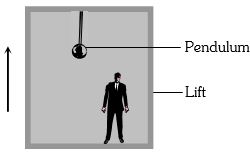
- 6A man measures the period of a simple pendulum inside a stationary lift and finds it to be $T$ sec. If the lift accelerates upwards with an acceleration $\frac{g}{4}$, then the period of the pendulum will beView Solution
- 7The displacement of a particle moving in $S.H.M.$ at any instant is given by $y = a\sin \omega t$. The acceleration after time $t = \frac{T}{4}$ is (where $T$ is the time period)View Solution
- 8A ring is suspended from a point $S$ on its rim as shown in the figure. When displaced from equilibrium, it oscillates with time period of $1\,second.$ The radius of the ring is ..... $m$ (take $g = \pi ^2$ )View Solution

- 9View SolutionThe velocity of simple pendulum is maximum at
- 10View SolutionThe velocity of a particle performing simple harmonic motion, when it passes through its mean position is