$A$ particle of mass m is constrained to move on $x$ -axis. $A$ force $F$ acts on the particle. $F$ always points toward the position labeled $E$. For example, when the particle is to the left of $E, F$ points to the right. The magnitude of $F$ is a constant $F$ except at point $E$ where it is zero. The system is horizontal. $F$ is the net force acting on the particle. The particle is displaced a distance $A$ towards left from the equilibrium position $E$ and released from rest at $t = 0.$ Find minimum time it will take to reach from $x = - \frac{A}{2}$ to $0$.
Advanced


Download our appand get started for free
Experience the future of education. Simply download our apps or reach out to us for more information. Let's shape the future of learning together!No signup needed.*
Similar Questions
- 1A simple pendulum oscillating in air has period $T.$ The bob of the pendulum is completely immersed in a non-viscous liquid. The density of the liquid is $\frac {1}{16}$ of the material of the bob. If the bob is inside liquid all the time, its period of oscillation in this liquid isView Solution
- 2A particle doing simple harmonic motion, amplitude $= 4\, cm$, time period $= 12\, sec$. The ratio between time taken by it in going from its mean position to $2 \,cm$ and from $2\, cm$ to extreme position isView Solution
- 3A vibratory motion is represented by $x = 2\,A\,\cos \,\omega t + A\,\cos \,\left( {\omega t + \frac{\pi }{2}} \right) + A\,\cos \,\left( {\omega t + \pi } \right) + \frac{A}{2}\,\cos \,\left( {\omega t + \frac{{3\pi }}{2}} \right)$ The resultant amplitude of motion isView Solution
- 4Which graph represents the difference between total energy and potential energy of a particle executing $SHM$ Vs it's distance from mean position?View Solution
- 5A block of mass $m$ is having two similar rubber ribbons attached to it as shown in the figure. The force constant of each rubber ribbon is $K$ and surface is frictionless. The block is displaced from mean position by $x\,cm$ and released. At the mean position the ribbons are underformed. Vibration period isView Solution
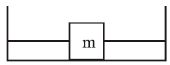
- 6A mass at the end of a spring executes harmonic motion about an equilibrium position with an amplitude $A.$ Its speed as it passes through the equilibrium position is $V.$ If extended $2A$ and released, the speed of the mass passing through the equilibrium position will beView Solution
- 7A pendulum has time period $T$ in air. When it is made to oscillate in water, it acquired a time period $T' = \sqrt 2 T$. The density of the pendulum bob is equal to (density of water $= 1$)View Solution
- 8If the length of a pendulum is made $9$ times and mass of the bob is made $4$ times then the value of time period becomesView Solution
- 9The velocity of a particle in simple harmonic motion at displacement $y$ from mean position isView Solution
- 10One end of a long metallic wire of length $L$ is tied to the ceiling. The other end is tied to massless spring of spring constant $K$. A mass $ m$ hangs freely from the free end of the spring. The area of cross-section and Young's modulus of the wire are $A$ and $Y$ respectively. If the mass is slightly pulled down and released, it will oscillate with a time period $T$ equal toView Solution