A particle of mass m is hanging vertically by an ideal spring of force constant K. If the mass is made to oscillate vertically, its total energy is
Easy


Download our appand get started for free
Experience the future of education. Simply download our apps or reach out to us for more information. Let's shape the future of learning together!No signup needed.*
Similar Questions
- 1In forced oscillation of a particle the amplitude is maximum for a frequency $\omega_{1}$ of the force, while the energy is maximum for a frequency $\omega_{2}$ of the force, thenView Solution
- 2A simple pendulum suspended from the ceiling of a stationary lift has period $T_0$. When the lift descends at steady speed, the period is $T_1$, and when it descends with constant downward acceleration, the period is $T_2$. Which one of the following is true?View Solution
- 3A pendulum bob has a speed of $3\, {m} / {s}$ at its lowest position. The pendulum is $50 \,{cm}$ long. The speed of bob, when the length makes an angle of $60^{\circ}$ to the vertical will be $ .......\,{m} / {s}$ $\left(g=10 \,{m} / {s}^{2}\right)$View Solution
- 4A spring executes $SHM$ with mass of $10\,kg$ attached to it. The force constant of spring is $10\,N/m$.If at any instant its velocity is $40\,cm/sec$, the displacement will be .... $m$ (where amplitude is $0.5\,m$)View Solution
- 5View SolutionThe phase difference between displacement and acceleration of a particle in a simple harmonic motlon is
- 6The velocity of a particle executing SHM varies with displacement $( x )$ as $4 v ^2=50- x ^2$. The time period of oscillations is $\frac{x}{7} s$. The value of $x$ is $............$ $\left(\right.$ Take $\left.\pi=\frac{22}{7}\right)$View Solution
- 7Two springs of force constants $300\, N / m$ (Spring $A$) and $400$ $N / m$ (Spring $B$ ) are joined together in series. The combination is compressed by $8.75\, cm .$ The ratio of energy stored in $A$ and $B$ is $\frac{E_{A}}{E_{B}} .$ Then $\frac{E_{A}}{E_{B}}$ is equal toView Solution
- 8A vibratory motion is represented by $x = 2A\,\cos \omega t + A\,\cos \,\left( {\omega t + \frac{\pi }{2}} \right) + A\,\cos \,\left( {\omega t + \pi } \right)$ $ + \frac{A}{2}\,\cos \left( {\omega t + \frac{{3\pi }}{2}} \right)$. The resultant amplitude of the motion isView Solution
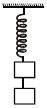
- 9Two small bodies of mass of $2\, kg$ each attached to each other using a thread of length $10\, cm$, hang on a spring whose force constant is $200\, N/m$, as shown in the figure. We burn the thread. What is the distance between the two bodies when the top body first arrives at its highest position .... $cm$ ? (Take $\pi^2 = 10$)View Solution
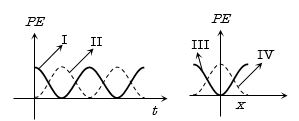
- 10For a particle executing $S.H.M.$ the displacement $x$ is given by $x = A\cos \omega t$. Identify the graph which represents the variation of potential energy $(P.E.)$ as a function of time $t$ and displacement $x$View Solution