In forced oscillation of a particle the amplitude is maximum for a frequency $\omega_{1}$ of the force, while the energy is maximum for a frequency $\omega_{2}$ of the force, then
AIEEE 2004, Medium


Download our appand get started for free
Experience the future of education. Simply download our apps or reach out to us for more information. Let's shape the future of learning together!No signup needed.*
Similar Questions
- 1A $3\ kg$ sphere dropped through air has a terminal speed of $25\ m/s$. (Assume that the drag force is $-bv$.) Now suppose the sphere is attached to a spring of force constant $k = 300\ N/m$, and that it oscillates with an initial amplitude of $20\ cm$. What is the angular frequencu of its damped $SHM$? ..... $rad/s$View Solution
- 2The distance covered by a particle undergoing $SHM$ in one time period is (amplitude $= A$)View Solution
- 3A body is executing simple harmonic motion of amplitude $a$ and period $T$ about the equilibrium position $x=0$. Large numbers of snapshots are taken at random of this body in motion. The probability of the body being found in a very small interval $x$ to $x+|d x|$ is highest atView Solution
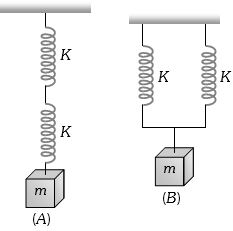
- 4Two identical spring of constant $K$ are connected in series and parallel as shown in figure. A mass $m$ is suspended from them. The ratio of their frequencies of vertical oscillations will beView Solution
- 5A particle of mass $m$ performs $SHM$ along a straight line with frequency $f$ and amplitude $A.$View Solution
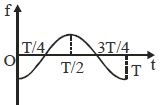
- 6A body is performing simple harmonic motion with amplitude a and time period $T$. Variation of its acceleration $(f)$ with time $(t)$ is shown in figure. If at time $t$, velocity of the body is $v$, which of the following graphs is correctView Solution
- 7If a spring of stiffness $k$ is cut into two parts $A$ and $B$ of length $l_{A}: l_{B}=2: 3$, then the stiffness of spring $A$ is given byView Solution
- 8A particle moves in $xy$ plane according to the law $x = a \sin \omega t$ and $y = a(1-\cos \omega t)$ where $a$ and $\omega$ are constants. The particle tracesView Solution
- 9Astone is swinging in a horizontal circle $0.8\, m$ in diameter at $30 \,rev / min.$ Adistant horizontal light beam causes a shadow of the stone to be formed on a nearly vertical wall. The amplitude and period of the simple harmonic motion for the shadow of the stone areView Solution
- 10A pendulum is suspended in a lift and its period of oscillation when the lift is stationary is $T_0$. What must be the acceleration of the lift for the period of oscillation of the pendulum to be $T_0/2$ ?View Solution