Question
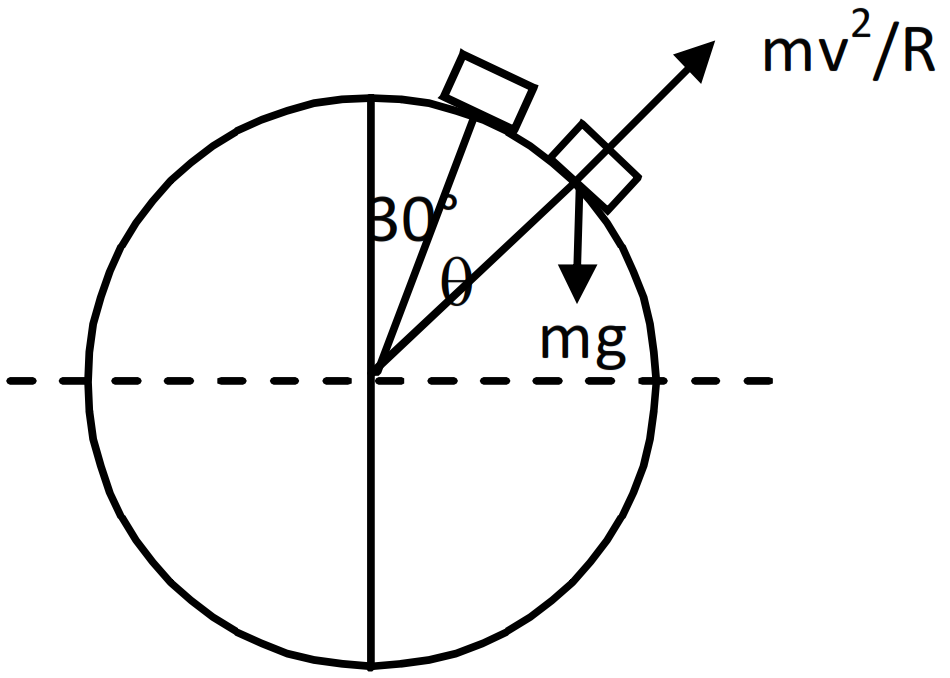
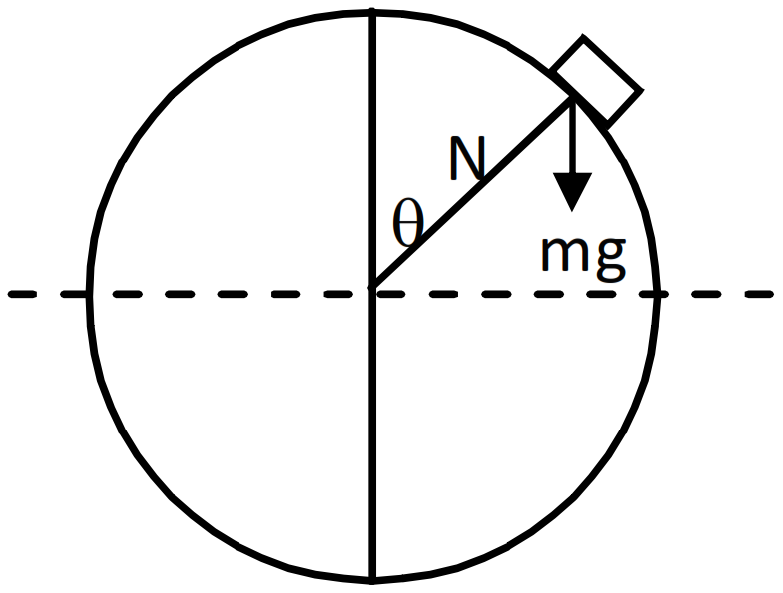
A particle of mass m is kept on a fixed, smooth sphere of radius R at a position, where the radius through the particle makes an angle of 30° with the vertical. The particle is released from this position.
  1. What is the force exerted by the sphere on the particle just after the release?
  2. Find the distance travelled by the particle before it leaves contact with the sphere.
Answer

  1.  


When the particle is released from rest (fig), the centrifugal force is zero. N force is zero $=\text{mg}\cos\theta$

$=\text{mg}\cos30^\circ=\frac{\sqrt3\text{mg}}{2}$
  1.  


When the particle leaves contact with the surface (fig), N = 0.

So, $\frac{\text{mv}^2}{\text{R}}\text{mg}\cos\theta$

$\Rightarrow\text{v}^2=\text{Rg}\cos\theta\ \dots(1)$

Again, $\frac{1}{2}\text{mv}^2=\text{mgR}(\cos30^\circ-\cos\theta)$

$\Rightarrow\text{v}^2=2\text{Rg}\Big(\frac{\sqrt3}{2}-\cos\theta\Big)\ \dots(2)$

From equn. (1) and equn. (2),

$\text{Rg}\cos\theta=\sqrt3\text{Rg}-2\text{Rg}\cos\theta$

$\Rightarrow3\cos\theta=\sqrt3$

$\Rightarrow\cos\theta=\frac{1}{\sqrt3}$

$\Rightarrow\theta=\cos^{-1}\frac{1}{\sqrt3}$

So, the distance travelled by the particle before leaving contact,

$\ell=\text{R}\Big(\theta-\frac{\pi}{6}\Big)$ $\Big[\text{because}30^\circ=\frac{\pi}{6}\Big]$

putting the value of $\theta,$ we get $\ell=0.43\text{R}$

Need a full question paper?

Generate a complete, print-ready paper with questions like this in minutes — across 16+ boards, with answer keys.

Start Generating Free

Similar questions

A constant force acting on a body of mass 3.0kg changes its speed from $2.0ms^{-1}$ to $3.5ms^{-1}$ in $25s$. The direction of the motion of the body remains unchanged. What is the magnitude and direction of the force?
A point particle of mass $0.1kg$ is executing S.H.M. of amplitude of $0.1m$. When the particle passes through the mean position, its kinetic energy is $8 \times 10^{-3}$ joule. Obtain the equation of motion of this particle if the initial phase of oscillation is $45^\circ$
If the tension in the string in figure is 16N and the acceleration of each block is $0.5m/s^2$, find the friction coefficients at the two contacts with the blocks.
A rectangular box lies on a rough inclined surface. The coefficient of friction between the surface and the box is $\mu$. Let the mass of the box be m.
  1. At what angle of inclination $\theta$ of the plane to the horizontal will the box just start to slide down the plane?
  2. What is the force acting on the box down the plane, if the angle of inclination of the plane is increased to a $\theta>$?
  3. What is the force needed to be applied upwards along the plane to make the box either remain stationary or just move up with uniform speed?
  4. What is the force needed to be applied upwards along the plane to make the box move up the plane with acceleration a?
The motion of a particle executing simple harmonic motion is described by the displacement function,$\text{x(t)}=\text{A}\cos(\omega\text{t}+\phi).$
If the initial (t = 0) position of the particle is 1cm and its initial velocity is $\omega\text{ cm/s,}$ what are its amplitude and initial phase angle? The angular frequency of the particle is $\pi\text{s}^{-1}.$ If instead of the cosine function, we choose the sine function to describe the SHM: $\text{x}=\text{B}\sin(\omega\text{t}+\alpha),$ what are the amplitude and initial phase of the particle with the above initial conditions.
A curved surface is shown in. The portion BCD is free of friction. There are three spherical balls of identical radii and masses. Balls are released from rest one by one from A which is at a slightly greater height than C.
With the surface AB, ball 1 has large enough friction to cause rolling down without slipping, ball 2 has a small friction and ball 3 has a negligible friction.
  1. For which balls is total mechanical energy conserved?
  2. Which ball (s) can reach D?
  3. For balls which do not reach D, which of the balls can reach back A?
The two blocks in an Atwood machine have masses $2.0kg$ and $3.0kg$. Find the work done by gravity during the fourth second after the system is released from rest.
A composite wire of diameter 1 cm consisting of copper and steel wire of lengths 2.2 m and 2.0 m respectively. Total extension of the wire, when stretched by a force is 1.2 mm . Calculate the force given that Young's modulus for copper is $1.1 \times 10^{11} \mathrm{~Pa}$ and for steel is $2.0 \times 10^{11} \mathrm{~Pa}$.
Explain by making a labelled diagram of two dimensional collision or oblique collision.
The plates of a capacitor of capacitance $10\mu\text{F},$ charged to $60\mu\text{C},$ are joined together by a wire of resistance $10\Omega$ at t = 0. Find the charge on the capacitor in the circuit at (a) t = 0 (b) $\text{t}=30\mu\text{s}$ (c) $\text{t}=120\mu\text{s}$ and (d) t = 1.0ms.