Question
A point particle of mass $0.1kg$ is executing S.H.M. of amplitude of $0.1m$. When the particle passes through the mean position, its kinetic energy is $8 \times 10^{-3}$ joule. Obtain the equation of motion of this particle if the initial phase of oscillation is $45^\circ$
Answer

The displacement of a particle in S.H.M is given by$\text{y}=\text{a}\sin(\omega\text{t}+\phi)$
Velocity $=\frac{\text{dy}}{\text{dt}}=\omega\text{a}\cos(\omega\text{t}+\phi)$ The velocity is maximum when the particle passes through the mean position i.e.$=\Big(\frac{\text{dy}}{\text{dt}}\Big)_\text{max}=\omega\text{a}$
The kinetic energy at this instant is given by$=\frac{1}{2}\text{m}\Big(\frac{\text{dy}}{\text{dt}}\Big)^2$
$=\frac{1}{2}\text{m}\times\omega^2\text{a}^2$
$=8\times10^{-3}\text{ joule}$
$\frac{1}{2}\times(0.1)\omega^2\times(0.1)^2$
$=8\times10^{-3}\text{ joule}$
Solving we get $\omega=\pm4$ Substituting the values of a $\omega$ and $\phi$ in the equation of SHM., we get$\text{y}=0.1\sin(\pm4\text{t}+\frac{\pi}{4})\text{ metre}$

Need a full question paper?

Generate a complete, print-ready paper with questions like this in minutes — across 16+ boards, with answer keys.

Start Generating Free

Similar questions

A long wire carries a current of 4.00A. Find the energy stored in the magnetic field inside a volume ot 1.00mm at a distance of 10.0cm from the wire.
The transverse displacement of a string (clamped at its both ends) is given by
$\text{y}(\text{x, t})=0.06\sin\Big(\frac{2\pi}{3}\text{x}\Big)\cos(120\pi\text{ t})$
where x and y are in m and t in s. The length of the string is $1.5m$ and its mass is $3.0 \times 10^{–2}kg$.
Answer the following:
Determine the tension in the string.
Define root mean square velocity. How is the temperature of an ideal gas explained by the kinetic theory of gases?
A uniform chain of mass M and length L is held vertically in such a way that its lower end just touches the horizontal floor. The chain is released from rest in this position. Any portion that strikes the floor comes to rest. Assuming that the chain does not form a heap on the floor, calculate the force exerted by it on the floor when a length x has reached the floor.
Two vector forces 5 N and 3 N are acting on a particle. Find the magnitude and direction of resultant force.(a) When both the forces are in same direction.(b) When both the forces are at right angles.(c) When both the forces are inclined at angle $60^{\circ}$.
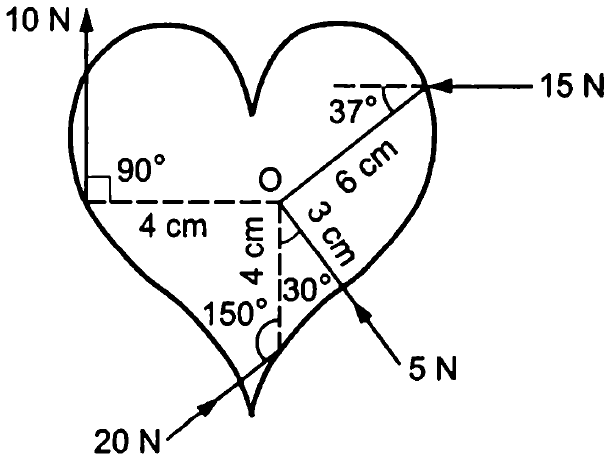
Calculate the total torque acting on the body shown in figure about the point O.
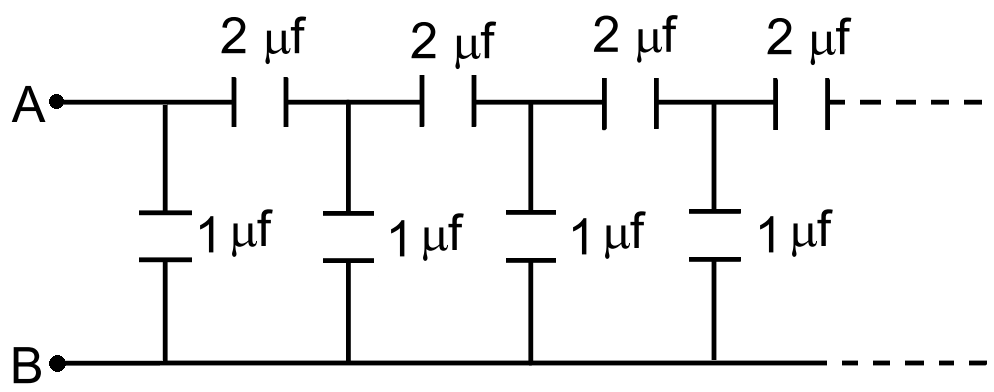
Find the equivalent capacitance of the infinite ladder shown in figure between the points A and B.
A $100kg$ gun fires a ball of $1kg$ horizontally from a cliff of height $500m$. It falls on the ground at a distance of $400m$ from the bottom of the cliff. Find the recoil velocity of the gun. (acceleration due to gravity $= 10m s^{–2}$)
The industrial revolution in England and Western Europe more than two centuries ago was triggered by some key scientific and technological advances. What were these advances?
The blades of a windmill sweep out a circle of area $A.$
  1. If the wind flows at a velocity $v$ perpendicular to the circle, what is the mass of the air passing through it in time $t?$
  2. What is the kinetic energy of the air?
  3. Assume that the windmill converts $25\%$ of the wind’s energy into electrical energy, and that $A = 30 m^2, v = 36\ km/h$ and the density of air is $1.2\ kgm^{-3}$. What is the electrical power produced?