MCQ
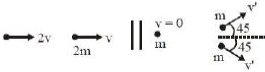
A particle of mass $m$ is moving with speed $2\, v$ collides with a mass $2\,m$ moving with speed $v$ in the same direction. After collision, the first mass is stopped completely while the second one splits into two particles each of mass $m$, which move at angle $45^o$ with respect to the original direction. The speed of each of the moving particle will be
  • A
    $v/\left( {2\sqrt 2 } \right)$
  • ${2\sqrt 2 }\,v$
  • C
    $\sqrt {2\,} v$
  • D
    $v/\sqrt 2 $

Answer

Correct option: B.
${2\sqrt 2 }\,v$
b
Linear momentum conservation

$m$ $2v + 2m v = m $$ \times \,0 + m\frac{{v'}}{{\sqrt 2 }} \times 2$

$v' = 2\sqrt 2 \,v.$

Need a full question paper?

Generate a complete, print-ready paper with questions like this in minutes — across 16+ boards, with answer keys.

Start Generating Free

Similar questions

The bob of a simple pendulum of mass m and total energy $E$ will have maximum linear momentum equal to
An ideal gas expands isothermally from a volume ${V_1}$ to ${V_2}$ and then compressed to original volume ${V_1}$adiabatically. Initial pressure is ${P_1}$ and final pressure is ${P_3}$. The total work done is $W$. Then
A particle is moving in a circular path. The acceleration and momentum of the particle at a certain moment are $\vec a = (4\hat i + 3\hat j)\ m/s^2$ and $\vec p = (8\hat i - 6\hat j)\ kg-m/s$ . The motion of the particle is
What vector must be added to the two vectors $\hat i - 2\hat j + 2\hat k$ and $2\hat i + \hat j - \hat k,$ so that the resultant may be a unit vector along $X-$axis
A rocket of initial mass $1500\, kg$ ejects gas at a constant rate of $10\, kg/s$ with a  relative speed of $5\, km/s$. ............ $ms^{-2}$ is the acceleration of the rocket $50\, seconds$ after the  blast neglecting gravity .
A diatomic ideal gas is used in a Carnot engine as the working substance. If during the adiabatic expansion part of the cycle the volume of the gas increases from $V$ to $32\ V$, the efficiency of the engine is
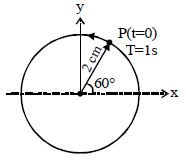
Figure shows the circular motion of a particle. The radius of the circle, the period, sense of revolution and the initial position are indicated in the figure. The simple harmonic motion of the $x-$ projection of the radius vector of the rotating particle $P$ is
A container of fixed volume has a mixture of one mole of hydrogen and one mole of helium in equilibrium at temperature $T$. Assuming the gases are ideal, the correct statement$(s)$ is(are)

$(A)$ The average energy per mole of the gas mixture is $2RT$.

$(B)$ The ratio of speed of sound in the gas mixture to that in helium gas is $\sqrt{6 / 5}$.

$(C)$ The ratio of the rms speed of helium atoms to that of hydrogen molecules is $1 / 2$.

$(D)$ The ratio of the rms speed of helium atoms to that of hydrogen molecules is $1 / \sqrt{2}$.

A glass flask is filled up to a mark with $50\, cc$ of mercury at $18°C.$ If the flask and contents are heated to $38°C.$ ......... $cc$ mercury will be above the mark $?$ $(\alpha$ for glass is $ 9 × 10^{-6}{°}C^{-1}$ and coefficient of real expansion of mercury is $180 × 10^{-6}{°}C^{-1})$ 
An iron bar of length $10\, m$ is heated from $0°C$ to $100°C.$ If the coefficient of linear thermal expansion of iron is $ 10 \times 10^{-6}{°C^{-1}}$, the increase in the length of bar is  .......... $cm$