MCQ
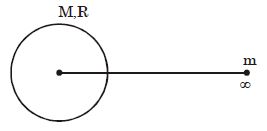
A particle of mass $m$ is released from infinity and it move towards a big solid sphere made of a jelly like material. Neglecting the resistance offered by material of sphere, find the velocity of the particle when it crosses the centre of the sphere
  • A
    $\sqrt {\frac{{2GM}}{R}} $
  • B
    $\sqrt {\frac{3}{2}\frac{{GM}}{R}} $
  • $\sqrt {\frac{{3GM}}{R}} $
  • D
    $\sqrt {\frac{{21GM}}{R}} $

Answer

Correct option: C.
$\sqrt {\frac{{3GM}}{R}} $
c
$\frac{1}{2} \mathrm{mV}^{2}=\frac{3 \mathrm{GMm}}{2 \mathrm{R}} \Rightarrow \mathrm{V}=\sqrt{\frac{3 \mathrm{GM}}{\mathrm{R}}}$

Need a full question paper?

Generate a complete, print-ready paper with questions like this in minutes — across 16+ boards, with answer keys.

Start Generating Free

Similar questions

On decreasing the temperature, surface tension:
For a black body at temperature $727^{\circ} C$, its radiating power is $60\; watt$ and temperature of surrounding is $227^{\circ} C$. If temperature of black body is changed to $1227^{\circ} C$ then its radiating power will be ..... $watt$
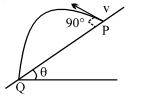
If time taken by the projectile to reach $Q$ is $T$, then $PQ$ =
If $\vec{a}$ and $\vec{b}$ makes an angle $\cos ^{-1}\left(\frac{5}{9}\right)$ with each other, then $|\vec{a}+\vec{b}|=\sqrt{2}|\vec{a}-\vec{b}|$ for $|\vec{a}|=n|\vec{b}|$ The integer value of $n$ is . . . . . . .. 
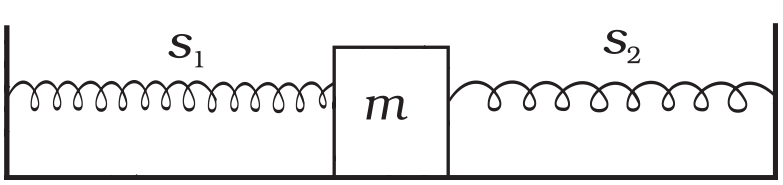
When a mass in is connected individually to two springs $S_1$ and $S_2$, the oscillation frequencies are $V_1$ and $V_2$. If the same mass is attached to the two springs as shown in figure, the oscillation frequency would be:
If the ratio of radii of two liquid drops is 1 : 2 then the ratio of their pressure excess will be
A soap bubble, having radius of $1\; \mathrm{mm}$, is blown from a detergent solution having a surface tension of $2.5 \times 10^{-2}\; N / m$. The pressure inside the bubble equals at a point $Z_{0}$ below the free surface of water in a container. Taking $g=10\; \mathrm{m} / \mathrm{s}^{2}$ density of water $=10^{3} \;\mathrm{kg} / \mathrm{m}^{3},$ the value of $\mathrm{Z}_{0}$ is......$cm$
A raindrop falling from a height h above ground, attains a near terminal velocity when it has fallen through a height (3/4)h. Which of the diagrams shown in correctly shows the change in kinetic and potential energy of the drop during its fall up to the ground?
A long horizontal rod has a bead which can slide along its length, and initially placed at a distance $L$ from one end $A$ of the rod. The rod is set in angular motion about $A$ with constant angular acceleration $\alpha$. If the coefficient of friction between the rod and the bead is $\mu$, and gravity is neglected, then the time after which the bead starts slipping is
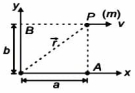
A particle is moving along a straight line parallel to $x$-axis with constant velocity. Find angular momentum about the origin in vector form