Question
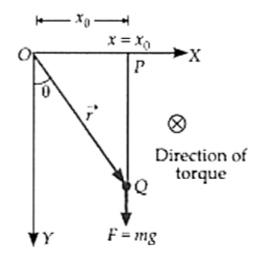
A particle of mass $m$ is released from point P at $x = x _0$ on the X -axis from origin O and falls vertically along the Y-axis, as shown in Fig.
Image

i. Find the torque $t$ acting on the particle at a time $t$ when it is at point Q with respect to O .
ii. Find the angular momentum L of the particle about O at this time t .
iii. Show that $\tau=\frac{d L}{d t}$ in this example.
Answer

i. The force of gravity, $F = mg$ produces the torque $\tau$. Let $\vec{r}$ be the position vector of Q . Then the magnitude of the torque is given by
$
\begin{aligned}
& \tau=r F \sin \theta \\
& =r \times m g \times \frac{x_0}{r}=m g x_0 \quad\left[\because \sin \theta=\frac{x_0}{r}\right]
\end{aligned}
$
The direction of the torque is directed into the plane of paper and perpendicular to it, as shown by $\otimes$.
ii. The magnitude of the angular momentum is $L=r p \sin \theta=r m v \sin \theta$
But the velocity v at point Q is given by $v = u + at =0+ gt = gt$
$
\therefore \quad L=r m g t . \frac{x_0}{r}=m g x_0 t
$
The direction of angular momentum is the same as that of torque.
iii. Now $L = mgx _0 t$
Differentiating both sides with respect to $f$, we get
$
\frac{d L}{d t}=\frac{d}{d t}\left(m g x_0 t\right)=m g x_0=\tau
$
Hence the relation $\tau=\frac{d L}{d}$ holds in this example.

Need a full question paper?

Generate a complete, print-ready paper with questions like this in minutes — across 16+ boards, with answer keys.

Start Generating Free

Similar questions

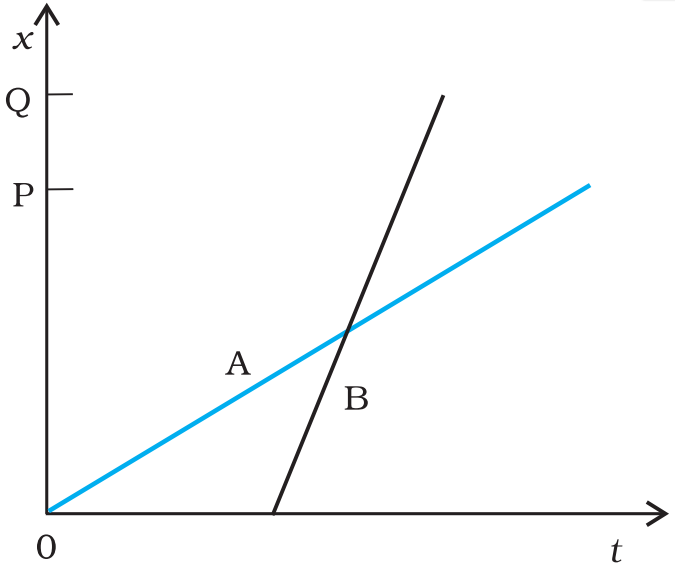
The position$-$time $(x-t)$ graphs for two children $A$ and $B$ returning from their school $O$ to their homes $P$ and $Q$ respectively are shown in Choose the correct entries in the brackets below;
  1. $(A/B)$ lives closer to the school than $(B/A)$.
  2. $(A/B)$ starts from the school earlier than $(B/A)$.
  3. $(A/B)$ walks faster than $(B/A)$.
  4. A and B reach home at the $($same$/$different$)$ time.
  5. $(A/B)$ overtakes $(B/A)$ on the road $($once$/$twice$)$.
A 250g block slides on a rough horizontal table. Find the work done by the frictional force in bringing the block to rest if it is initially moving at a speed of 40cm/s. If the friction coefficient between the table and the block is 0.1, how far does the block move before coming to rest?
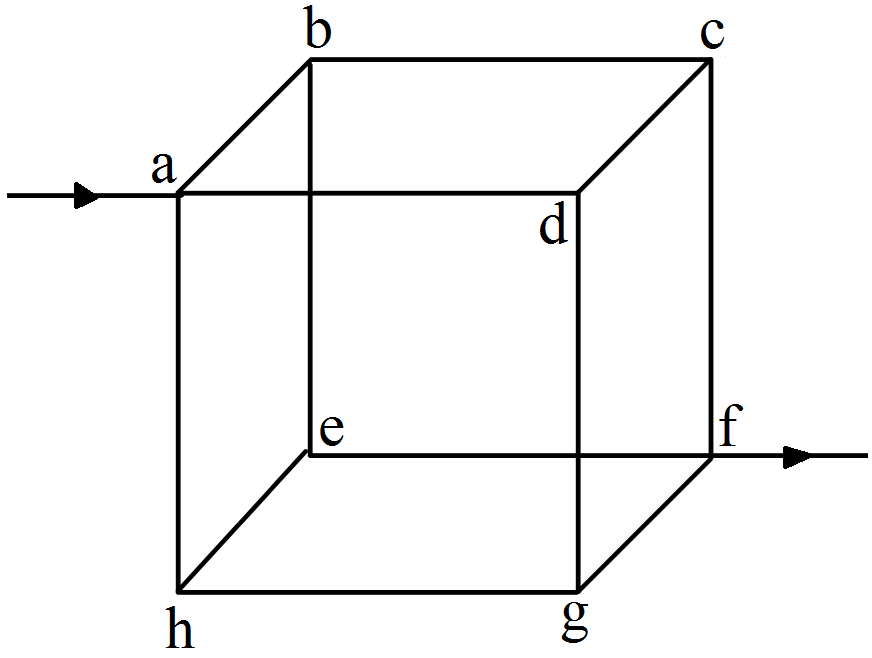
Twelve wires, each of equal resistance r, are joined to form a cube, as shown in the figure. Find the equivalent resistance between the diagonally opposite points a and f.
A beam of monochromatic light of wavelength $\lambda$ ejects photoelectrons from a cesium surface $\big(\Phi=1.9\text{eV}\big).$ These photoelectrons are made to collide with hydrogen atoms in ground state. Find the maximum value of $\lambda$ for which (a) hydrogen atoms may be ionized, (b) hydrogen atoms may get excited from the ground state to the first excited state and (c) the excited hydrogen atoms may emit visible light.
One end of a light spring of natural length d and spring constant k is fixed on a rigid wall and other end is fixed in a smooth ring of mass m as shown in figure. Initially, the spring is stretched such that it makes an angle of $37^\circ$ with the horizontal.
Now, the ring is stretched from rest, find the speed of the ring when it will become horizontal, assume that ring slides on the vertical wall without friction.
A source of frequency $250Hz$ produces sound waves of wavelength $1.32m$ in a gas at STP. Calculate the change in the wavelength, when temperature of the gas is $40°C$.
Consider the situation of the previous problem. Suppose each of the blocks is pulled by a constant force F instead of any impulse. Find the maximum elongation that the spring will suffer and the distances moved by the two blocks in the process.
What is thermal expansion of gases? Prove that the value of volume coefficient and pressure coefficient are equal.
What are force and inertia? Explain with examples.
The $\text{K}_\alpha$ X-rays of aluminium (Z = 13) and zinc (Z = 30) have wavelengths 887pm and 146pm respectively. Use Moseley's law $\sqrt{\text{v}}=\text{a}(\text{z-b})$ to find the wavelengths of the $\text{K}_\alpha$ X-ray of iron (Z = 26).