Question
What are force and inertia? Explain with examples.

Answer

self

Need a full question paper?

Generate a complete, print-ready paper with questions like this in minutes — across 16+ boards, with answer keys.
Start Generating Free

Similar questions

The length of a second’s pendulum on the surface of Earth is 1m. What will be the length of a second’s pendulum on the moon?
In an experiment on the specific heat of a metal, a 0.20 kg block of the metal at $150^{\circ} \mathrm{C}$ is dropped in a copper calorimeter (of water equivalent 0.025 kg ) containing $150 \mathrm{~cm}^3$ of water at $27^{\circ} \mathrm{C}$. The final temperature is $40^{\circ} \mathrm{C}$. Compute the specific heat of the metal. If heat losses to the surroundings are not negligible, is your answer greater or smaller than the actual value for specific heat of the metal?
Explain the resolution of a vector in a threedimensional coordinate system and prove that
$
|\overrightarrow{A}|=\sqrt{A_x^2+A_y^2+A_z^2}
$
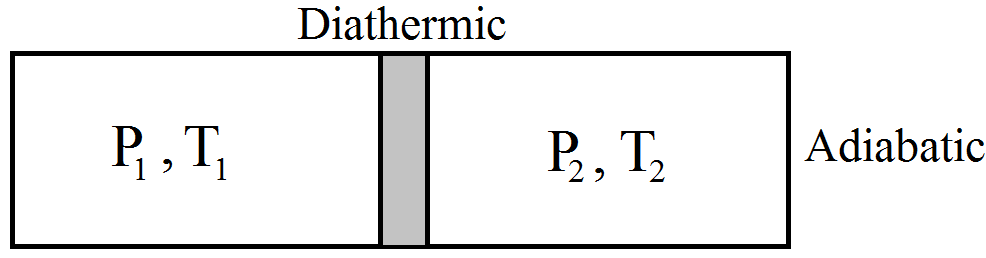
Figure. shows a cylindrical tube of volume V with adiabatic walls containing an ideal gas. The internal energy of this ideal gas is given by 1.5nRT. The tube is divided into two equal parts by a fixed diathermic wall. Initially, the pressure and the temperature are $P_1, T_1$ on the left and $p_2, T_2$ on the right. The system is left for sufficient time so that the temperature becomes equal on the two sides.
  1. How much work has been done by the gas on the left part?
  2. Find the final pressures on the two sides.
  3. Find the final equilibrium temperature.
  4. How much heat has flown from the gas on the right to the gas on theleft?
A drunkard walking in a narrow lane takes 5 steps forward and 3 steps backward, followed again by 5 steps forward and 3 steps backward, and so on. Each step is 1m long and requires 1s. Plot the x-t graph of his motion. Determine graphically and otherwise how long the drunkard takes to fall in a pit 13m away from the start.
A charge of $1\mu\text{C}$ is given to one plate of a parallel-plate capacitor of capacitance $0.1\mu\text{F}$ and a charge of $2\mu\text{C}$ is given to the other plate. Find the potential difference developed between the plates.
Read statement below carefully and state with reasons and examples, if it is true or false; A particle in one-dimensional motion. With positive value of acceleration must be speeding up.
The electric field in a region is given by $\overrightarrow{\text{E}}=\frac{\text{E}_0\text{x}}{\text{l}}\vec{\text{i}}.$ Find the charge contained inside a cubical volume bounded by the surfaces $x = 0, x = a, y = 0, y = a, z = 0$ and $z = a$. Take $E_0 = 5 \times 10^3Nc^{-1}, l = 2cm$ and $a = 1cm$.
A long solenoid of radius $2cm$ has $100$ turns/cm and carries a current of $5A$. A coil of radius 1cm having $100$ turns and a total resistance of $2\Omega$ is placed inside the solenoid coaxially. The coil is connected to a galvanometer. If the current in the solenoid is reversed in direction, find the charge flown through the galvanometer.
A comet revolves around the sun in a highly elliptical orbit having a minimum distance of $7 \times 10^{10}m$ and a maximum distance of $1.4 \times 10^{13}m$. If its speed while nearest to the Sun is $60km s^{-1}$, find its linear speed when situated farthest from the Sun.