A particle of mass $m$ moves in a one-dimensional potential energy $U(x) = -ax^2 + bx^4,$ where $'a'$ and $'b'$ are positive constants. The angular frequency of small oscillations about the minima of the potential energy is equal to
Advanced


Download our appand get started for free
Experience the future of education. Simply download our apps or reach out to us for more information. Let's shape the future of learning together!No signup needed.*
Similar Questions
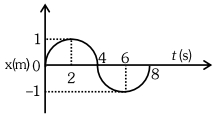
- 1The $x-t$ graph of a particle performing simple harmonic motion is shown in the figure. The acceleration of the particle at $t=2 s$ is :View Solution
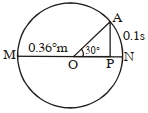
- 2The point $A$ moves with a uniform speed along the circumference of a circle of radius $0.36\, m$ and covers $30^{\circ}$ in $0.1\, s$. The perpendicular projection $'P'$ from $'A'$ on the diameter $MN$ represents the simple harmonic motion of $'P'.$ The restoration force per unit mass when $P$ touches $M$ will be ...... $N$View Solution
- 3The displacement equation of a particle is $x = 3\sin 2t + 4\cos 2t.$ The amplitude and maximum velocity will be respectivelyView Solution
- 4Equations $y = 2A \cos ^2 \omega \,t$ and $y = A (\sin \omega t + \cos \omega t )$ represent the motion of two particles.View Solution
- 5A plank with a small block on top of it is under going vertical $SHM.$ Its period is $2\, sec.$ The minimum amplitude at which the block will separate from plank is :View Solution
- 6$Assertion :$ Resonance is a special case of forced vibration in which the natural frequency of vibration of the body is the same as the impressed frequency of external periodic force and the amplitude of forced vibration is maximum.View Solution
$Reason :$ The amplitude of forced vibrations of a body increases with an increase in the frequency of the externally impressed periodic force. - 7Two particles are executing $SHM$ in a straight line. Amplitude $'A'$ and time period $'T'$ of both the particles are equal. At time $t = 0$ one particle is at displacement $x_1 = +A$ and other at ${x_2} = \frac{{ - A}}{2}$ and they are approaching towards each other. Time after which they will cross each other isView Solution
- 8Column $I$ gives a list of possible set of parameters measured in some experiments. The variations of the parameters in the form of graphs are shown in Column $II$. Match the set of parameters given in Column $I$ with the graph given in Column $II$. Indicate your answer by darkening the appropriate bubbles of the $4 \times 4$ matrix given in the $ORS$.View Solution
Column $I$ Column $II$ $(A)$ Potential energy of a simple pendulum (y axis) as a function of displacement ( $\mathrm{x}$ axis) $Image$ $(B)$ Displacement (y axis) as a function of time (x axis) for a one dimensional motion at zero or constant acceleration when the body is moving along the positive $\mathrm{x}$-direction $Image$ $(C)$ Range of a projectile (y axis) as a function of its velocity ( $\mathrm{x}$ axis) when projected at a fixed angle $Image$ $(D)$ The square of the time period (y axis) of a simple pendulum as a function of its length ( $\mathrm{x}$ axis) $Image$ 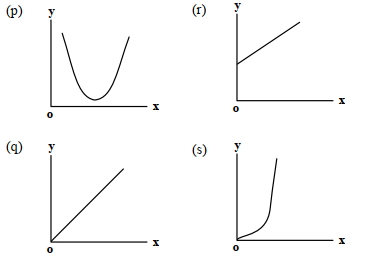
- 9A particle executes $S.H.M.,$ the graph of velocity as a function of displacement is :-View Solution
- 10A solid cylinder of density $\rho_0$, cross-section area $A$ and length $l$ floats in a liquid of density $\rho\left( >\rho_0\right)$ with its axis vertical, as shown. If it is slightly displaced downward and released, the time period will be .......View Solution