MCQ
A particle of mass $m$ moving with a velocity $\vec V$ makes a head on elastic collision with another particle of same mass initially at rest. The velocity of the first particle after the collision will be
  • A
    $\vec V$
  • B
    $ - \vec V$
  • C
    $ - 2\vec V$
  • Zero

Answer

Correct option: D.
Zero
d
(d)In perfectly elastic head on collision of equal masses velocities gets interchanged

Need a full question paper?

Generate a complete, print-ready paper with questions like this in minutes — across 16+ boards, with answer keys.

Start Generating Free

Similar questions

An object of mass $10\ kg$ is moving with velocity of $10\ ms^{-1}$. A force of $50N$ acted upon it for $2s.$ Percentage increase in its $KE$ is:
A projectile is fired from horizontal ground with speed $v$ and projection angle $\theta$. When the acceleration due to gravity is $g$, the range of the projectile is $d$. If at the highest point in its trajectory, the projectile enters a different region where the effective acceleration due to gravity is $g^{\prime}=\frac{g}{0.81}$, then the new range is $d^{\prime}=n d$. The value of $n$ is. . . . .
Consider two solid spheres $\mathrm{P}$ and $\mathrm{Q}$ each of density $8 \mathrm{gm} \mathrm{cm}^{-3}$ and diameters $1 \mathrm{~cm}$ and $0.5 \mathrm{~cm}$, respectively. Sphere $\mathrm{P}$ is dropped into a liquid of density $0.8 \mathrm{gm} \mathrm{cm}^{-3}$ and viscosity $\eta=3$ poiseulles. Sphere $Q$ is dropped into a liquid of density $1.6 \mathrm{gm} \mathrm{cm}^{-3}$ and viscosity $\eta=2$ poiseulles. The ratio of the terminal velocities of $\mathrm{P}$ and $\mathrm{Q}$ is 
A mass $m =100\, gms$ is attached at the end of a light spring which oscillates on a frictionless horizontal table with an amplitude equal to $0.16$ metre and time period equal to $2 \,sec$. Initially the mass is released from rest at $t = 0$ and displacement $x = - 0.16$ metre. The expression for the displacement of the mass at any time $t$ is
Identify the correct statements from the following:

$(A)$ Work done by a man in lifting a bucket out of a well by means of a rope tied to the bucket is negative.

$(B)$ Work done by gravitational force in lifting a bucket out of a well by a rope tied to the bucket is negative.

$(C)$ Work done by friction on a body sliding down an inclined plane is positive.

$(D)$ Work done by an applied force on a body moving on a rough horizontal plane with uniform velocity in zero.

$(E)$ Work done by the air resistance on an oscillating pendulum in negative.

Choose the correct answer from the options given below:
Assuming earth to be a sphere of a uniform density, what is the value of gravitational acceleration in a mine $100\, km$ below the earth’s surface ........ $m/{s^2}$. (Given $R = 6400 \,km$)
Consider a system of two identical particles. One of the particles is at rest and the other has an acceleration $\overrightarrow{\text{a}}.$ The centre of mass has an acceleration:
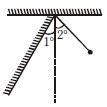
A simple pendulum of length $1\,m$ is allowed to oscillate with amplitude $2^o$. It collides elastically with a wall inclined at $1^o$ to the vertical. Its time period will be : (use $g = \pi ^2$ )
A body of mass $1\, kg$ rests on a horizontal floor with which it has a coefficient of static friction $\frac{1}{\sqrt{3}}$. It is desired to make the body move by applying the minimum possible force $F\, N$. The value of $F$ will be the Nearest Integer) [Take $g =10 \,ms ^{-2}$ ]
A right rod one meter long has two point masses, $0.1\ kg$ each, fixed at its ends. the moment of inertia of the system about a transverse axis through its centre of mass is: