MCQ
A particle of mass $m$ projected with a velocity ' $u$ ' making an angle of $30^{\circ}$ with the horizontal. The magnitude of angular momentum of the projectile about the point of projection when the particle is at its maximum height $\mathrm{h}$ is :
  •  $\frac{\sqrt{3}}{16} \frac{\mathrm{mu}^3}{\mathrm{~g}}$
  • B
     $\frac{\sqrt{3}}{2} \frac{m u^2}{g}$
  • C
     $\frac{m u^3}{\sqrt{2} g}$
  • D
    zero

Answer

Correct option: A.
 $\frac{\sqrt{3}}{16} \frac{\mathrm{mu}^3}{\mathrm{~g}}$
a
$ \mathrm{L}=m u \cos \theta H $

$ =m u \cos \theta \times \frac{u^2 \sin ^2 \theta}{2 g} $

$ =\frac{m u^3}{2 g} \times \frac{\sqrt{3}}{2} \times\left(\frac{1}{2}\right)^2=\frac{\sqrt{3} m u^3}{16 g}$

Need a full question paper?

Generate a complete, print-ready paper with questions like this in minutes — across 16+ boards, with answer keys.

Start Generating Free

Similar questions

The distance of the Sun from earth is $1.5 \times 10^{11} \,m$ and its angular diameter is $(2000) \,s$ when observed from the earth. The diameter of the Sun will be ...........
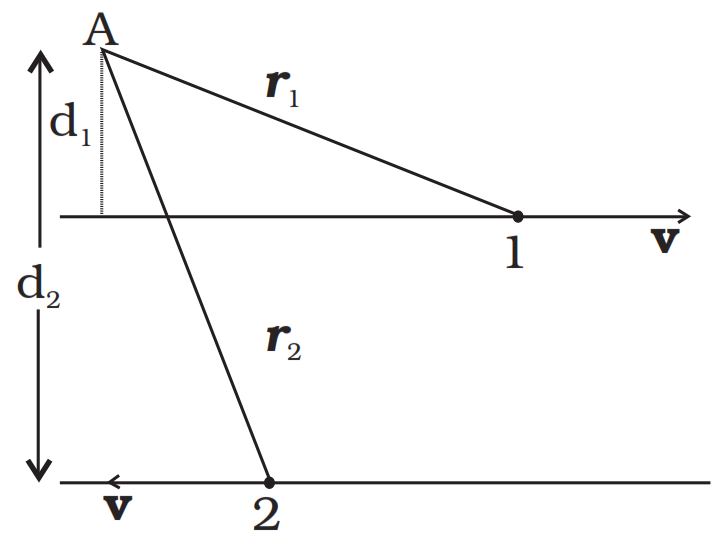
Shows two identical particles $1$ and $2$, each of mass $m,$ moving in opposite directions with same speed $v$ along parallel lines. At a particular instant, $r_1$ and $r_2$ are their respective position vectors drawn from point A which is in the plane of the parallel lines . Choose the correct options:
  1. Angular momentum $I_1$ of particle $1$ about $A$ is $I = mvd_1$
  2. Angular momentum $I_2$ of particle $2$ about $A$ is $I_2= mvr_2$
  3. Total angular momentum of the system about $A$ is $\text{I}=\text{mv}(\text{r}_1+\text{r}_2)$
  4. Total angular momentum of the system about $A$ is $\text{I}=\text{mv}(\text{d}_2-\text{d}_1)\otimes$ represents a unit vector coming out of the page. $\otimes$ represents a unit vector going into the page.
A ball of mass $ m$  moving with velocity $V$, makes a head on elastic collision with a ball of the same mass moving with velocity $2V$ towards it. Taking direction of $V$ as positive velocities of the two balls after collision are
Which of the following has unit but no dimension?
If the source of light used in a Young's double slit experiment is changed from red to violet:
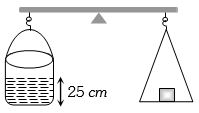
A cylinder containing water up to a height of $25 cm$  has a hole of cross-section $\frac{1}{4}c{m^2}$ in its bottom. It is counterpoised in a balance. What is the initial change in the balancing weight when water begins to flow out
Consider the following two equations:
$A. \overrightarrow{\text{R}}=\frac{1}{\text{M}}\sum\limits_{\text{i}}\text{m}_\text{i}\overrightarrow{\text{r}}_\text{i}$
$B. \overrightarrow{\text{a}}_\text{cm}=\frac{\overrightarrow{\text{F}}}{\text{M}}$
In a noninertial frame 
An object with uniform density $\rho$ is attached to a spring that is known to stretch linearly with applied force as shown below.When the spring object system is immersed in a liquid of density $\rho_1$ as shown in the above figure, the spring stretches by an amount $x_1\left(\rho > \rho_1\right)$. When the experiment is repeated in a liquid of density $\left(\rho_2 < \rho_1\right)$, the spring stretches by an amount $x_2$. Neglecting any buoyant force on the spring, the density of the object is
The angular velocity ( $rad / s$ ) of the minute hand of a hand clock is
In a situation the contact force by a rough horizontal surface on a body placed on it has constant magnitude. If the angle between this force and the vertical is decreased, the frictional force between the surface and the body will: