Question
A particle on a stretched string supporting a travelling wave, takes 5.0ms to move from its mean position to the extreme position. The distance between two consecutive particles, which are at their mean positions, is 2.0cm. Find the frequency, the wavelength and the wave speed.
Answer

Time period, $\text{T}=4\times5\text{ms}$

$=20\times10^{-3}$

$=2\times10^{-2}\text{s}$

$\Rightarrow\lambda=2\times2\text{cm}$

$=4\text{cm}$

Frequency, $\text{f}=\frac{1}{\text{T}}$

$=\frac{1}{(2\times10^{-2})}=50\text{s}^{-1}$

$=50\text{Hz}$

Wave speed = $\lambda\text{f}=4\times50\text{m/s}$

$=2000\text{m/s}$

$=2\text{m/s}$

Need a full question paper?

Generate a complete, print-ready paper with questions like this in minutes — across 16+ boards, with answer keys.

Start Generating Free

Similar questions

A bullet fired at an angle of 30° with the horizontal hits the ground 3.0km away. By adjusting its angle of projection, can one hope to hit a target 5.0km away? Assume the muzzle speed to be fixed, and neglect air resistance.
A liquid cools from 70°C to 60°C in 5 minutes. Calculate the time taken by the liquid to cool from 60°C to 50°C, if the temperature of the surrounding is constant at 30°C.
Establish the following vector inequalities geometrically or otherwise:
$|\text{a}+\text{b}|\le|\text{a}|+|\text{b}|$
When does the equality sign above apply?
On a two-lane road, car A is travelling with a speed of 36km h–1. Two cars B and C approach car A in opposite directions with a speed of 54km h–1 each. At a certain instant, when the distance AB is equal to AC, both being 1km, B decides to overtake A before C does. What minimum acceleration of car B is required to avoid an accident?
A parallel-plate capacitor of plate area 40cm2 and separation between the plates 0.10mm, is connected to a battery of emf 2.0V through a $16\Omega$ resistor. Find the electric field in the capacitor 10ns after the connections are made.
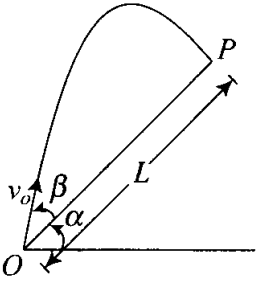
A particle is projected in air at an angle $\beta$ to a surface which itself is inclined at an angle $\alpha$ to the horizontal (Fig.).

  1. Time of flight.
(Hint: This problem can be solved in two different ways:

  1. Point P at which particle hits the plane can be seen as intersection of its trajectory (parobola) and straight line. Remember particle is projected at an angle $(\alpha+\beta)$ w.r.t. horizontal.
  2. We can take x-direction along the plane and y-direction perpendicular to the plane. In that case resolve g (acceleration due to gravity) in two differrent components, gx along the plane and gy perpendicular to the plane. Now the problem can be solved as two independent motions in x and y directions respectively with time as a common parameter.)
A mass m is placed on a platform from a height 'h'. The platform is attached to a spring whose other end is fixed to the ground. Find the compression in the spring, if the spring constant is k.
The electric potential existing m space is V(x, y, z) = A(xy + yz + zx).
  1. Write the dimensional formula of A.
  2. Find the expression for the electric field.
  3. If A is 10 SI units, find the magnitude of the electric field at (1m, 1m, 1m).
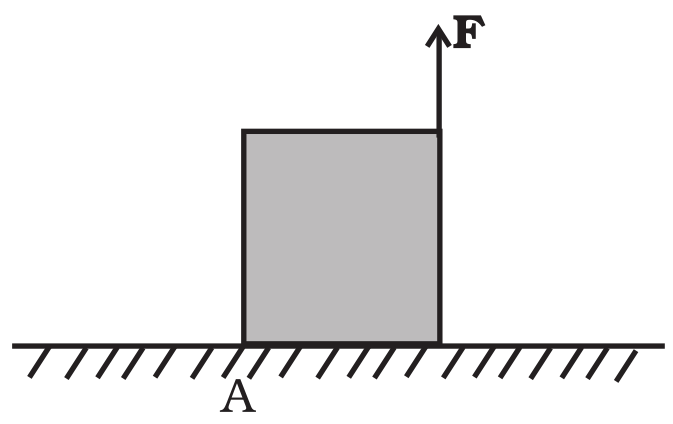
A uniform cube of mass m and side a is placed on a frictionless horizontal surface. A vertical force F is applied to the edge as shown in match the following (most appropriate choice):

a. $\frac{\text{mg}}{4}<\text{F}<\frac{\text{mg}}{2}$ i. Cube will move up.
b. $\text{F}>\frac{\text{mg}}{2}$ ii. Cube will not exhibit motion.
c. $\text{F}>\text{mg}$ iii. Cube will begin to rotate and slip at A.
d. $\text{F}=\frac{\text{mg}}{4}$ iv. Normal reaction effectively at $\frac{\text{a}}{3}$


The bob of a simple pendulum has a mass of 40g and a positive charge of 4.0 × 10-6C. It makes 20 oscillations in 45s. A vertical electric field pointing upward and of magnitude 2.5 × 104NC-1 is switched on. How much time will it now take to complete 20 oscillations?