Question
A particle performs uniform circular motion with an angular momentum L. If the frequency of particle's motion is doubled and its K.E. is halved, what happens to its angular momentum?

Answer

$\text{L}=\text{mvr}$ and $\text{v}=\text{r}\omega=\text{r}(2\pi\text{n})$
$\text{r}=\frac{\text{v}}{2\pi\text{n}}$
$\therefore\ \text{L}=\text{mv}\Big(\frac{\text{v}}{2\pi\text{n}}\Big)=\frac{\text{mv}^2}{2\pi\text{n}}$
As $\text{K.E.}=\frac{1}{2}\text{mv}^2,$ therefore, $\text{L}=\frac{\text{K.E.}}{\pi\text{n}}$
When K.E. is halved and frequency (n) is doubled, them,
$\text{L'}=\frac{\text{K.E'.}}{\pi\text{n'}}=\frac{\frac{\text{K.E.}}{2}}{\pi(2)\text{n}}$
$=\frac{\text{K.E.}}{4\pi\text{n}}=\frac{\text{L}}{4}$
i.e., angular momentum becomes one fourth.

Need a full question paper?

Generate a complete, print-ready paper with questions like this in minutes — across 16+ boards, with answer keys.
Start Generating Free

Similar questions

A cylinder containing a gas is lifted from the first floor to the second floor. What is the amount of work done on the gas? What is the amount of work done by the gas? Is the internal energy of the gas increased? Is the temperature of the gas increased?
The maximum height attained by a projectile is increased by 10% by increasing its speed of projection, without changing the angle of projection. What will the percentage increase in the horizontal range?
Two ideal monoatomic gases A and B at 27°C and 37°C are mixed. The number of moles in gas A are 2 and number of moles in gas B are 3. What will be the temperature of the mixture?
An engine is attached to a wagon through a shock absorber of length 1.5m. The system with a total mass of 50,000kg is moving with a speed of 36km h-1 when the brakes are applied to bring it to rest. In the process of the system being brought to rest, the spring of the shock absorber gets compressed by 1.0m. If 90% of energy of the wagon is lost due to friction, calculate the spring constant.
Can normal force do a nonzero work on an object. If yes, give an example. If no, give reason.
A constant force of 2.50N accelerates a stationary particle of mass 15g through a displacement of 2.50m. Find the work done and the average power delivered.
State Kepler's laws of planetary motion and deduce Newton's Law of gravitation from them.
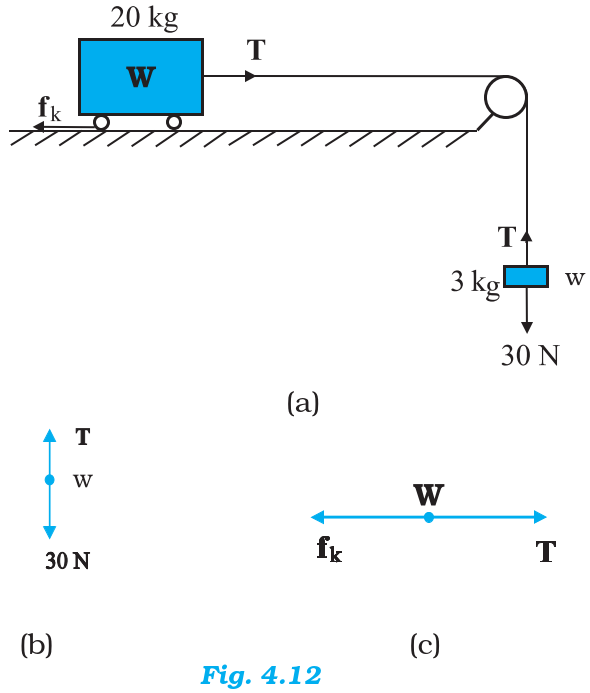
What is the acceleration of the block and trolley system shown in a Fig. 4.12(a), if the coefficient of kinetic friction between the trolley and the surface is 0.04 ? What is the tension in the string? (Take $g=$ $10 m s ^{-2}$ ). Neglect the mass of the string.
Image
A copper rod of length 1.0m is clamped at its middle point. Find the frequencies between 20Hz - 20,000Hz at which standing longitudinal waves can be set up in the rod. The speed of sound in copper is 3.8km/s.
A train standing at the outer signal of a railway station blows a whistle of frequency 400Hz still air. The train begins to move with a speed of 10m s-1 towards the platform. What is the frequency of the sound for an observer standing on the platform? (sound velocity in air = 330m s–1)