MCQ
A particle revolves round a circular path. The acceleration of the particle is
  • A
    Along the circumference of the circle
  • B
    Along the tangent
  • Along the radius
  • D
    Zero

Answer

Correct option: C.
Along the radius
c
Along the radius directed towards the centre.

Need a full question paper?

Generate a complete, print-ready paper with questions like this in minutes — across 16+ boards, with answer keys.
Start Generating Free

Similar questions

A lift is coming from 8th floor and is just about to reach 4th floor. Taking ground floor as origin and positive direction upwards for all quantities, which one of the following is correct?
Let $\vec{A}=2 \hat{i}-3 \hat{j}+4 \hat{k}$ and $\vec{B}=4 \hat{i}+j+2 \hat{k}$ then $|\vec{A} \times \vec{B}|$ is equal to ...................
A person is standing in an elevator. In which situation he finds his weight less than actual when
A sphere is rotating about a diameter:
  1. The particles on the surface of the sphere do not have any linear acceleration.
  2. The particles on the diameter mentioned above do not have any linear acceleration.
  3. Different particles on the surface have different angular speeds.
  4. All the particles on the surface have same linear speed.
The temperature of the mixture of one mole of helium and one mole of hydrogen is increased from 0°C to 100°C at constant pressure. The amount of heat delivered will be:
A spring whose unstretched length is $\ell $ has a force constant $k$. The spring is cut into two pieces of unstretched lengths $\ell_1$ and $\ell_2$ where, $\ell_1 = n\ell_2$ and $n$ is an integer. The ratio $k_1/k_2$ of the corresponding force constants, $k_1$ and $k_2$ will be
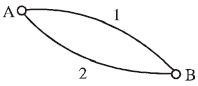
A small body slips, subject to the force of friction, from point $A$ to point $B$ along two curved surfaces of equal radius, first along route $1,$ then along route $2$. Friction does not depend on the speed and the coefficient of friction on both routes is the same. In which case will the body’s speed at $B$ be greater?
A body at rest breaks into two pieces of equal masses. The parts will move
  1. In same direction.
  2. Along different lines.
  3. In opposite directions with equal speeds.
  4. In opposite directions with unequal speeds.
Let np and ne be the number of holes and conduction electrons in an intrinsic semiconductor.

  1. $\text{n}_\text{p} > \text{n}_\text{e}$

  2. $\text{n}_\text{p} = \text{n}_\text{e}$

  3. $\text{n}_\text{p} < \text{n}_\text{e}$

  4. $\text{n}_\text{p}\neq\text{n}_\text{e}$

Select the appropriate property of an ideal gas