MCQ
A particle revolves with constant angular acceleration $\pi\, rad/s^2$. If the particle starts from rest, how many revolution will it make in the first $10\, seconds$ ?
  • A
    $16$
  • B
    $10$
  • C
    $20$
  • $25$

Answer

Correct option: D.
$25$
d
$\alpha=\pi \operatorname{rad} / \mathrm{s}^{2}$

$\theta=\omega_{0} t+\frac{1}{2} \alpha t^{2}$

$\omega_{0}=0$

$\therefore \quad \theta=\frac{1}{2} \alpha t^{2}$

$2 \mathrm{n} \pi=\frac{1}{2} \propto \mathrm{t}^{2}$

$2 \mathrm{n} \pi=\frac{1}{2}(\pi)(10)^{2}$

$\mathrm{x}=25$

Need a full question paper?

Generate a complete, print-ready paper with questions like this in minutes — across 16+ boards, with answer keys.
Start Generating Free

Similar questions

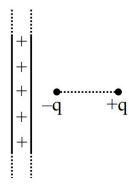
An electric dipole is placed at a distance of 2 cm from an infinite plane sheet having positive charge density $\sigma_0$. Choose the correct option from the following.
Image
If pressure at half the depth of a lake is equal to $2/3$ pressure at the bottom of the lake then what is the depth of the lake...... $m$
Two conductors are made of the same material and have the same length. Conductor $A$ is a solid wire of diameter $1.0\, mm$. Conductor $B$ is a hollow tube of outside diameter $2.0\, mm$ and inside diameter $1.0\, mm$. The resistance ratio $R_A/R_B$ will be
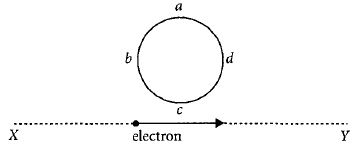
An electron moves on a straight line path $XY$ as shown. The $abcd$ is a coil adjacent to the path of electron. What will be the direction of current, if any, induced in the coil?
Standardisation of thermometers is obtained with
The thermal conductivity of a material in $CGS$ system is $0.4$ . In steady state, the rate of flow of heat $10 cal/sec-cm2$ , then the thermal gradient will be ....... $^oC/cm$
Consider the combination of $2$ capacitors $C _{1}$ and $C _{2},$ with $C _{2}> C _{1},$ when connected in parallel, the equivalent capacitance is $\frac{15}{4}$ time the equivalent capacitance of the same connected in series. Calculate the ratio of capacitors, $\frac{ C _{2}}{ C _{1}}$
The relation between the linear magnification $m,$ the object distance $u$ and the focal length $f$ is
What is the angle between $(\overrightarrow P + \overrightarrow Q )$ and $(\overrightarrow P \times \overrightarrow Q )$
If $2.5 \times 10^{-6\,} N$ average force is exerted by a light wave on a non-reflecting surface of $30\, cm ^{2}$ area during $40$ minutes of time span, the energy flux of light just before it falls on the surface is .................. $W / cm ^{2}$

(Round off to the Nearest Integer)

(Assume complete absorption and normal incidence conditions are there)