MCQ
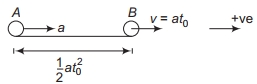
A particle starts moving from rest in a straight line with constant acceleration. After time $t_0$, acceleration changes its sign (just opposite to the initial direction), remaining the same in magnitude. Determine the time from the beginning of motion in which the particle returns to the initial position.
  • A
    $2 t_0$
  • $(2+\sqrt{2}) t_0$
  • C
    $3 t_0$
  • D
    $(2-\sqrt{2}) t_0$

Answer

Correct option: B.
$(2+\sqrt{2}) t_0$
b
(b)

Taking, $s=u t+\frac{1}{2} a t^2$, from point $B$ onwards we have,$-\frac{1}{2} a t_0^2=\left(a t_0\right) t-\frac{1}{2} a t^2$

$\therefore \quad t^2-2 t_0 t-t_0^2=0$

$\therefore \quad t=\frac{2 t_0 \pm \sqrt{4 t_0^2+4 t_0^2}}{2}=\left(t_0+\sqrt{2} t_0\right)$

$\therefore \quad \text { Total time }=t_{A B}+t=(2+\sqrt{2}) t_0$

Need a full question paper?

Generate a complete, print-ready paper with questions like this in minutes — across 16+ boards, with answer keys.

Start Generating Free

Similar questions

Energy of a quanta of frequency ${10^{15}}Hz$ and $h = 6.6 \times {10^{ - 34}}J{\rm{ - }}\sec $ will be
The transistors provide good power amplification when they are used in
In an experiment to measure the internal resistance of a cell by potentiometer, it is found that the balance point is at a length of $2\,m$ when the cell is shunted by a $5\,\Omega $ resistance; and is at a length of $3\,m$ when the cell is shunted by a $10\,\Omega $ resistance. The internal resistance of the cell is, then ................ $\Omega $
A solid sphere of radius $R$ is placed on smooth horizontal surface. A horizontal force $F$ is applied at height $h$ from the lowest point. For the maximum acceleration of centre of mass, which is correct?
Given that a photon of light of wavelength $10,000\;\mathring A$ has an energy equal to $1.23\; eV$. When light of wavelength $5000\;\mathring A$ and intensity $I _0$ falls on a photoelectric cell, the saturation current is $0.40 \times 10^{-6}\; A$ and the stopping potential is $1.36\; V$; then the work function is ..... $eV$
A particle of mass $m$ having negative charge $q$ move along an ellipse around a fixed positive charge $Q$ so that its maximum and minimum distances from fixed charge are equal to $r_1$ and $r_2$ respectively. The angular momentum $L$ of this particle is
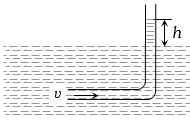
An $ L-$ shaped glass tube is just immersed in flowing water such that its opening is pointing against flowing water. If the speed of water current is $v$, then
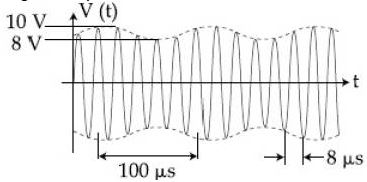
An amplitude modulated signal is plotted below Which one of the following best described the above signal?
Which is incorrect
Through which mode of propagation, the radio waves can be sent from one place to another