MCQ
A particle starts rotating from rest. Its angular displacement is expressed by the following equation $\theta  = 0.025{t^2} - 0.1t$ where $\theta $ is in radian and $t $ is in seconds. The angular acceleration of the particle is 
  • A
    $0.5 \,rad/$$sec^2$ at the end of $10 \,sec$
  • B
    $0.3 \,rad/$$sec^2$ at the end of $2 \,sec$
  • C
    $0.05\, rad/$$sec^2$at the end of $1 \,sec$
  •  Constant $0.05,\ rad/$$sec^2$  

Answer

Correct option: D.
 Constant $0.05,\ rad/$$sec^2$  
d
$\alpha=\frac{d w}{d t}=\frac{d^{2} 0}{d t^{2}}$

$\frac{d \emptyset}{d t}=2 \times 0.025 t-0.1$

$\frac{d^{2} \theta}{d t}=0.05$

Need a full question paper?

Generate a complete, print-ready paper with questions like this in minutes — across 16+ boards, with answer keys.

Start Generating Free

Similar questions

A container, whose bottom has round holes with diameter $0.1$ $mm $ is filled with water. The maximum height in cm upto which water can be filled without leakage will be ........ $cm$

Surface tension $= 75 \times 10^{-3}$ $ N/m $  and $g = 10$ $ m/s^2$:

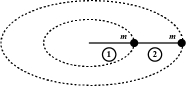
Two particles each of mass $m$ are moving in horizontal circle with same angular speed. If both string are of same length then the ratio of tension in string $\frac{T_1}{T_2}$ is .........
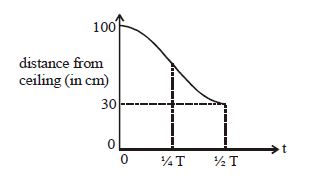
A spring hangs vertically from the ceiling and a mass is attached to its free end. When the mass is pulled down and released, it oscillates vertically with simple harmonic motion of period $T$ . The variation with time $t$ of its distance from the ceiling is as shown. Which statement gives a correct deduction from this graph?
Hairs of shaving brush cling together when it is removed from water due to
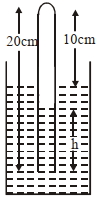
A $20 \,cm$ long tube is closed at one end. It is held vertically, and its open end is dipped in water until only half of it is outside the water surface. Consequently, water rises in it by height $h$ as shown in the figure. The value of $h$ is closest to .............. $\,m / s$ (assume that the temperature remains constant, $P _{\text {armosphere }}=10^5 \,N / m ^2$, density. of water $=10^3 \,kg / m ^3$, and acceleration due to gravity $g =10 \,m / s ^2$ )
The greatest height to which a man can throw a stone is $h$. The greatest distance to which he can throw it, will be
The pressure at the bottom of a tank containing a liquid does not depend on
The ratio of specific heats $(\gamma )$ of a ideal gas is given by
Two identical solid copper spheres of radius $R$ placed in contact with each other. The gravitational attracton between them is proportional to
The quantity $\frac{\text{PV}}{\text{kT}}$ represents: