MCQ
The ratio of specific heats $(\gamma )$ of a ideal gas is given by
  • A
    $\frac{1}{{1 - \frac{R}{{{C_P}}}}}$
  • B
    ${1 + \frac{R}{{{C_V}}}}$
  • C
    $\frac{{{C_P}}}{{{C_P} - R}}$
  • All of these

Answer

Correct option: D.
All of these
d
$\gamma=\frac{C_{\mathrm{P}}}{\mathrm{C}_{\mathrm{V}}}$

and $C_{P}-C_{V}=R$

Need a full question paper?

Generate a complete, print-ready paper with questions like this in minutes — across 16+ boards, with answer keys.
Start Generating Free

Similar questions

The rotation period of an earth satellite close to the surface of the earth is $83$ minutes. The time period of another earth satellite in an orbit at a distance of three earth radii from its surface will be .......... $\min$
In problem $7.5,$ the $CM$ of the plate is now in the following quadrant of $x - y$ plane:
A disc is rotating with an angular speed of $\omega$.  If a child sits on it, which of the following is conserved
It is possible for a substance to coexist in all three phases in equilibrium, when the substance is at
The degrees of freedom of a triatomic gas is
When a force of constant magnitude and a fixed direction acts on a moving object, then its path is
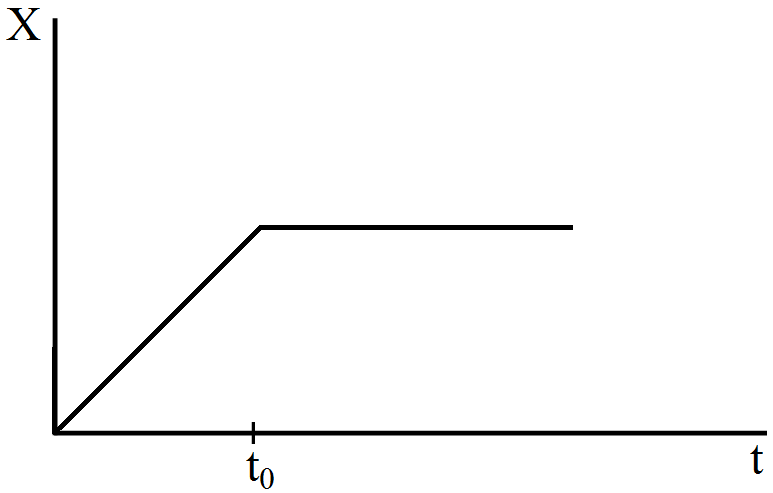
Figure shows the displacement-time graph of a particle moving on the $X-$axis.
Let $\mathop A\limits^ \to  $ be a unit vector along the axis of rotation of a purely rotating body and $\mathop B\limits^ \to  $ be a unit vector along the velocity of a particle $ P$ of the body away from the axis. The value of $\mathop A\limits^ \to  .\mathop B\limits^ \to  $ is
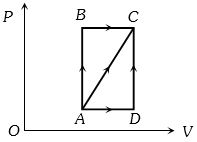
A thermodynamic process is shown in the figure. The pressures and volumes corresponding to some points in the figure are :

${P_A} = 3 \times {10^4}Pa,\;{P_B} = 8 \times {10^4}Pa$ and ${V_A} = 2 \times {10^{ - 3}}{m^3},\;{V_D} = 5 \times {10^{ - 3}}{m^3}$

In process $AB$, $600 J$ of heat is added to the system and in process $BC, 200 J $ of heat is added to the system. The change in internal energy of the system in process $ AC$ would be ...... $J$
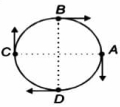
Four particles $A, B, C$ and $D$ are moving with constant speed $v$ each. At the instant shown relative velocity of $A$ with respect to $B, C$ and $D$ are in directions