MCQ
A particle stays at rest as seen in a frame. We can conclude that,
  • A
    The frame is inertial.
  • B
    Resultant force on the particle is zero.
  • C
    The frame may be inertial but resultant force on the particle is zero.
  • D
    The frame may be non-inertial but there is a non zero resultant force.
Answer

  1. The frame may be inertial but resultant force on the particle is zero.
  2. The frame may be non-inertial but there is a non zero resultant force.

Explanation:

Particle will be seen at rest only when frame is inertial and resultant force on particle is zero. Also, if frame is non inertial (i.e., accelerated), the particle must also possess the same acceleration in magnitude and direction i.e., resultant force on the particle must be non zero.

Need a full question paper?

Generate a complete, print-ready paper with questions like this in minutes — across 16+ boards, with answer keys.

Start Generating Free

Similar questions

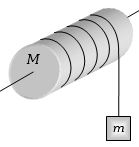
In the following figure, a body of mass $m$ is tied at one end of a light string and this string is wrapped around the solid cylinder of mass $M$ and radius $R$. At the moment $t = 0$ the system starts moving. If the friction is negligible, angular velocity at time $t$ would be
$300 \,cal$. of heat is given to a heat engine and it rejects $225 \,cal$. of heat. If source temperature is $227^{\circ} C$, then the temperature of sink will be____${ }^{\circ} C$.
A metal bal of mass $0.1\, kg$ is heated upto $500\,{}^oC$ and dropped into a vessel of heat capacity $800\, JK^{-1}$ and containing $0.5\, kg$ water. The initial temperature of water and vessel is $30\,{}^oC$. ........ $\%$ is the approximate percentage increment in the temperature of the water. [Specific heat Capacities of water and metal are, respectively $4200\, Jkg^{-1}K^{-1}$ and $400\, Jkg^{-1}K^{-1}$]
Resonance is an example of
$100 \,gm$ of ice at $0°C$ is mixed with $100\, g$ of water at $100°C.$ What will be the final temperature of the mixture .......... $^oC$
A ball is projected from ground with a velocity $V$ at an angle $\theta$ to the vertical. On its path it makes an elastic collison with a vertical wall and returns to ground. The total time of flight of the ball is 
A clay ball of mass $m$ and speed $v$ strikes another metal ball of same mass $m$, which is at rest. They stick together after collision. The kinetic energy of the system after collision is
A body of mass $40 \,gm$ is moving with a constant velocity of $2\, cm/sec$ on a horizontal frictionless table. The force on the table is  ....... $dyne$
The slopes of isothermal and adiabatic curves are related as
The angle between vectors $\vec a$ and $\vec b$ is $\frac{\pi }{6}$. The angle between vectors $ - 3\vec a$ and $ 2\vec b$ is