A particle undergoing simple harmonic motion has time dependent displacement given by $x(t)\, = \,A\,\sin \,\frac{{\pi t}}{{90}}$. The ratio of kinetic to potential energy $o$ the particle at $t=210\,s$ will be
JEE MAIN 2019, Medium


Download our appand get started for free
Experience the future of education. Simply download our apps or reach out to us for more information. Let's shape the future of learning together!No signup needed.*
Similar Questions
- 1A particle executes harmonic motion with an angular velocity and maximum acceleration of $3.5\, rad/sec$ and $ 7.5\, m/s^2$ respectively. The amplitude of oscillation is .... $m$View Solution
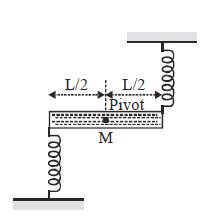
- 2A uniform stick of mass $M$ and length $L$ is pivoted at its centre. Its ends are tied to two springs each of force constant $K$ . In the position shown in figure, the strings are in their natural length. When the stick is displaced through a small angle $\theta $ and released. The stickView Solution
- 3A particle in $S.H.M.$ is described by the displacement function $x(t) = a\cos (\omega t + \theta )$. If the initial $(t = 0)$ position of the particle is $1\, cm $ and its initial velocity is $\pi \,cm/s$. The angular frequency of the particle is $\pi \,rad/s$, then it’s amplitude isView Solution
- 4If particle is executing simple harmonic motion with time period $T$, then the time period of its total mechanical energy is ...........View Solution
- 5The height of a swing changes during its motion from $0.1\, m$ to $2.5\, m$. The minimum velocity of a boy who swings in this swing is ..... $m/s$View Solution
- 6A particle is performing simple harmonic motion along $x-$axis with amplitude $4 \,cm$ and time period $1.2\, sec$. The minimum time taken by the particle to move from $x =2 ,cm$ to $ x = + 4\, cm$ and back again is given by .... $\sec$View Solution
- 7A particle executes $S.H.M.$ according to equation $x=10( cm ) \cos \left[2 \pi t+\frac{\pi}{2}\right]$, where $t$ is in second. The magnitude of the velocity of the particle at $t=\frac{1}{6} \,s$ will be .............. $cm / s$View Solution
- 8The function $sin^2\,(\omega t)$ representsView Solution
- 9The function ${\sin ^2}(\omega t)$ representsView Solution
- 10A simple harmonic wave having an amplitude a and time period $T$ is represented by the equation $y = 5\sin \pi (t + 4)m.$ Then the value of amplitude $(a)$ in $(m)$ and time period $(T) $ in second areView Solution