Question
A particular particle created in a nuclear reactor leaves a 1cm track before decaying. Assuming that the particle moved at 0.995c, calculate the life of the particle:
  1. In the lab frame and.
  2. In the frame of the particle.

Answer

$\text{d}=1\text{cm}, \ \text{v}=0.995\text{c}$
  1. Time in Laboratory frame $=\frac{\text{d}}{\text{v}}=\frac{1\times10^{-2}}{0.995\text{c}}$
$=\frac{1\times10^{-2}}{0.995\times3\times10^{8}}=33.5\times10^{-12}=33.5\text{PS}$
  1. In the frame of the particle
$\text{t}'=\frac{\text{t}}{\sqrt{1-\frac{\text{v}^2}{\text{c}^2}}}=\frac{33.5\times10^{-12}}{\sqrt{1-(0.995)^2}}=335.41\text{PS}$

Need a full question paper?

Generate a complete, print-ready paper with questions like this in minutes — across 16+ boards, with answer keys.

Start Generating Free

Similar questions

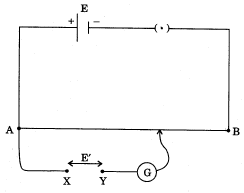
For the potentiometer circuit shown in the given figure, points X and Y reprensent the two terminals of an unknown emf E'. A student observed that when the jockey in moved from the end A to the end B of the potentiometer wire, the deflection in the galvanometer remains in the same direction.What may be the two possible faults in the circuit that could result in this obsevation?
If the galvanometer deflection at the end B is (i) more, (ii) less, than that at the end A, which of the two faults, listed above, would be there in the circuit?
Give reasons in support of your answer in each case.
Magnitude of electric field of a plane electromagnetic wave is $40 V / m$ and it vibrates with a frequency of $2 \times 10^{10} s^{-1}$. Calculate the wavelength of the wave.
A coil of inductance 5.0mH and negligible resistance is connected to the oscillator of the previous problem. Find the peak currents in the circuit for $\omega=100\text{s}^{-1},500\text{s}^{-1},1000\text{s}^{-1}.$
As the earth rotates about its axis, a person living in his house at the equator goes in a circular orbit of radius equal to the radius of the earth. Why does he/ she not feel weightless as a satellite passenger does?
Draw a labelled diagram of Hertz’s experimental set-up to produce electromagnetics waves. Explain the generation of electromagnetic waves using this set-up.
What is Rydberg constant ? Write down its unit.
Define the term ‘decay constant’ of a radioactive sample. The rate of disintegration of a given radioactive nucleus is $10000$ disintegrations/ s and $5,000$ disintegrations/ s after $20hr$. and $30hr$. respectively from start. Calculate the half life and initial number of nuclei at $t = 0.$
A vector $\overrightarrow{\text{A}}$ makes an angle of 20° and $\overrightarrow{\text{B}}$ makes an angle of 110° with the X-axis. The magnitudes of these vectors are 3 m and 4 m respectively. Find the resultant.
An object P is focused by a microscope M. A glass slab of thickness 2.1cm is introduced between P and M. If the refractive index of the slab is 1.5, by what distance should the microscope be shifted to focus the object again?
A radioactive isotope is being produced at a constant rate $\frac{\text{dN}}{\text{dt}}=\text{R}$ in an experiment. The isotope has a half-life $\text{t}_{\frac{1}2{}}.$ Show that after a time $\text{t}>>\text{t}_{\frac{1}{2}},$ the number of active nuclei will become constant. Find the value of this constant.