For the potentiometer circuit shown in the given figure, points X and Y reprensent the two terminals of an unknown emf E'. A student observed that when the jockey in moved from the end A to the end B of the potentiometer wire, the deflection in the galvanometer remains in the same direction.
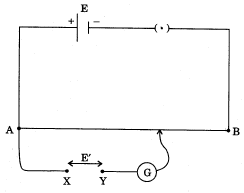 What may be the two possible faults in the circuit that could result in this obsevation?
If the galvanometer deflection at the end B is (i) more, (ii) less, than that at the end A, which of the two faults, listed above, would be there in the circuit?
Give reasons in support of your answer in each case.
What may be the two possible faults in the circuit that could result in this obsevation?If the galvanometer deflection at the end B is (i) more, (ii) less, than that at the end A, which of the two faults, listed above, would be there in the circuit?
Give reasons in support of your answer in each case.
CBSE OUTSIDE DELHI - SET 1 2007
Download our app for free and get started
Possible Faults
Cause: Negative terminal of E' is connected to X Reason : Potential difference across wire and the cell E' send current through the galvanometer in the same sense and the galvanometer deflection increases with an increase in the length of the wire. (iii) If galvanometer shows less deflection at B Cause: |E'| > |E| Reason: Potential difference across the potentiometer wire opposes E' and current in galvanometer decreases with an increase in the length of the wire.
- The negative terminal of E' is connected to point X.
- |E'| > |E'|
Cause: Negative terminal of E' is connected to X Reason : Potential difference across wire and the cell E' send current through the galvanometer in the same sense and the galvanometer deflection increases with an increase in the length of the wire. (iii) If galvanometer shows less deflection at B Cause: |E'| > |E| Reason: Potential difference across the potentiometer wire opposes E' and current in galvanometer decreases with an increase in the length of the wire.

Download our appand get started for free
Experience the future of education. Simply download our apps or reach out to us for more information. Let's shape the future of learning together!No signup needed.*
Similar Questions
- 1View SolutionThe graph shown here shows the variation of terminal potential difference V, across a combination of three cells in series to a resistor, versus current i:
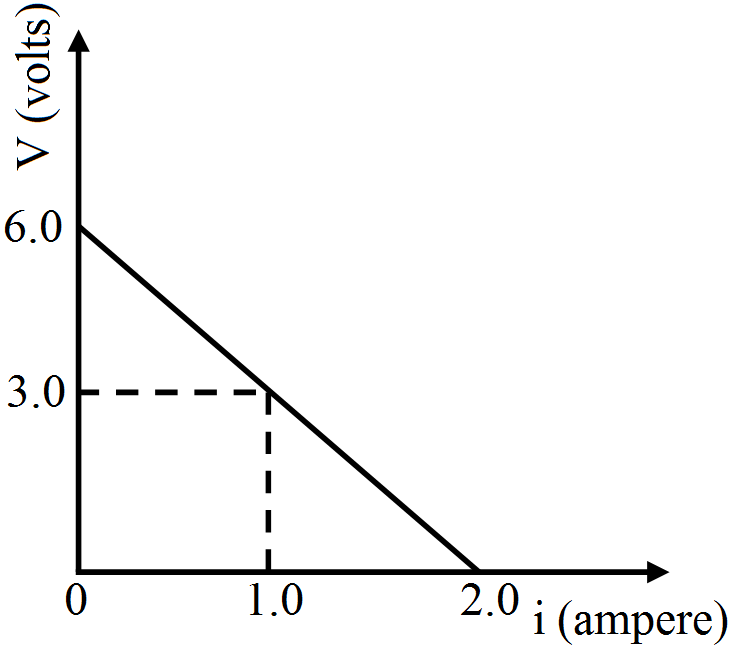
- Calculate the emf of each cell.
- For what current i, will the power dissipation of the circuit be maximum?
- 2View SolutionWrite the mathematical relation for the resistivity of a material in terms of relaxation time, number density and mass and charge of charge carriers in it. Explain, using this relation, why the resistivity of a metal increases and that of a semi-conductor decreases with rise in temperature.
- 3View SolutionWhat is the advantage of using thick metallic strips to join wires in a potentiometer?
- 4View SolutionA number of identical cells, n, each of emf E, internal resistance r connected in series are charged by a d.c. source of emf E', using a resistor R.
- Draw the circuit arrangement.
- Deduce the expressions for (a) the charging current and (b) the potential difference across the combination of the cells.
- 5The earth’s surface has a negative surface charge density of $10^{-9} Cm^{-2}.$ The potential difference of $400 kV$ between the top of the atmosphere and the surface results $($due to the low conductivity of the lower atmosphere$)$ in a current of only $1800 A$ over the entire globe. If there were no mechanism of sustaining atmospheric electric field, how much time $($roughly$)$ would be required to neutralise the earth’s surface? $($This never happens in practice because there is a mechanism to replenish electric charges, namely the continual thunderstorms and lightning in different parts of the globe$). ($Radius of earth $= 6.37 \times 10^6 m.)$View Solution
- 6View SolutionName the charge carriers of electric current in:
- Silver foil.
- Hydrogen discharge tube.
- Germanium semiconductor.
- Wire made of alloy nichrome.
- Superconductor.
- 7A heating element using nichrome connected to a $230 V$ supply draws an initial current of $ 3.2 A$ which settles after a few seconds to a steady value of $2.8 A$. What is the steady temperature of the heating element if the room temperature is $27.0^\circ C?$ Temperature coefficient of resistance of nichrome averaged over the temperature range involved is $1.70\times10^{-4}{^\circ\text{C}}^{-1}.$View Solution
- 8A storage battery of emf $8.0 V$ and internal resistance $0.5\ \Omega$ is being charged by a $120 V\ dc$ supply using a series resistor of $15.5\ \Omega.$ What is the terminal voltage of the battery during charging? What is the purpose of having a series resistor in the charging circuit?View Solution
- 9A capacitance C charged to a potential difference V is discharged by connecting its plates through a resistance R. Find the heat dissipated in one time constant after the connections are made. Do this by calculating $\int\text{i}^2\text{R}$ dt and also by finding the decrease in the energy stored in the capacitor.View Solution
- 10View SolutionHow many time constants will elapse before the charge on a capacitors falls to 0.1% of its maximum value in a discharging RC circuit?