MCQ
A passenger in an aeroplane shall:
- ANever see a rainbow.
- BMay see a primary and a secondary rainbow as concentric circles.
- CMay see a primary and a secondary rainbow as concentric arcs.
- DShall never see a secondary rainbow.
A passenger in an aeroplane shall:
Solution:
As aeroplane is at higher altitude, the passenger in an aeroplane may see a primary and a secondary rainbow like concentric circles.
Key Concept:
Generate a complete, print-ready paper with questions like this in minutes — across 16+ boards, with answer keys.
If the atom  follows the Bohr model and the radius of is n times the Bohr radius, then find n
|
(a) 100 |
(b) 200 |
(c) 4 |
(d) |
In the circuit shown here, E1 = E2 = E3 = 2 V and R1 = R2 = 4 ohms. The current flowing between points A and B through battery E2 is

|
(a) Zero |
(b) 2 amp from A to B |
|
(c) 2 amp from B to A |
(d) None of the above |
Field at the centre of a circular coil of radius r, through which a current I flows is
|
(a) Directly proportional to r |
(b) Inversely proportional to I |
|
(c) Directly proportional to I |
(d) Directly proportional to |
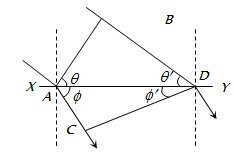
In the adjoining diagram, a wavefront AB, moving in air is incident on a plane glass surface XY. Its position CD after refraction through a glass slab is shown also along with the normals drawn at A and D. The refractive index of glass with respect to air (μ = 1) will be equal to
|
(a) |
(b) |
(c) |
(d) |
A small cylindrical soft iron piece is kept in a galvanometer so that
|
(a) A radial uniform magnetic field is produced |
|
(b) A uniform magnetic field is produced |
|
(c) There is a steady deflection of the coil |
|
(d) All of these |
Critical angle for light going from medium (i) to (ii) is q. The speed of light in medium (i) is v then speed in medium (ii) is
|
(a) v(1- cosθ) |
(b) v/sinθ |
(c) v/cosθ |
(d) v(1- sinθ) |


