Questions · Page 1 of 4

M.C.Q (1 Marks)

Take a timed test

50 questions · self-marked practice — reveal the answer and mark yourself.

MCQ 11 Mark

Two unequal resistors are connected in series across a battery. Then the:

  • A
    Potential difference across each resistor is the same.
  • B
    Current in the smaller resistor is larger.
  • C
    Potential difference across the bigger resistor is greater.
  • D
    Power dissipated in both resistors is the same.
Answer
  1. Potential difference across the bigger resistor is greater.
View full question & answer
MCQ 21 Mark

The focal length of the objective of a compound microscope is:

  • A
    Greater than the focal length of eyepiece.
  • B
    Lesser than the focal length of eyepiece.
  • C
    Equal to the focal length of eyepiece.
  • D
    Equal to the length of its tube.
Answer
  1. Lesser than the focal length of eyepiece.
View full question & answer
MCQ 31 Mark

A biconvex lens of glass having refractive index 1.47 is immersed in a liquid. It becomes invisible and behaves as a plane glass plate. The refractive index of the liquid is:

  • A
    1.47
  • B
    1.62
  • C
    1.33
  • D
    1.51
Answer
  1. 1.47

Explanation:

  • As per the question, the biconvex lens of glass having refractive index 1.47 is immersed in a liquid and then behaves like a plane glass plate.
  • This shows that the ray will pass undeviated through it.
  • This is only possible when the medium's refractive index is the same as that of a biconvex lens.
  • Thus, the refractive index of the liquid must be 1.47.
View full question & answer
MCQ 41 Mark

For a glass prism, the angle of minimum deviation will be smallest for the light of:

  • A
    Red colour.
  • B
    Blue colour.
  • C
    Yellow colour.
  • D
    Green colour.
Answer
  1. Red colour.

Explanation:

When a ray of light passes through a prism, it disperses the ray of light into seven colours. They are - Violet, Indigo, Blue, Green, Yellow, Orange, Red i.e., VIBGYOR.

The angle of deviation increases in order.

It means that Violet bends the most and Red the least. The extent of bending depends on their wavelength. Red has larger wavelength than blue.

View full question & answer
MCQ 51 Mark

The resistance of a metal wire increases with increasing temperature on account of:

  • A
    Decrease in free electron density.
  • B
    Decrease in relaxation time.
  • C
    Increase in mean free path.
  • D
    Increase in the mass of electron.
Answer
  1. Decrease in relaxation time.

Explanation:

$\rho=\frac{1}{\rho}=\frac{\text{m}}{\text{ne}^2\tau}$

As we increase temperature, average speed of the electrons, which act as the carriers of current, increases resulting in more frequent collisions. The average time of collisions $\tau,$ thus decreases with temperature.

View full question & answer
MCQ 61 Mark

Larger aperture of objective lens in an astronomical telescope:

  • A
    Increases the resolving power of telescope.
  • B
    Decreases the brightness of the image.
  • C
    Increases the size of the image.
  • D
    Decreases the length of the telescope.
Answer
  1. Increases the resolving power of telescope.

​​​​​​​Explanation:

The larger the objective, the more light the telescope collects and increases the brightness of image.

The field of view of the telescope decreases as the aperture increases, but the resolving power increases.

The objective lens of a telescope forms an real image of the night sky, the size of that image is in proportion to the focal length of the objective lens. It increases with increase in size of objective lens.

View full question & answer
MCQ 71 Mark

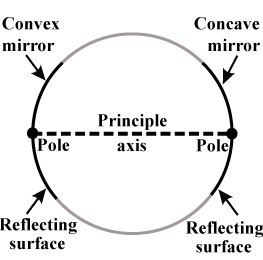
The line joining the pole and the centre of curvature of a mirror is called the:

  • A
    Aperture
  • B
    Principal section
  • C
    Principal axis
  • D
    Pole
Answer
  1. Principal axis

Explantation:

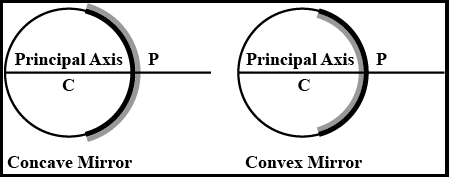
The line joining the pole and the center of curvature of a mirror is called the principal axis.

View full question & answer
MCQ 81 Mark

A ray of light incident at an angle θ on a refracting face of a prism emerges from the other face normally. If the angle of the prism is 5º and the prism is made of a material of refractive index 1.5, the angle of incidence is:

  • A
    7.5º.
  • B
    5º.
  • C
    15º.
  • D
    2.5º.
Answer
  1. 7.5º.

Solution:

Key concept:

In thin prisms, the distance between the refracting surfaces is ineligible and the angle of prism (A) is very small. Since A = r1 + r2, therefore if A is small then both r1, and r2 are also small, and the same is true for i1and i2.
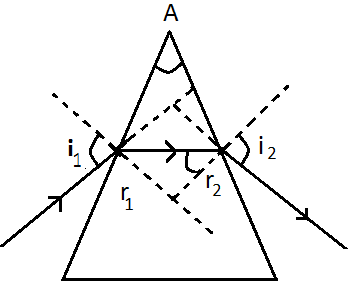
According to Snell's law, $1\sin\text{i}_1=\mu.\sin\text{r}_1\Rightarrow\text{i}_1=\mu.\text{r}_1$

Also, $1.\sin\text{i}_2=\mu.\sin\text{r}_2\Rightarrow\text{i}_2=\mu.\text{r}_2$

Therefore, deviation, $\delta=(\text{i}_1-\text{r}_1)+(\text{i}_2-\text{r}_2)$

$\Rightarrow\ \delta=(\text{i}_1+\text{i}_2)-(\text{r}_1+\text{r}_2)=(\text{r}_1+\text{r}_2)(\mu-1)$

$\Rightarrow\ \delta=\text{A}(\mu-1)$

Since, deviation $\delta=(\mu-1)\text{A}$

$=(1.5-1)\times5^\circ=2.5^\circ$

The angle of the prism is 5º. The ray emerges from refracting face of a prism normally.

Then, i2 = r2 = 0

As A = r1 + r2 ⇒ A or r1 = 5º

But $\text{i}_1=\mu.\text{r}_1=\frac{3}{2}\times5=7.5^\circ$
View full question & answer
MCQ 91 Mark

.......... happens when a wave passes from one medium to another at an angle.

  • A
    Refraction
  • B
    Reflection
  • C
    Dispersion
  • D
    Scattering
Answer
  1. Refraction

Explanation:

Refraction is a phenomenon in which when a ray passes from one medium to another it bends away from its straight-line path due to the difference in optical densities or refractive indices of the two mediums.

View full question & answer
MCQ 101 Mark

By properly combining two prisms made of different materials, it is possible to:

  • A
    Have dispersion without average deviation.
  • B
    Have deviation without dispersion.
  • C
    Have both dispersion and average deviation.
  • D
    Have neither dispersion nor average deviation.
Answer
  1. ​​​​​​Have dispersion without average deviation.
  2. Have deviation without dispersion.
  3. Have both dispersion and average deviation.

Explanation:

Consider the case of prisms combined such that the refractive angles are reversed w.r.t. each other. Then, the net deviation of the yellow ray will be,

$\delta_\text{y}=(\mu_\text{y}-1)\text{A}-(\mu_\text{y}'-1)\text{A}'$

And, the net angular dispersion will be

$\delta_\text{y}-\delta_\text{r}=(\mu_\text{y}-1)\text{A}(\omega-\omega')$

Thus, by choosing appropriate conditions, we can have the above mentioned cases.

View full question & answer
MCQ 111 Mark

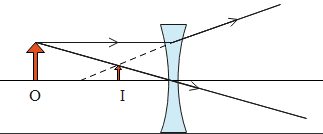
What kind of image is obtained always for concave lens?

  • A
    Virtual, Erect and Diminished
  • B
    Real, Erect and Large
  • C
    Real, Erect and Diminished
  • D
    All of these
Answer
  1. Virtual, Erect and Diminished

    Explanation:

    As can be seen in image, Virtual, Erect and Diminished image is obtained always for concave lens.

View full question & answer
MCQ 121 Mark

The central point of a spherical mirror is called:

  • A
    Pole
  • B
    Centre of sphere
  • C
    Centre of curvature
  • D
    None of these
Answer
  1. Pole

Explanation:

The central point of a spherical mirror is called the Pole of the mirror.

View full question & answer
MCQ 131 Mark

An achromatic combination of lenses produce:

  • A
    Images in black and white
  • B
    Colored images
  • C
    Images unaffected by variation of refractive index with wavelength
  • D
    Highly enlarged images
Answer
  1. Images unaffected by variation of refractive index with wavelength

Explanation:

An achromatic combination of lenses provide deviation without dispersion. So, images are unaffected by variation of refractive index with wavelength.

View full question & answer
MCQ 141 Mark

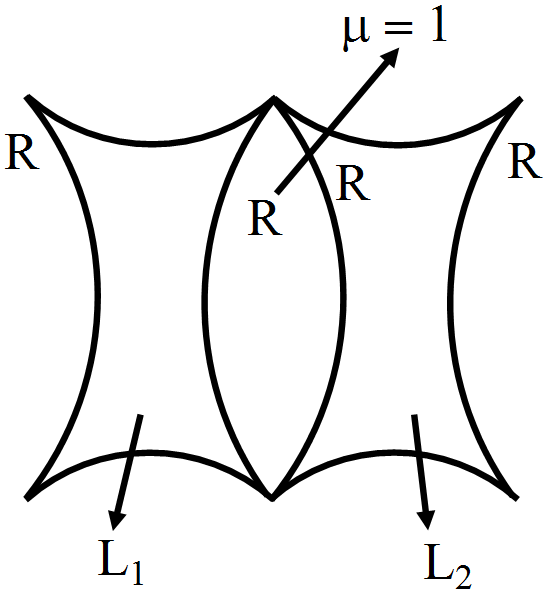
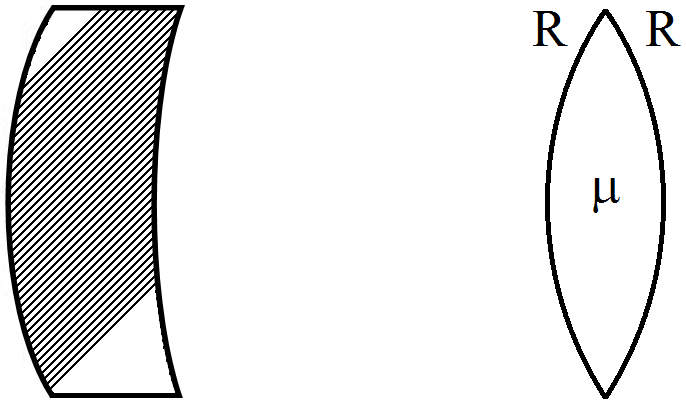
Two concave lenses L1 and L2 are kept in contact with each other. If the space between the two lenses is filled with a material of refractive index $\mu\approx1,$ the magnitude of the focal length of the combination:

  • A
    Becomes undefined.
  • B
    Remains unchanged.
  • C
    Increases.
  • D
    Decreases.
Answer
  1. Decreases.

Explanation:

$\frac{1}{\text{f}}=\frac{1}{\text{f}_{\text{L}_1}}+\frac{1}{\text{f}_{\text{L}_2}}$

$\frac{1}{\text{f}_{\text{L}_1}}=(\mu-1)\Big(\frac{-2}{\text{R}}\Big)=\frac{1}{\text{f}_{\text{L}_2}}$

Local length of the combination.

$\frac{1}{\text{f}}=(\mu-1)\Big(\frac{-2}{\text{R}}\Big)+(\mu-1)\Big(\frac{-2}{\text{R}}\Big)$

$\frac{1}{\text{f}}=-4(\mu-1)\Big(\frac{1}{\text{R}}\Big)$

$\text{f}=\frac{\text{R}}{4(\mu-1)}$

Where $\text{f}_{\text{L}_1}=\text{f}_{\text{L}_2}=\frac{\text{R}}{2(\mu-1)}$

$(\text{f}_{\text{L}_1}=\text{f}_{\text{L}_2})>\text{f}$

View full question & answer
MCQ 151 Mark

The magnifying power of a simple microscope can be increased if we use an eyepiece of:

  • A
    Higher focal length
  • B
    Smaller focal length
  • C
    Higher diameter
  • D
    Smaller diameter
Answer
  1. Smaller focal length

Explanation:

The only difference between simple microscope and compound microscope is an eyepiece of smaller focal length than objective which increases magnifying power.

View full question & answer
MCQ 161 Mark

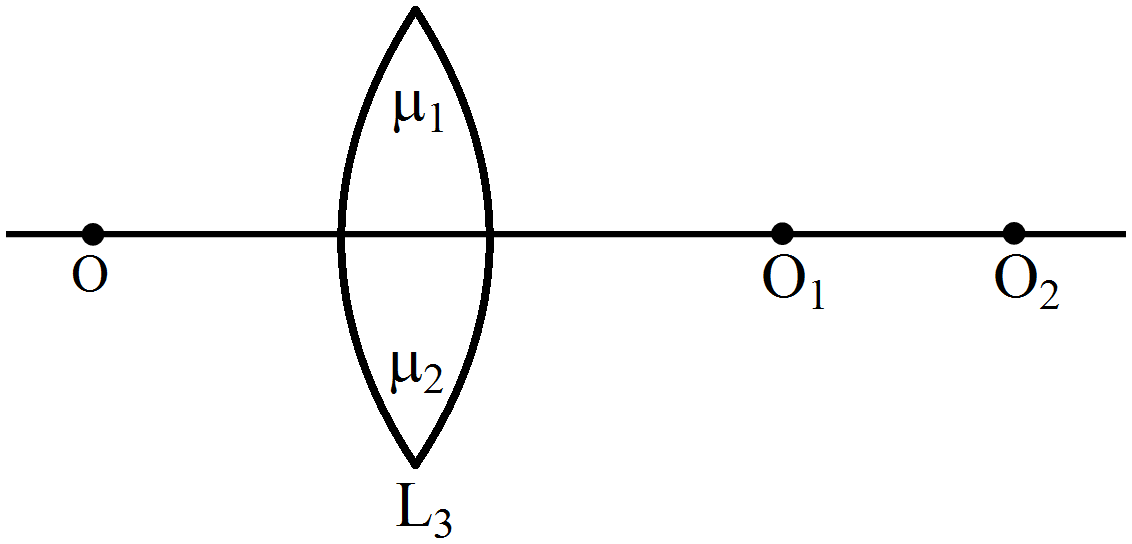
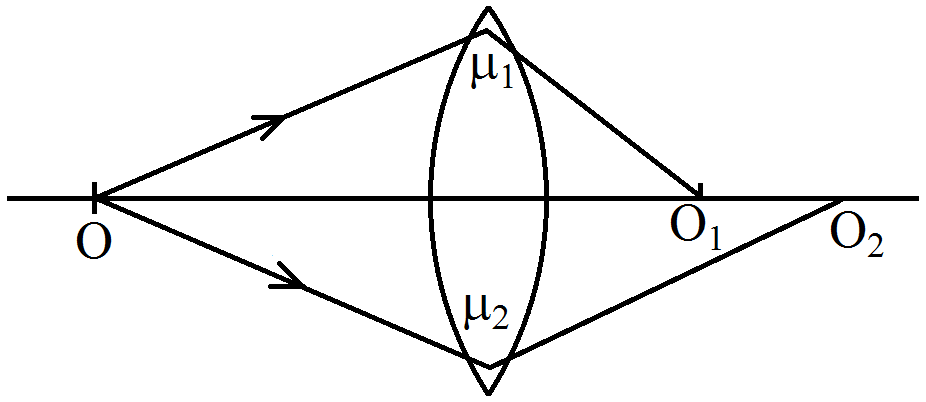
Consider three converging lenses L1, L2 and L3 having identical geometrical construction. The index of refraction of L1 and L2 are $\mu_1$ and $\mu_2$ respectively. The upper half of the lens L3 has a refractive index $\mu_1$ and the lower half has $\mu_2$. A point object O is imaged at O1 by the lens L1 and at O2 by the lens L2 placed in same position. If L3 is placed at the same place:

  • A
    There will be an image at O1
  • B
    There will be an image at O2
  • C
    The only image will form somewhere between O1 and O2
  • D
    The only image will form away from O2.
Answer
  1. There will be an image at O1
  2. There will be an image at O2

Explanation:

It rays are Passing through m1 then Image will be form at "O1" and If rays are Passing through m2 then Image will be form at "O2".

View full question & answer
MCQ 171 Mark

A passenger in an aeroplane shall:

  • A
    Never see a rainbow.
  • B
    May see a primary and a secondary rainbow as concentric circles.
  • C
    May see a primary and a secondary rainbow as concentric arcs.
  • D
    Shall never see a secondary rainbow.
Answer
  1. May see a primary and a secondary rainbow as concentric circles.

Solution:

As aeroplane is at higher altitude, the passenger in an aeroplane may see a primary and a secondary rainbow like concentric circles.

Key Concept:

  1. If an object move with constant speed (V0) towards a convex lens from infinity to focus, the image will move slower in the beginning and then faster. Also $\text{V}_\text{i}=\Big(\frac{\text{f}}{\text{f}+\text{u}}\Big)^2\text{V}_0$.
  2. If an object approaches the lens, the image moves away from lens with a non-uniform acceleratiion.
View full question & answer
MCQ 181 Mark

Magnification of an optical instrument is expressed in:

  • A
    m
  • B
    m−1
  • C
    D
  • D
    It has no unit
Answer
  1. It has no unit

Explantion:

$\text{Magnification}=\frac{\text{Image Height}}{\text{Object Height}}​ $

because unit of image height and object height is same hence unit of magnification is none because it is a constant number. So, it has got to unit.

View full question & answer
MCQ 191 Mark

If the light moving in a straight line bends by a small but fixed angle, it may be a case of:

  • A
    Reflection.
  • B
    Refraction.
  • C
    Diffraction.
  • D
    Dispersion.
Answer
  1. Reflection.
  2. Refraction.

Explanation:

When the light strikes on a surface nearly parallel to it, it then bends by a small and fixed angle after reflection. Also, when the light travels from one medium to another with slight differences in their refractive indices, it bends by a small angle. Thus, the bending of light by a small but fixed angle can be the case of either reflection or refraction.

View full question & answer
MCQ 201 Mark

What type of lens from the following would you have in your magnifying lens to read a page in small print?

  • A
    A convex lens of focal length 80cm.
  • B
    A concave lens of focal length 80cm.
  • C
    A concave lens of focal length 4cm.
  • D
    A convex lens of focal length of 4cm.
Answer
  1. A convex lens of focal length of 4cm.

Explanation:

A concave lens always produces virtual, erect and diminished images and the decrease in the size of the image depends on the position of the object.

Concave lens will shrink the size of the already small letters. Hence, it is undesirable.

A convex lens produces real and virtual, erect and inverted, diminished, same sized and magnified image of the object, depending upon the position of the object on the principal axis.

When the object is placed at a distance less than the focal length of convex lens, an enlarged and erect image of the object is formed, which will make it easier to read small letters.

View full question & answer
MCQ 211 Mark

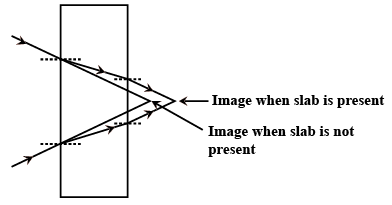
A glass slab is placed in the path of beam of convergent light. The point of convergence of light:

  • A
    Moves towards the glass slab
  • B
    Moves away from the glass slab
  • C
    Remains at the same point
  • D
    Undergoes a lateral shift
Answer
  1. Moves away from the glass slab

Explanation:

As a glass has refractive index of $\frac{3}{2}$ with respect to air, the convergent light will bend towards the normal in the glass and again bend away from the normal, but in the whole process the beam is displaced parallel to initial path as shown in figure and converge at a greater distance from the glass slab.

View full question & answer
MCQ 221 Mark

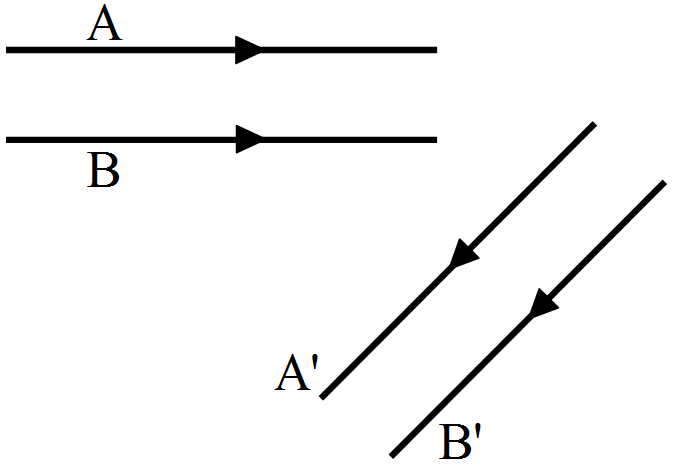
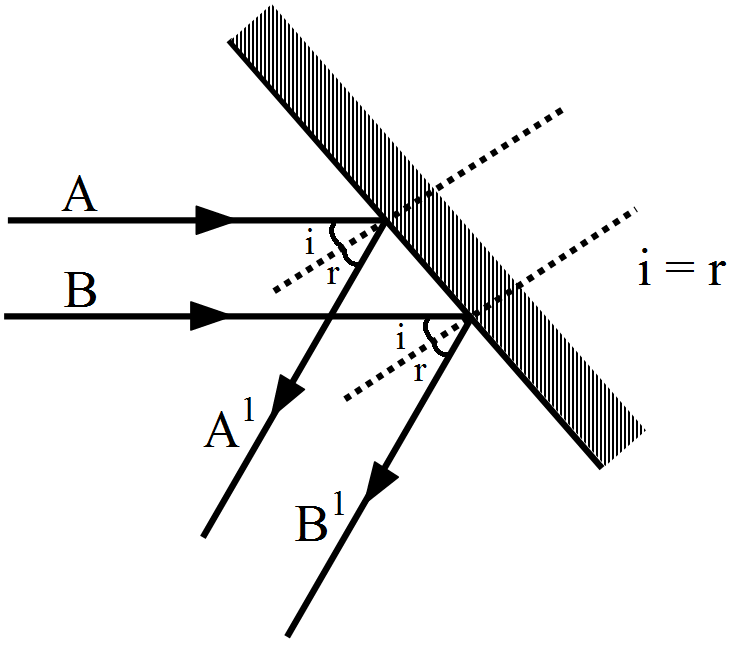
Two rays A and B being reflected by a mirror and going as A' and B'. The mirror:

  • A
    Is plane.
  • B
    Is convex.
  • C
    Is concave.
  • D
    May be any spherical mirror.
Answer
  1. Is plane.

Explanation:

Here initially A & B is parallel to each other after reflection by teh plane mirror A' & B' goes Parallel to each other.

View full question & answer
MCQ 231 Mark

If a glass prism is dipped in water, its dispersive power:

  • A
    Increases.
  • B
    Decreases.
  • C
    Does not change.
  • D
    May increase or decrease depending on whether the angle of the prism is less than or greater than 60°.
Answer
  1. Decreases.

Explanation:

If $\mu$ is the refractive index and is the angle of prism, then the angular dispersion produced by the prism will be given by $\delta=(\mu-1)\text{A}.$

Because the relative refractive index of glass with respect to water is small compared to the refractive of glass with respect to air, the dispersive power of the glass prism is more in air than that in water.

View full question & answer
MCQ 241 Mark

The rays of different colors fail to converge at a point after going through a converging lens. This defect is called _________.

  • A
    Spherical aberration
  • B
    Distortion
  • C
    Coma
  • D
    Chromatic aberration
Answer
  1. Chromatic aberration

Explanation:

Chromatic aberation is the defect due to which rays of different wavelength converge at various point after passing through converging lens. It is due to varying refractive index for various wavelength.

View full question & answer
MCQ 251 Mark

In producing a pure spectrum, the incident light is passed through a narrow slit placed in the focal plane of an achromatic lens because a narrow slit:

  • A
    Produces less diffraction.
  • B
    Increases intensity.
  • C
    Allows only one colour at a time.
  • D
    Allows a more parallel beam when it passes through the lens.
Answer
  1. ​​​​​​Allows a more parallel beam when it passes through the lens.

Explanation:

To produce a pure spectrum, a parallel light beam is required to be incident on the dispersing element. So, the incident light is passed through a narrow slit placed in the focal plane of an achromatic lens.

View full question & answer
MCQ 261 Mark

A narrow beam of white light goes through a slab having parallel faces.

  • A
    The light never splits in different colours.
  • B
    The emergent beam is white.
  • C
    The light inside the slab is split into different colours.
  • D
    The light inside the slab is white.
Answer
  1. The emergent beam is white.
  2. The light inside the slab is split into different colours.

Explanation:

White light will split into different colours inside the glass slab because the value of refractive index is different for different wavelengths of light; thus, they suffer different deviations. But the emergent light will be white light. As the faces of the glass slide are parallel, the emerging lights of different wavelengths will reunite after refraction.

View full question & answer
MCQ 271 Mark

 A man is looking at a small object placed at his near point. Without altering the position of his eye or the object, he puts a simple microscope of magnifying power 5X before his eyes. The angular magnification achieved is:

  • A
    5
  • B
    2.5
  • C
    1
  • D
    0.2
Answer
  1. 1
Explanation:

We have,

h = Object height

u = Object distance = 25cm

D = Near point = 25cm

Now,

$\text{m}=\frac{\frac{\text{h}}{\text{u}}}{\frac{\text{h}}{\text{D}}}$
$\Rightarrow\text{m}=\frac{\frac{\text{h}}{25}}{\frac{\text{h}}{25}}$
$\Rightarrow \text{m}=1$
View full question & answer
MCQ 281 Mark

Between the primary and secondary rainbows, there is a dark band known as Alexandar’s dark band. This is because:

  • A
    Light scattered into this region interfere destructively.
  • B
    There is no light scattered into this region.
  • C
    Light is absorbed in this region.
  • D
    Angle made at the eye by the scattered rays with respect to the incident light of the sun lies between approximately 42º and 50º.
Answer
  1. Light scattered into this region interfere destructively.
  1. Angle made at the eye by the scattered rays with respect to the incident light of the sun lies between approximately 42º and 50º.

Solution:

The Alexandar's dark band lies between the primary and secondary rainbows, formed due to light scattered into this region interfere destructively. The primary rainbows subtends an angle nearly 41º to 42º at observer's eye, whereas secondary rainbows subtends an angle nearly 51º to 54º at observer's eye w.r.t. incident light ray.

Hence, the scattered rays with respect to the incident light of the sun lies between approximately 42º and 50º.

View full question & answer
MCQ 291 Mark

A short pulse of white light is incident from air to a glass slab at normal incidence. After travelling through the slab, the first colour to emerge is:

  • A
    Blue.
  • B
    Green.
  • C
    Violet.
  • D
    Red.
Answer
  1. Red.

Solution:

As velocity of wave is given by the relation $\text{v}=\text{f}\lambda$. When light ray goes from one medium to other medium, the frequency of light remains unchanged. Hence $\text{v}\propto\lambda$ or greater the wavelength, greater the speed.

The light of red colour is of highest wavelength and therefore of highest speed. Therefore, after travelling through the slab, the red colour emerges first.

View full question & answer
MCQ 301 Mark

The bending of light as it passes from one medium into another is commonly known as:

  • A
    Reflection
  • B
    Refraction
  • C
    Scattering
  • D
    Dispersion
Answer
  1. Refraction

Explanation:

In refraction ray of light passes from one medium to another medium. The ray of light bends towards normal in the denser medium.

View full question & answer
Question 311 Mark

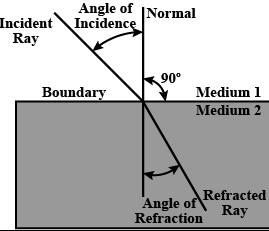
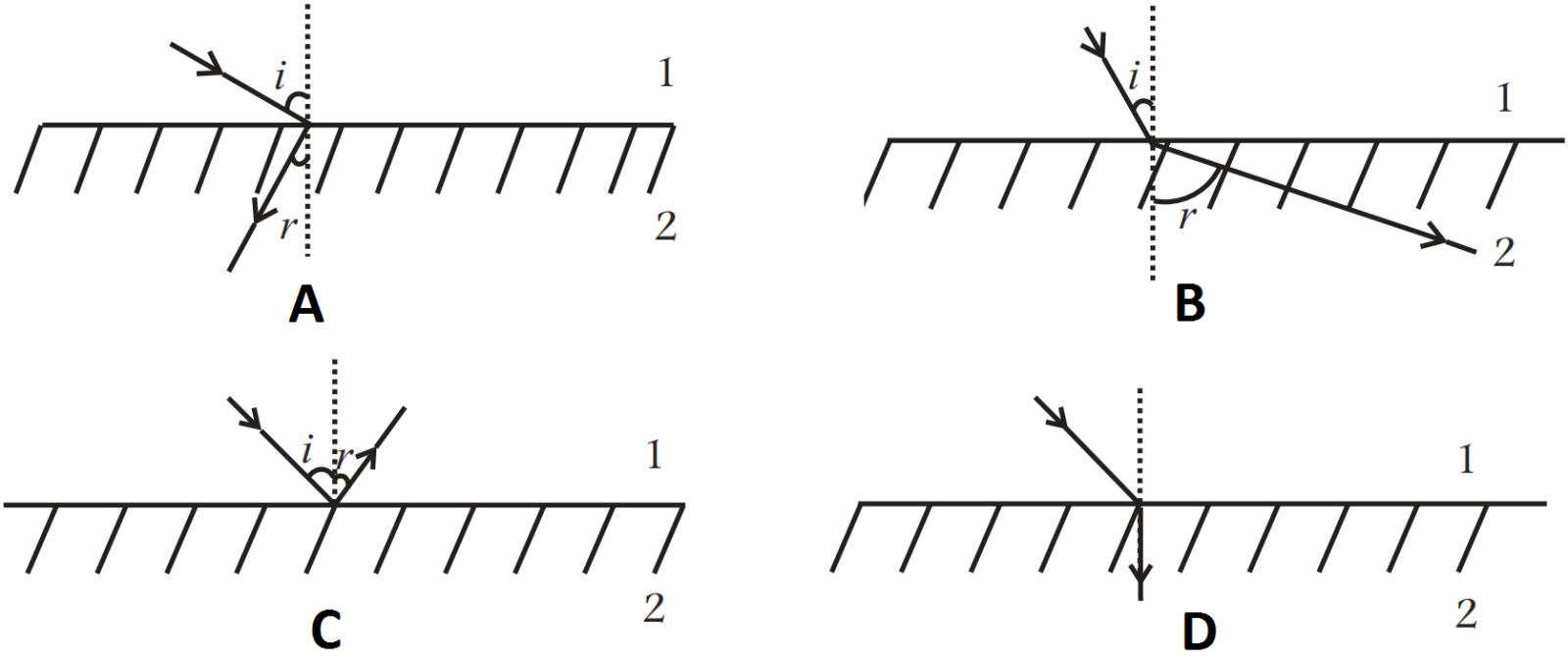
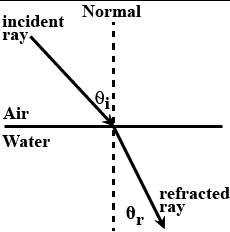
There are certain material developed in laboratories which have a negative refractive index (Fig). A ray incident from air (medium 1) into such a medium (medium 2) shall follow a path given by:

Answer
  1.  

Solution:

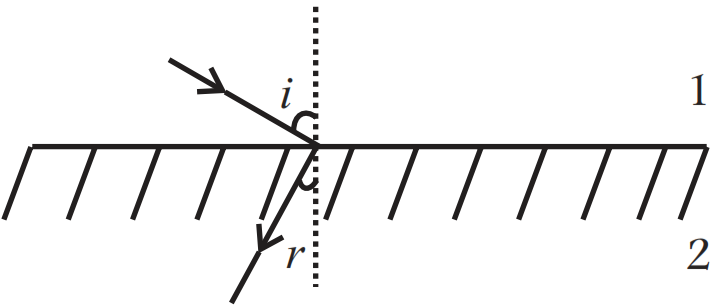
The materials with negative refractive index responds to Snell’s law just opposite way. If incident ray from air (Medium 1) incident on those material, the ray refract or bend same side of the normal as in option (a).

View full question & answer
MCQ 321 Mark

A manufacturer uses a concave lens instead of a convex lens in a magnifying glass by mistake. What will be the effect on the working of the lens?

  • A
    Images will be blurred.
  • B
    Images will be clearer.
  • C
    Images will be diminished.
  • D
    Images will be further magnified.
Answer
  1. Images will be diminished.

Explanation:

Images formed by a concave lens are always diminished. 

View full question & answer
MCQ 331 Mark

The refraction of light is commonly known as:

  • A
    Bending
  • B
    Scattering
  • C
    Reflection
  • D
    Interference
Answer
  1. Bending

Explanation:

The refraction of light is commonly known as bending.

The refracted rays bend towards the normal when they enter from rarer to denser medium.

The refracted rays bend away from the normal when they enter from denser to rarer medium.

View full question & answer
MCQ 341 Mark

Which of the following (referred to a spherical mirror) do (does) not depend on whether the rays are paraxial or not?

  • A
    Pole.
  • B
    Focus.
  • C
    Radius of curvature.
  • D
    Principal axis.
Answer
  1.  Pole.

  2. Focus.

  1. Principal axis.

Explanation:

If Paraxial rays comes to parallel to the spherical mirror is pasees to the Focus of the spherical mirror. 

View full question & answer
MCQ 351 Mark

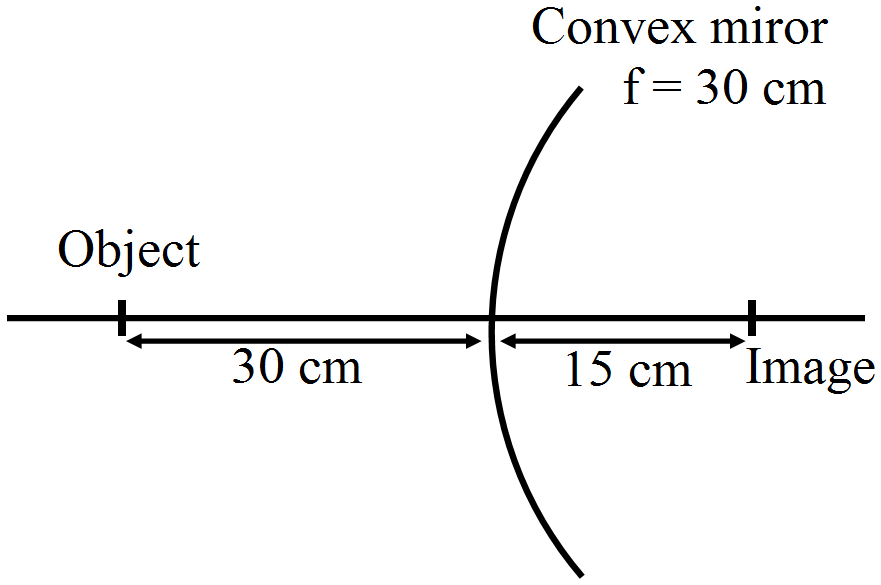
A point object is placed at a distance of 30cm from a convex mirror of focal length 30cm. The image will form at:

  • A
    Infinity.
  • B
    Pole.
  • C
    Focus.
  • D
    15cm behind the mirror.
Answer
  1. Infinity.

Explanation:

By mirror formula:

$\frac{1}{\text{V}}+\frac{1}{\text{u}}=\frac{1}{\text{f}}$

Here u = -30cm

f = +30cm

So, $\frac{1}{\text{V}}-\frac{1}{30}=\frac{1}{30}$

Þ v= 15cm behind the mirror.

View full question & answer
MCQ 361 Mark

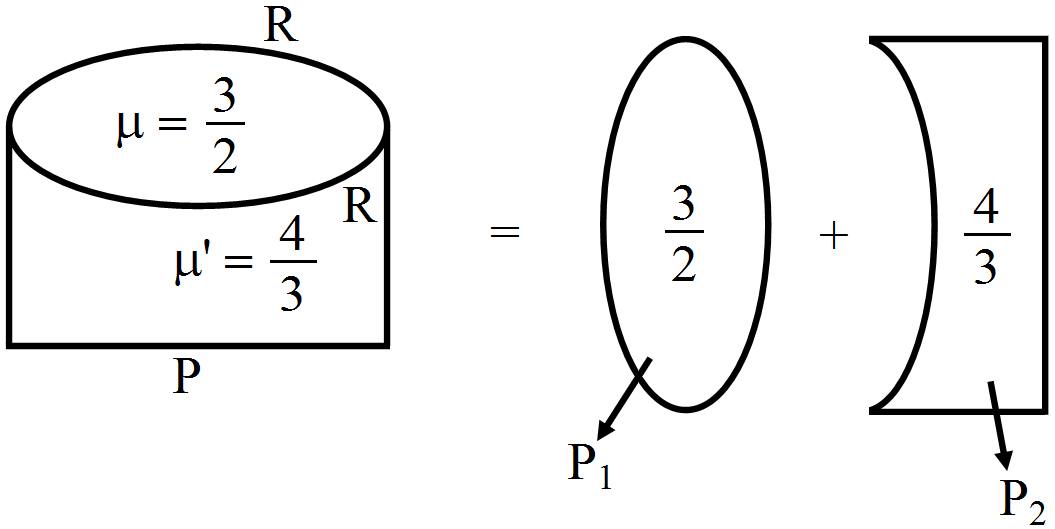
A thin lens is made with a material having refractive index $\mu=1.5.$ Both the sides are convex. It is dipped in water $(\mu=1.33).$ It will behave like:

  • A
    A convergent lens.
  • B
    A divergent lens.
  • C
    A rectangular slab.
  • D
    A prism.
Answer
  1. a convergent lens.

Explanation:

Here P, P1 & P2 are the power of Lenses.

P = P1 + P2

$\frac{1}{\text{f}}=\frac{1}{\text{f}_1}+\frac{1}{\text{f}_2}$

$=(\mu-1)\Big(\frac{2}{\text{R}}\Big)+(\mu'-1)\Big(\frac{-1}{\text{R}}\Big)$

$=\Big(\frac{3}{2}-1\Big)\Big(\frac{2}{\text{R}}\Big)-\Big(\frac{4}{3}-1\Big)\Big(\frac{1}{\text{R}}\Big)$

$\frac{1}{\text{f}}=\frac{1}{\text{R}}-\frac{1}{3\text{R}}$

$\frac{1}{\text{f}}=\frac{3-1}{3\text{R}}$

$\text{f}=\frac{3\text{R}}{2}$

focal length of combined is positive means it will behave like a canvergent lens.

View full question & answer
MCQ 371 Mark

The radius of curvature of the curved surface of a plano-convex lens is 20cm. If the refractive index of the material of the lens be 1.5, it will.

  • A
    Act as a convex lens only for the objects that lie on its curved side.
  • B
    Act as a concave lens for the objects that lie on its curved side.
  • C
    Act as a convex lens irrespective of the side on which the object lies.
  • D
    Act as a concave lens irrespective of side on which the object lies.
Answer
  1. Act as a convex lens irrespective of the side on which the object lies.

Solution:

We know that, $\text{f}=\frac{\text{R}}{\mu-1}$

Substituting $\text{R}=20\text{cm},\mu=1.5,$ we get

$\text{f}=\frac{20}{1.5-1}=40\text{cm}$

Since, the focal length is greater than zero.

Therefore, lens act as a convex lens irrespective of the side on which the object lies.

View full question & answer
MCQ 381 Mark

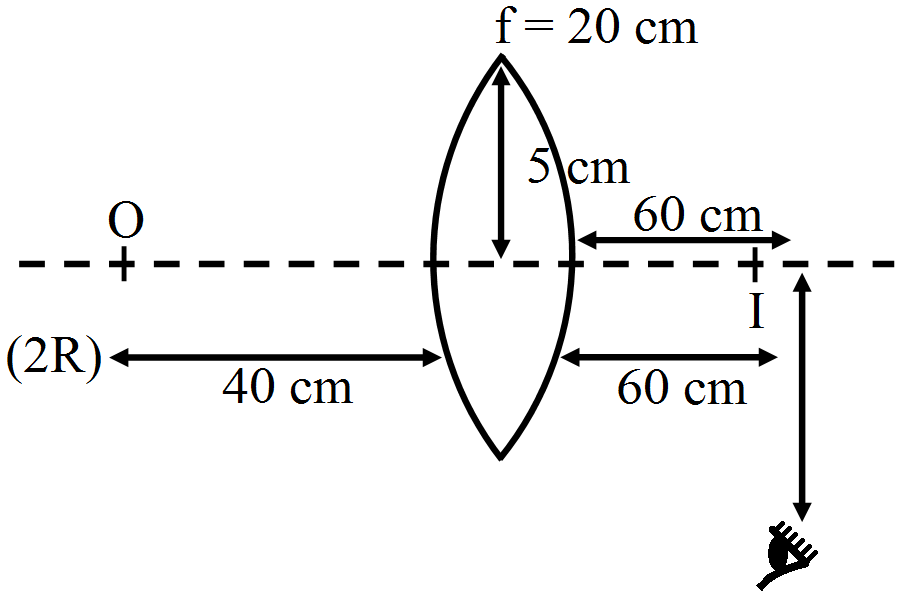
A point object O is placed on the principal axis of a convex lens of focal length f = 20cm at a distance of 40cm to the left of it. The diameter of the lens is 10cm. An eye is placed 60cm to right of the lens and a distance h below the principal axis. The maximum value of h to see the image is:

  • A
    0
  • B
    2.5cm
  • C
    5cm
  • D
    10cm.
Answer
  1. 2.5cm

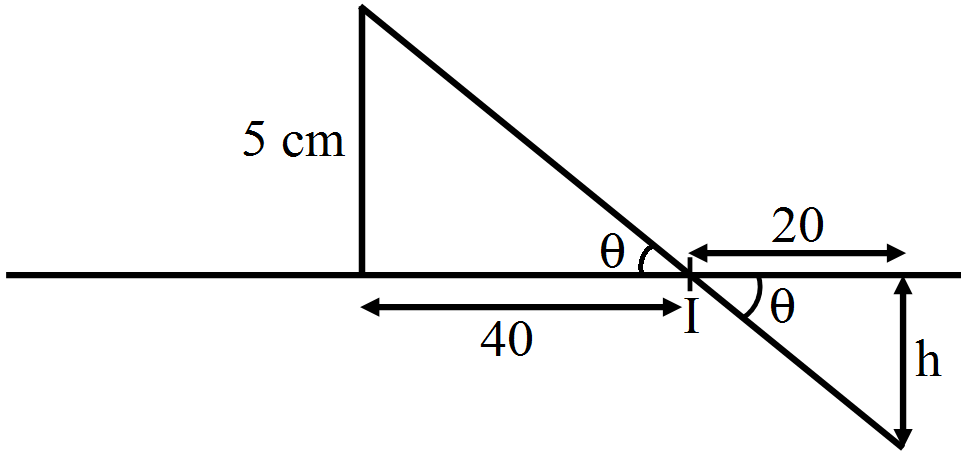
Explanation:

$\tan\theta=\frac{5}{40}=\frac{\text{h}}{20}$

$\text{h}=\frac{5}{2}=\frac{\text{h}}{20}$

$\text{h}=\frac{5}{2}=2.5\text{cm}$

The maximum value of "h =2.5cm" to see the Image of the object.

View full question & answer
MCQ 391 Mark

A double convex lens has two surfaces of equal radii R and refractive index $\mu=1.5$ We have,

  • A
    $\text{f}=\frac{\text{R}}{2}$
  • B
    $\text{f}=\text{R}$
  • C
    $\text{f}=-\text{R}$
  • D

    $\text{f}=2\text{R}$

Answer
  1. $\text{f}=\text{R}$

Explanation:

$\Rightarrow\frac{1}{\text{f}}=(\mu-1)\Big(\frac{1}{\text{R}_1}-\frac{1}{\text{R}_2}\Big)$

$\Rightarrow\frac{1}{\text{f}}=\Big(\frac{3}{2}-1\Big)\Big(\frac{1}{\text{R}}-\Big(-\frac{1}{\text{R}}\Big)\Big)$

$\frac{1}{\text{f}}=\frac{1}{\text{R}}$

$\text{f}=\text{R}$

View full question & answer
MCQ 401 Mark

The shift by which object appears to be raised ....... with the increase in the thickness of the denser medium.

  • A
    Increases
  • B
    Decreases
  • C
    Both
  • D
    None
Answer
  1. Increases

Explanation:

The shift increase with the increase in the thickness of the denser medium, but the shift decrease with the increase in wavelength of light used.

View full question & answer
MCQ 411 Mark

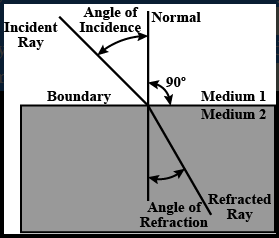
Select the correct alternative, The angle between the normal and refracted ray is called:

  • A
    Angle of deviation
  • B
    Angle of incidence
  • C
    Angle of refraction
  • D
    None of these
Answer
  1. Angle of refraction

Explanation:

The angle formed between the normal and refracted ray at the point of refraction is called angle of refraction.

View full question & answer
MCQ 421 Mark

 A normal eye is not able to see objects closer than 25cm because:

  • A
    The focal length of the eye is 25cm.
  • B
    The distance of the retina from the eye-lens is 25cm.
  • C
    The eye is not able to decrease the distance between the eye-lens and the retina beyond a limit.
  • D
    The eye is not able to decrease the focal length beyond a limit.
Answer
  1. The eye is not able to decrease the focal length beyond a limit.

Explanation:

The ciliary muscles adjust the focal length to form an image on the retina, but the muscles cannot be strained beyond a limit. Hence, if the object is brought too close to the eye, the focal length cannot be adjusted to form the image on the retina.

View full question & answer
MCQ 431 Mark

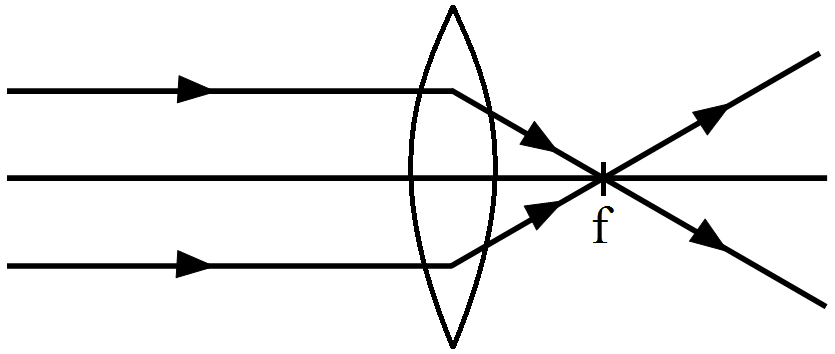
A parallel beam of light is incident on a converging lens parallel to its principal axis. As one moves away from the lens on the other side on its principal axis, the intensity of light:

  • A
    Remains, constant.
  • B
    Continuously increases.
  • C
    Continuously decreases.
  • D
    First increases then decreases.
Answer
  1. First increases then decreases.

Explanation:

The intensity o light is first increases then decreases.

View full question & answer
MCQ 441 Mark

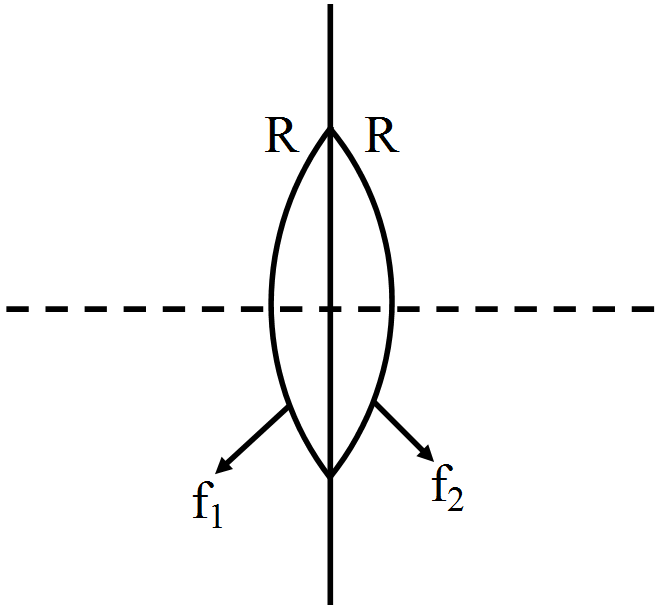
A symmetric double convex lens is cut in two equal parts by a plane perpendicular to the principal axis. If the power of the original lens was 4D, the power of a cutlens will be:

  • A
    2D
  • B
    3D
  • C
    4D
  • D
    5D.
Answer
  1. 2D

Explanation:

Before cut

$\frac{1}{\text{f}}=(\mu-1)\Big(\frac{2}{\text{R}}\Big)=4\text{D} \ ...(1)$

After cut

$\frac{1}{\text{f}_1}=(\mu-1)\Big(\frac{1}{\text{R}}\Big)+\frac{1}{\text{f}_2}=(\mu-1)\Big(\frac{1}{2}\Big) \ ...(2)$

From eq. (1) we get Power of f1 = power of f2

$\text{P}=\frac{1}{\text{f}_1}=\frac{1}{\text{f}_2}=2\text{D}$

View full question & answer
MCQ 451 Mark

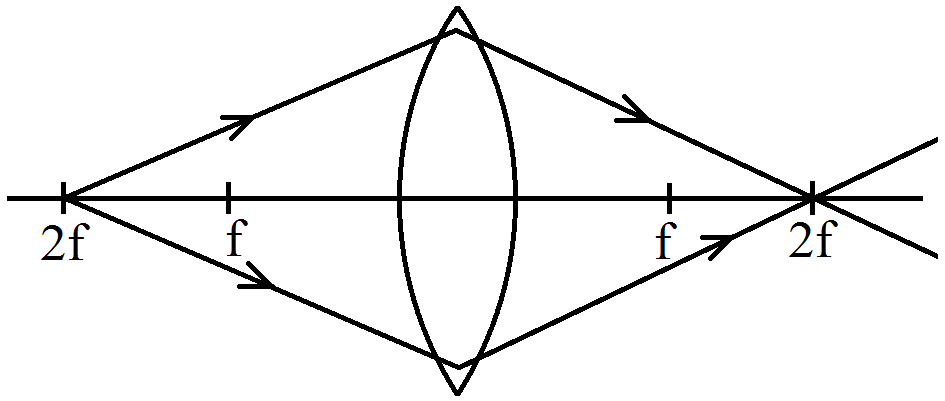
A point source of light is placed at a distance, of 2f from a converging lens of focal length f. The intensity on the other side of the lens is maximum at a distance:

  • A
    f
  • B
    between f and 2
  • C
    2f
  • D
    more than 2f.
Answer
  1. 2f

Explanation:

The Intensity on the other side of the lans is maximum at a distance 2f.

View full question & answer
MCQ 461 Mark

In which of the following the final image is erect?

  • A
    Simple microscope.
  • B
    Compound microscope.
  • C
    Astronomical telescope.
  • D
    Galilean telescope.
Answer
  1. Simple microscope.
  2. Galilean telescope.

Explanation:

In a simple microscope, the image formed is virtual and above the axis on the same side of the object. Similarly, in a Galilean telescope, the image formed is virtual, erect and magnified and between the objective lens and the eyepiece. A compound microscope and an astronomical telescope produce inverted images.

View full question & answer
MCQ 471 Mark

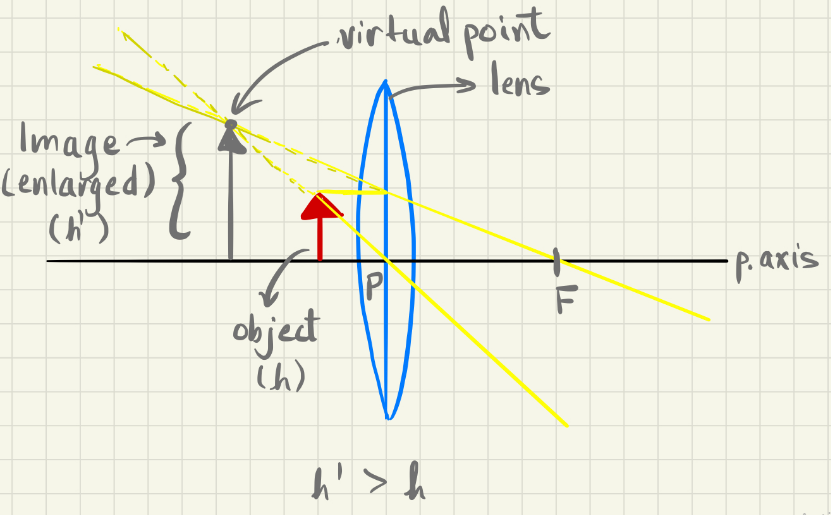
A thin lens with focal length f to be used as magnifying glass. Which of the following statements regarding the situation is true?

  • A
    A converging lens may be used, and the object be placed at a distance greater than 2f from the lens.
  • B
    A diverging lens may be used, and the object be placed between f and 2f from the lens.
  • C
    A converging lens may be used, and the object be placed at a distance less than f from the lens.
  • D
    A diverging lens may be used, and the object be placed at any point other than the focal point.
Answer
  1. A converging lens may be used, and the object be placed at a distance less than f from the lens.

Explanation:

A converging lens, magnifies the image of an object if it is placed at a distance less than the focal length of the lens.

View full question & answer
MCQ 481 Mark

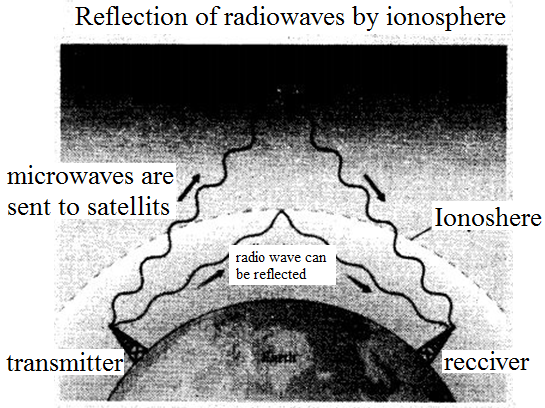
The phenomena involved in the reflection of radiowaves by ionosphere is similar to:

  • A
    Reflection of light by a plane mirror.
  • B
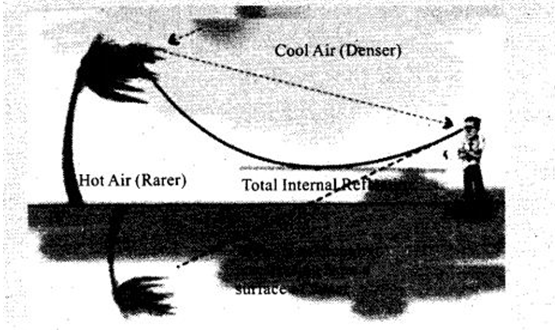
    Total internal reflection of light in air during a mirage.
  • C
    Dispersion of light by water molecules during the formation of a rainbow.
  • D
    Scattering of light by the particles of air.
Answer
  1. Total internal reflection of light in air during a mirage.

Solution:

Radio waves are reflected by a layer of atmosphere called the Ionosphere, so they can reach distant parts of the Earth. The reflection of radio waves by ionosphere is due to total internal reflection. It is the same as total internal reflection of light in air during a mirage, i.e., angle of incidence is greater than critical angle.

Important point: The ionized part of the Earth’s atmosphere is known as the ionosphere. Ultraviolet light from the sun collides with atoms in this region knocking electrons loose. The creates ions, or atoms with missing electrons. This is what gives the Ionosphere its name- and it is the free electrons that cause the reflection and absorption of ratio waves.

View full question & answer
MCQ 491 Mark

Which of the following would you prefer to use while reading small letters found in a dictionary?

  • A
    A concave mirror
  • B
    A concave lens
  • C
    A convex mirror
  • D
    A convex lens
Answer
  1. A convex lens

Explanation:

Convex lens can form an erect, virtual and enlarged image when the object is positioned between its pole and focus.

View full question & answer
MCQ 501 Mark

A tall man of height 6 feet, want to see his full image. Then required minimum length of the mirror will be-

  • A
    12 feet
  • B
    3 feet
  • C
    16 feet
  • D
    Any length
Answer
  1. 3 feet
View full question & answer
M.C.Q (1 Marks) - Physics STD 12 Science Questions - Vidyadip